


Almost two decades after the United States launched what would become its longest-ever war with air strikes on Afghanistan's ruling Taliban regime, the hardline group are in a stronger position than ever.
The invasion on October 7, 2001 quickly toppled the militants, who had harboured Al-Qaeda, the group behind the September 11 attacks that killed nearly 3,000 people in America just weeks earlier.
Nineteen years after their brutal Islamist regime collapsed, the Taliban are pushing for a return to power, having signed a landmark troop withdrawal deal with Washington in February and currently holding peace talks with the Afghan government.
Fearful that the Taliban have changed little since the darkest days of their regime – when they killed women accused of adultery, attacked minority religious groups and barred girls from going to school – many Afghans worry about a new era of Taliban influence.
"I remember the Taliban regime like a nightmare. We are scared for our future and my daughter's future," said Kabul resident Katayoun Ahmadi, a 26-year-old mother.
She recalled seeing severed hands and fingers on Kabul's streets following amputations for petty crimes under the Taliban's strict interpretation of Sharia law.
-
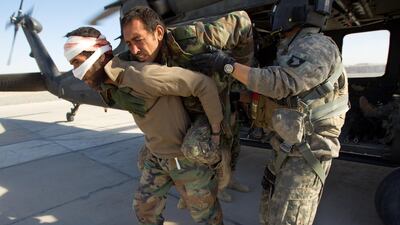
Sergeant Jay Kenney, 26, with the 101st Airborne Division, Task Force Destiny, assists wounded Afghan National Army (ANA) soldiers off the Blackhawk UH-60A helicopter after they were rescued in an air mission in Kandahar on December 12, 2010 in Kandahar province, Afghanistan. Getty Images -
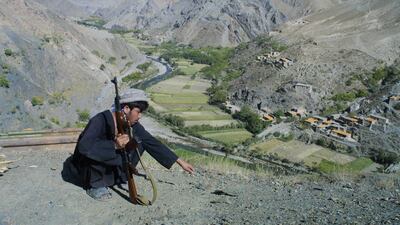
An Afghan Northern Alliance fighter mans the front line against the Taliban on October 2, 2001 near Jabul os Sarache, 30 miles north of Kabul. Getty Images -
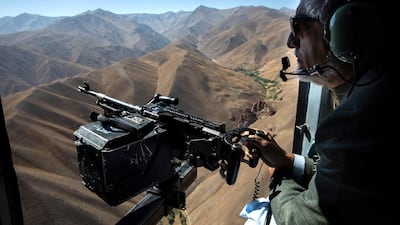
Abdullah Abdullah, chief executive of Afghanistan travelling via helicopter for the final campaign rally in Bamiyan, Afghanistan on September 25, 2019. Afghans will head to the polls on Saturday, September 28th. Getty Images -
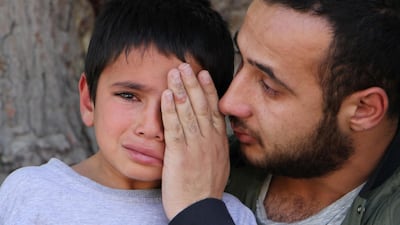
Mustafa Tamanna, 10, son of Afghan reporter Zabihullah Tamanna, weeps during the funeral ceremony in Kabul, Afghanistan on June 7, 2016. Tamanna was killed by a rocket-propelled grenade fired by the Taliban. Getty Images -
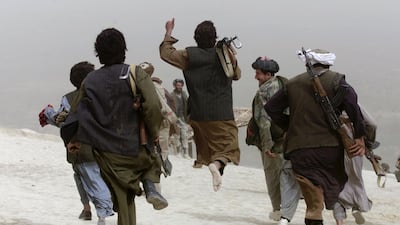
Northern Alliance soldiers come back from the front line after a battle near Charatoy town in the north of Afghanistan on October 10, 2001. REUTERS -
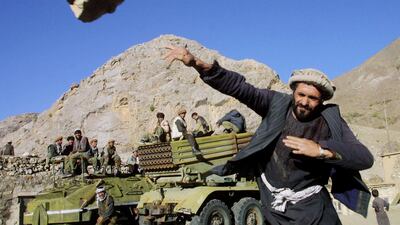
A Northern Alliance fighter throwing rocks as part of a popular national game yards away from a multiple Grad missile launcher in October 12, 2001 in the Salang Gorge in Northern Afghanistan. Getty Images -
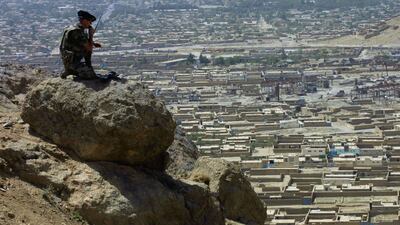
A French soldier from the 7th Mountain Regiment, part of the International Security and Assistance Force (ISAF) stands on a boulder overlooking Kabul during a patrol August 3, 2002 in Afghanistan. The ISAF has been patrolling Kabul since January 2002, working with the government and a new police force to prevent the violence and lawlessness that threatened to engulf the city after a U.S.-led coalition forced the Taliban from power. Getty Images -
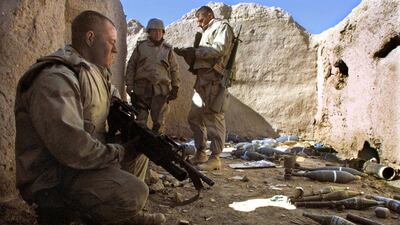
US Marine Sgt. Jerry Brown (L) of Jacksonville, North Carolina watches over a weapons cache found during a patrol near the American military compound at Kandahar Airport in January 16, 2002 in Kandahar, Afghanistan. The Marines recovered mortars, rockets, rocket-propelled grenades and artillery rounds discovered in various caches near the base while on the patrol. Getty Images) -
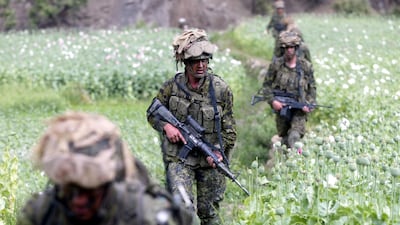
Members of the Princess Patricia's Canadian Light Infantry patrol through poppy fields in the village of Markhanai in May 6, 2002 in the Tora Bora valley region of Afghanistan. Getty Images -
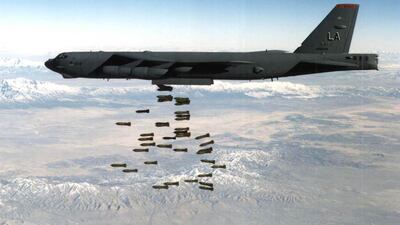
The United States and Britain on October 7, 2001 launched a first wave of air strikes against Afghanistan. President George W. Bush said the action heralded a "sustained, comprehensive and relentless" campaign against terrorism. REUTERS -
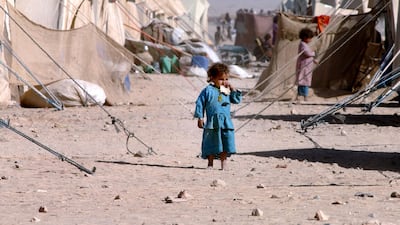
A young Afghan girl eats a piece of bread at the Chaman refugee camp on November 8, 2001 on the Pakistan border with Afghanistan. The UNHCR has estimated that since September 11, 2001 over 135,000 Afghans have crossed the border into Pakistan, adding to the already millions of refugees living in the country. Getty Images -
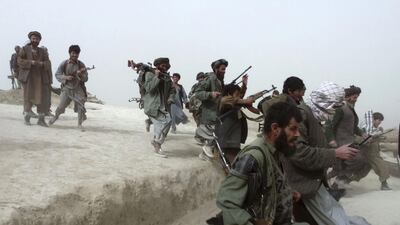
Afghan opposition Northern Alliance soldiers leap over a trench as they return from front line positions after battle near the town of Charatoy in the north of Afghanistan October 10, 2001. REUTERS -
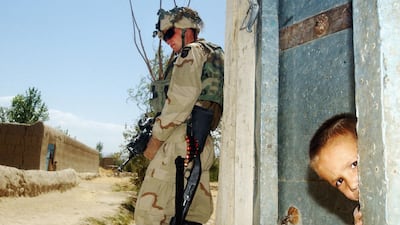
An Afghan child peeks out from the doorway of his family's home as a US Army soldier from the 101st Airborne stands guard in the eastern Afghan village of Hesarak on July 16, 2002 during what the Army refers to as a 'sensitive site exploitation' mission or 'SSE'. Getty Images -
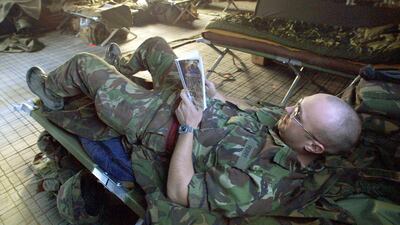
Fred Perry, a British Royal Engineer soldier, reads the book "Black Hawk Down" inside his tent after a day of work on January 29, 2002 at the International Security Assistance Force (ISAF) barracks at the Kabul airport in Kabul, Afghanistan. Getty Images -
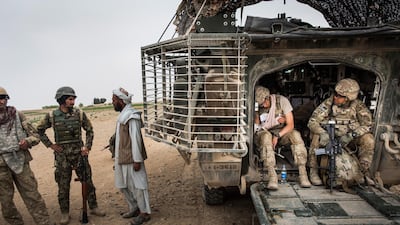
Afghan soldiers (L) speak to a local Afghan, while a medic in the U.S. Army's 1st Battalion, 36th Infantry Regiment, Charlie Company (R) monitors a soldier who has just survived a blast from an improvised explosive device (IED) while driving a vehicle during a mission near Command Outpost Pa'in Kalay, on March 19, 2013 in Kandahar Province, Maiwand District, Afghanistan. Getty Images -

Marines on a light armored vehicle prepare for patrol as an AH1W "Super Cobra" helicopter flies by on December 28, 2001 at the U.S. Marine Corps Base in Kandahar, Afghanistan. Getty Images -
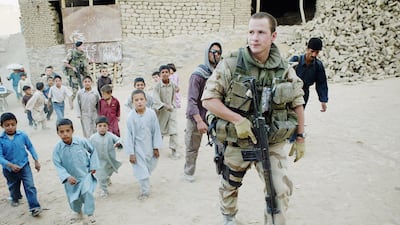
A Norwegian ISAF (International Security Assistance Force)soldier from Recce Squadron 3 patrols on October 4, 2004 in Kabul, Afghanistan as election officials get ready for the Presidential elections. Getty Images -
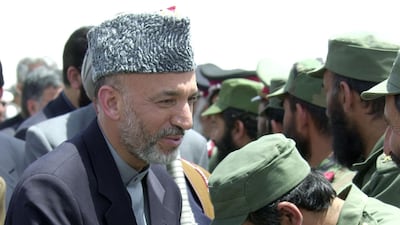
Interim Afghan leader Hamid Karzai (L) is greeted by a group of Afghan military officers on his arrival to Kandahar airbase on May 04, 2002 in Southern Afghanistan. Getty Images -
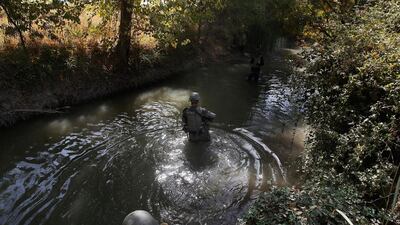
Soldiers in the U.S. Army's 101st Airborne Division wade though a creek to avoid buried insurgent bombs while on patrol October 16, 2010 in Zhari district west of Kandahar, Afghanistan. Getty Images -

British commandos descend from a mountain observation post overlooking the beginning of the Helmand River at the Kajaki hydroelectric dam on March 13, 2007 in Afghanistan's southern Helmand province. Getty Images -
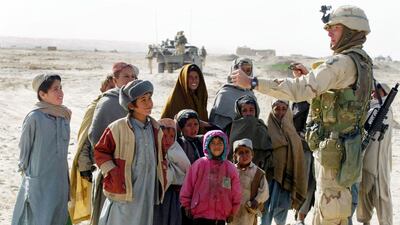
101st Airbornes 1st Sgt. Kerry Black from Westmoreland, Tennessee uses an Afghan child's sling shot on February 6, 2002 as children crowd around him while he patrols on the outskirts of Kandahar, Afghanistan. Getty Images -

Marine Cpl. Jonathan Eckert of Oak Lawn, IL attached to India Battery, 3rd Battalion, 12th Marine Regiment works his improvised explosive device (IED) sniffing dog Bee as they secure a compound during a patrol near Forward Operating Base (FOB) Zeebrugge on October 11, 2010 in Kajaki, Afghanistan. Getty Images -
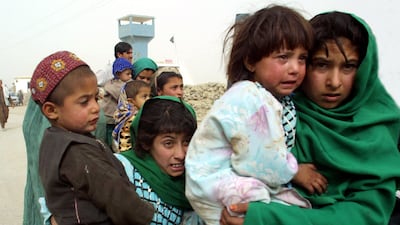
Afghan refugees walk across the border into Pakistan on October 11, 2001 as they leave Afghanistan at the Chaman crossing point on the 4th day of U.S.-led air strikes against the ruling Taliban and terrorist networks in the country. Getty Images -

Anti-Taliban Afghan fighters watch several explosions from U.S. bombings in the Tora Bora mountains in Afghanistan on December 16, 2001. -
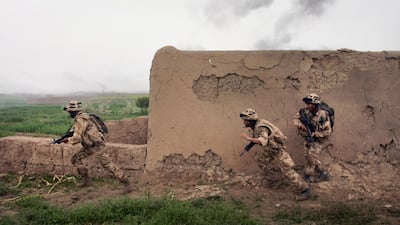
British Marines run under fire from the Taliban during a morning operation on March 18, 2007 near Kajaki in the Afghan province of Helmand. Getty Images -

Afghan Army troops prepare to board a British chinook helicopter from their base at Shorabak on March 12, 2007 in Southern Helmand province, Afghanistan. Getty Images -
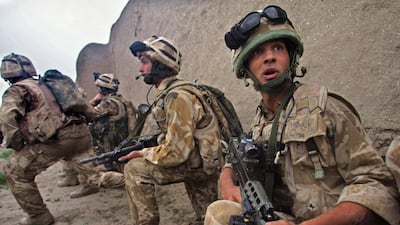
British Marine Joe Harvey from Stafford, England (R), watches as British forces come under fire by Taliban insurgents on March 18, 2007 near Kajaki in the Afghan province of Helmand. Getty Images -

U.S. Army 101st Airborne 3-187 "Bravo" company soliders pass through a corn field while conducting a sensitive site exploitation (SSE) mission July 23, 2002 near the town of Narizah in Southeastern Afghanistan. Getty Images -
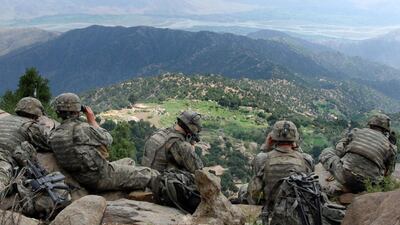
Scouts from 2nd Battalion, 503rd Infantry Regiment (Airborne), pull overwatch during Operation Destined Strike while 2nd Platoon, Able Company searches a village below the Chowkay Valley in Kunar Province, Afghanistan on August 22, 2006. US Army


The 2001 invasion heralded some enduring improvements for young Afghans – particularly girls – and ushered in a constitution guaranteeing certain freedoms including the right to an education.
But so far in peace talks in Doha, which started last month, the Taliban have said little about issues such as women's rights or freedom of expression.
Ms Ahmadi's husband Farzad Farnood, 35, a researcher for the Afghanistan Institute for Strategic Studies, said a rise in Taliban violence since a deal was signed between the hardline group and Washington shows the militants have not changed.
"Is this creating hope for Afghans? No, it is not," he said.
As a teenager, he witnessed the Taliban stoning a woman to death and public executions and floggings in Kabul's football stadium. His family had to hide their black-and-white television's antenna in a tree when the Taliban banned music and entertainment.
"All the achievements we have made in the last 18 years did not exist in the Taliban era," he said.
A Taliban spokesman declined to comment.
Zia-ul-Rahman, a former insurgent who battled foreign troops and Afghan government forces for four years, told AFP the Taliban were pushing for "the establishment of an Islamic system", even though the Islamic republic's constitution already gives primacy to the religion.
"We have no problem with girls getting an education or women working, but they have to wear a hijab," he added.
US involvement in Afghanistan has proven painfully difficult for the superpower, draining more than $1 trillion from its coffers and resulting in about 2,400 troop deaths in a war the Pentagon has characterised as a stalemate.
In Doha, the Taliban and the Afghan government are struggling to agree common language on a range of issues before they can even establish an agenda, in talks that could continue for years.
Some US lawmakers have said they would oppose any deal that fails to protect women and minorities, but President Donald Trump's administration has stressed it wants little to do with the outcome which he said will be "Afghan-owned".
Jawed Rahmani, a 38-year-old security worker in Kabul, said US disengagement would inevitably lead to a Taliban takeover of Afghanistan.
"These are not peace talks but a deal to hand over the next government to the Taliban," he said.
"People are happier with whatever we have right now, compared to the darkest era of the Taliban."

