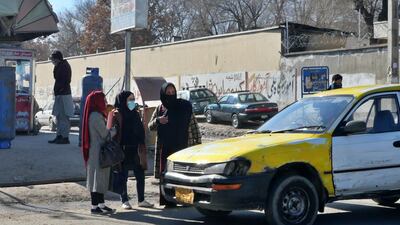
After years of violent abuse at the hands of her uncle, being deprived of her education was the final straw for Soheila, 17.
"I couldn't take it any more. My uncle was repeatedly beating me without reason," she tells The National, her blue eyes filled with tears.
She grips her hands together tightly as she talks, every few seconds releasing them momentarily before locking them together once more.
“My father didn’t want me because I wasn’t a boy, so I was brought up by my grandparents in Kabul,” says Soheila, whose family are from Ghazni province, 150 kilometres south-west of the Afghan capital.
“I was considering going to the police for a very long time.”
Soheila has been living in the Afghan Women Skills Development Centre women’s shelter in Kabul for a year now – it is her only option to remain safe and to continue her education.
While worldwide support services for women affected by domestic violence have, on the whole, recorded a surge in demand during the pandemic, there was a drop in the number of women seeking help during the three-month Covid-19 lockdown.
-

Muslims wear protective masks and attend Friday prayers at a mosque, amid concerns about the spread of coronavirus, in Kabul, Afghanistan on March 20, 2020. Reuters -

General view of the deserted Ghulam Haider Khan High school following Afghan authorities' orders to shut down schools for a month as a preventive measure against the coronavirus, in Kabul on March 19, 2020. AFP -
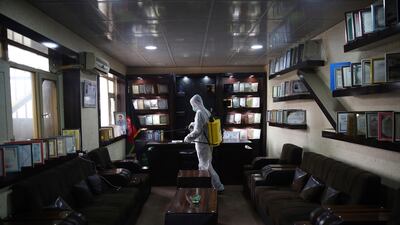
A volunteer in a protective suit sprays disinfectant in the offices of a local police station to help curb the spread of coronavirus in Kabul, Afghanistan, on March 23, 2020. AP Photo -
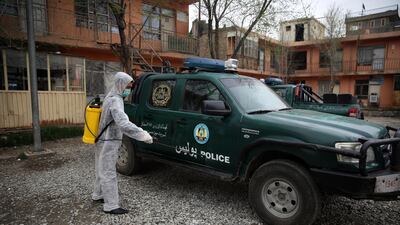
A volunteer in a protective suit sprays disinfectant on a police truck outside a local police station to help curb the spread of coronavirus in Kabul, Afghanistan, on March 23, 2020. AP Photo -
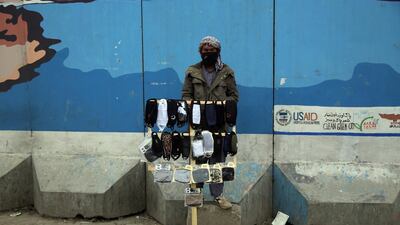
A street vendor selling protective masks that could help curb the spread of the new coronvirus waits for customers in Kabul, Afghanistan, on March 23, 2020. AP Photo -
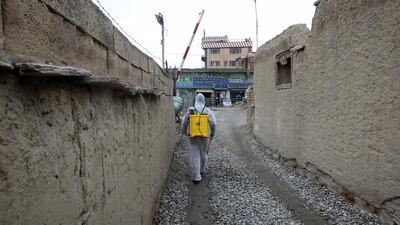
A worker disinfects area around a police station during a volunteered campaign of disinfecting areas and distributing face mask with gloves to fight against coronavirus in Kabul, Afghanistan, on March 23, 2020. According to the ministry of health of Afghanistan at least one person has died and 44 others are confirmed to be infected with coronavirus in the country. EPA -
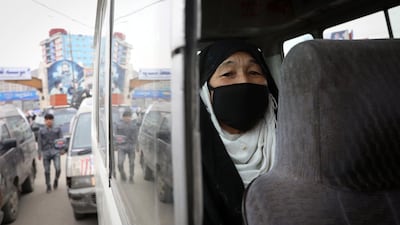
An Afghan woman wearing a face mask sitting in a bus in Kabul, Afghanistan, on March 23, 2020. EPA -
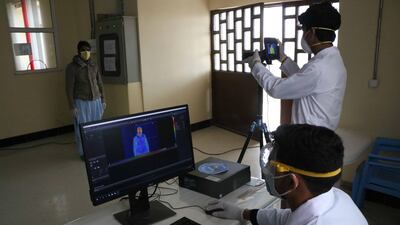
Health workers screen people crossing into Afghanistan from Iran on March 22, 2020. EPA -
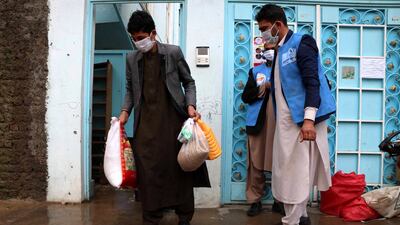
Afghan men receive free rations distributed in Herat, Afghanistan, on March 24, 2020. EPA -

Afghan women receive free rations distributed in Herat, Afghanistan, on March 24, 2020. EPA -
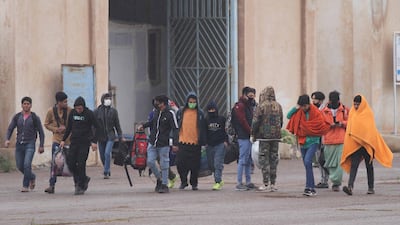
People cross into Afghanistan from Iran on March 22, 2020. EPA -
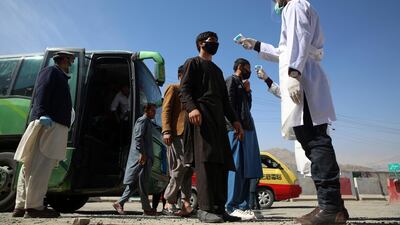
Afghan health workers measure the temperature of bus passengers in an effort to prevent the spread of the coronavirus, as they enter Kabul trough the city's western gate, on March 22, 2020. AP Photo -

A health worker wearing a protective suit sprays disinfectant outside of a building during an awareness campaign for coronavirus, in Jalalabad, Afghanistan on March 19, 2020. Reuters -
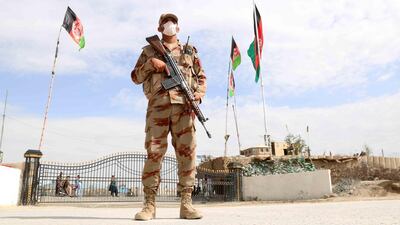
A Pakistani soldier stands guard at the Pakistan-Afghanistan border as it remains closed due to coronavirus, in Chaman, Pakistan, on March 20, 2020. EPA


Its director, Mahboba Saraj, believes it was not because of any decline in gender-based violence, but because women were unable to escape their abusers stuck at home together during lockdown – an opinion backed by many other women’s rights organisations in Afghanistan.
In the lead up to Soheila’s escape, her uncle – who she says is an architect – had stopped her from going to school and told her he wanted to arrange for her to be married. He beat her particularly badly on the day she finally ran away.
“I went to the police but at first they didn’t believe me. A female police officer eventually examined me and found proof of the abuse,” she says.
There were 3,477 cases recorded of violence against women during the first 10 months of 2020 at the Afghanistan Independent Human Rights Commission.

While this is an 11 per cent decline on the same period in 2019, the AIHRC suggests this could be because women were unable to access legal and judicial services, an escalation of insecurity throughout the country and the Covid-19 lockdown.
The AWSDC was the first women’s shelter to be set up in Afghanistan 15 years ago, according to Ms Saraj. As well as offering shelter it also provides skills classes.
Eleven children and 42 women live there, while three recently moved into their own accommodation with support from staff at the shelter.
"The age of the women ranges from 14 up to 74 years old. They are from various backgrounds and different parts of Afghanistan," Ms Saraj says.
“The women are brought to us by the police – either off the street or because they’ve attended a police station – or they’re referred to us by organisations.”

She says one of the biggest challenges is the public’s perception of women’s shelters.
"People refer to them as brothels. It's taken us all this time to be able to change people's minds on this, which we've done by giving them more information about what we do here," she says.
"We need these shelters, this is a service we have to keep providing."
Also taking refuge at the shelter is Bashira*, who fled her violent husband a month ago.
Her two-year-old son wriggles around in her arms and the numerous gold bracelets decorating Bashira’s thin wrists jangle as she talks.
She is warm and smiley initially, but as she starts to describe the home situation she fled, she breaks down in tears.
"My husband beat me and the children so badly that even during the winter we would hide in places outside the house in the freezing cold just to get away from him," says the mother of seven.
“He would thrash me with a cable that he kept next to the bed.”
Bashira, 35, says her husband would buy very little food – essentially starving her and the children – and they often lacked warm clothes.

Things became so desperate that she arranged for her eldest daughter to be married at the age of 15 in the hope that one of her children could be better cared for.
The day Bashira ran away, she had just 60 Afs ($0.79). She managed to cobble together a further 200 Afs from people on the street and a police officer who also advised her to go to the Ministry of Women's Affairs to seek help. It was just about enough for a taxi fare.
“I’m terrified of going back there. I’ll kill myself if that happens,” Bashira says .
“I’ve been here for one month and I feel like I’m living for the first time in my life. But I still have nightmares about my husband coming after me, or the children being harmed.”
Bashira could take only two of her children with her. The others are with her husband, along with his other wife and her children.
She says she lies awake every night with worry.
“I don’t have an education so without this shelter I can’t survive,” she says.
Zarmina*, 25, is eight months pregnant and has been at the shelter for three months. Her husband shaved her head twice, and her father-in-law beat her so badly he broke her leg.
She instinctively pulls her headscarf across her face as she talks about the abuse.
“My husband says the child is not his. But he has also threatened to take the child and divorce me. He is a drug addict, his behaviour is not normal,” says Zarmina, who is from Khost, about 233km south of Kabul.
“The day I left the last time, my father-in-law propositioned me for sex and when I refused he beat me so hard. At 3am I escaped through the window and finally went to the police. It was terrifying,” she says. “I feel safe here but I don’t want to be here long term.”
Of the three women, only Soheila knew about the existence of shelters and the legal and educational assistance they provide.
Last month, the Afghan Women’s Network launched a major radio and television advertisement campaign, with the help of international donors, aimed at reducing the social norm of domestic violence.
"The Talk for Harmony campaign [points] victims of domestic violence to psychosocial support while also communicating with perpetrators to try and encourage the use of de-escalation techniques," says Amina Rezaie, programme assistant at AWN.
“Many women face domestic violence in Afghanistan, so it is important for them to know what help is available to them.”
* Names were changed to protect the women's identities. Additional reporting by Masouma Tajik

