
Here are some facts about Aung San Suu Kyi, the 75-year-old who rode to power after a 2015 landslide election win that established Myanmar's first civilian government in half a century.
Early years abroad
– The daughter of independence hero Aung San, who was assassinated when she was two years old, Ms Suu Kyi spent much of her youth overseas.
– At Oxford University, Ms Suu Kyi met British academic Michael Aris, who would become her husband. They had two sons and settled in Oxford.
1988: Rise to prominence
– In 1988, Ms Suu Kyi returned to Yangon, then the capital, to care for her dying mother. There, she was swept up in student-led protests against the military, which had ruled since a 1962 coup.
– An eloquent public speaker, Ms Suu Kyi was a likely candidate to lead the movement but the protests were crushed, its leaders killed and jailed. She was soon imprisoned in her lakeside family home, where she remained until 2010, despite brief releases from house arrest.
– Ms Suu Kyi made a decision to remain in Myanmar to lead a campaign for democracy. Although the military made it clear she could leave, she feared she would not be allowed to return.

1991: Nobel Peace Prize
– Ms Suu Kyi was awarded the Nobel Peace Prize in 1991, which her elder son Alexander collected on her behalf.
– In August 2011, Ms Suu Kyi had her first meeting with Thein Sein, a former general and, as president at the time, head of the quasi-civilian administration. This marked the start of a pragmatic period of engagement with the government of former soldiers.

2015: Myanmar's leader
– In 2015, Ms Suu Kyi came to power on a platform of ending civil war, drumming up foreign investment, and reducing the army's role in politics. Ms Suu Kyi also promised Western allies she would address the plight of the Rohingya Muslim people, forming an advisory commission headed by Kofi Annan, the former UN secretary-general.
2017: Rohingya crisis
– A day after Mr Annan's report was released in August 2017, advising sweeping changes, Rohingya militants attacked security forces in Rakhine State. The military responded with a campaign that included the torching of hundreds of villages and killings. It was described by the UN human rights high commissioner as "a textbook example of ethnic cleansing."
Ms Suu Kyi blamed "terrorists" for an "iceberg of misinformation" about the crisis and said the military was exercising the "rule of law". In a September 2017 address to the nation, she appeared baffled about the exodus of Rohingyas, saying in reference to refugees: "We want to know why they are leaving."
– She went to The Hague in 2019 to face charges of genocide brought against Myanmar at the International Court of Justice. Ms Suu Kyi acknowledged the possibility war crimes had been committed but framed the crackdown as a legitimate military operation against terrorists.
– In 2020, a survey by election watchdog the People's Alliance for Credible Elections found that 79 per cent of people had trust in Ms Suu Kyi – still beloved as "The Lady" – up from 70 per cent the year before.

2021: Military coup after disputed election
– After a November 2020 parliamentary election, official results show her ruling party, the National League of Democracy , had won enough parliamentary seats to form the next administration. The NLD said it would seek to form a government of national unity.
– After weeks of disputes about the election results involving the military, in the early hours of February 1, Ms Suu Kyi, President Win Myint and other senior figures from the ruling party were detained.
-
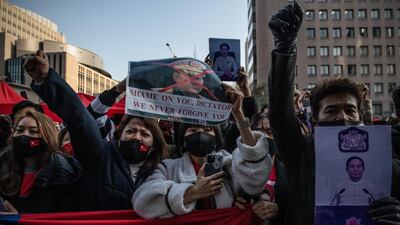
Myanmar nationals in Japan demonstrate against the military coup that took place in their home country on Monday, February 1, 2021. Getty Images -

A Myanmar national in Japan holds up a portrait of Aung San Suu Kyi during a protest held in front of the United Nations University in Tokyo. EPA -
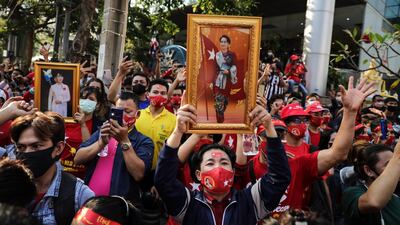
People hold up images of Myanmar's de-facto leader Aung San Suu Kyi at a protest outside Maynmar's embassy in Bangkok, Thailand. Getty Images -
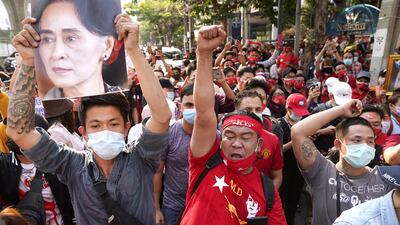
NLD supporters shout slogans outside Myanmar's embassy during a rally after the military seized power from a democratically elected civilian government and arrested its leader Aung San Suu Kyi, in Bangkok, Thailand. Reuters -
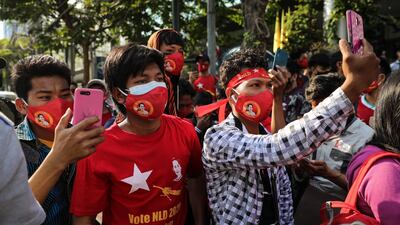
People use their smartphones to live stream a protest outside Myanmar's embassy in Bangkok, Thailand. Getty Images -
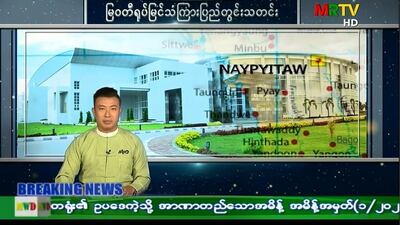
This screengrab provided via AFPTV and taken from a broadcast by Myanmar Radio and Television (MRTV) in Myanmar shows the announcement of a one-year state of emergency in the country. AFP -

A screen grab from Myanmar state television footage shows Myanmar Acting President Myint Swe (R) and General Min Aung Hlaing (L) as they attend a meeting. Reuters -
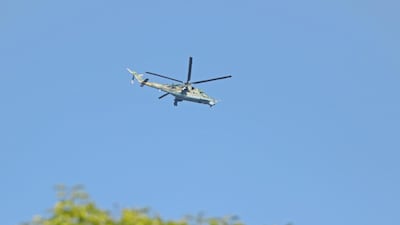
A military helicopter flies in Naypyitaw, Myanmar. EPA -
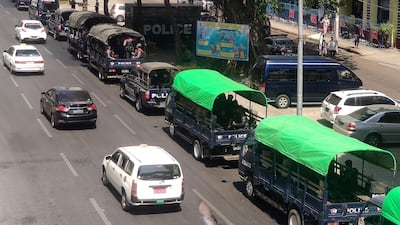
Cars pass police sitting in trucks along a road in Yangon, as Myanmar's military detained the country's de facto leader Aung San Suu Kyi and the country's president in a coup. AFP -
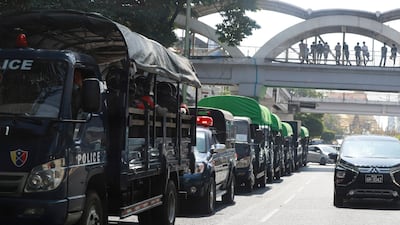
Policemen sit inside trucks parked on a road in the downtown area of Yangon, Myanmar. AP -
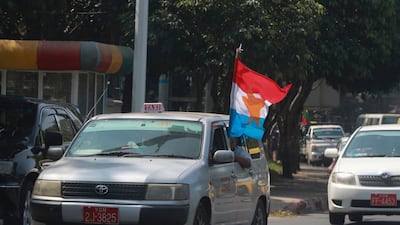
Myanmar military supporters riding a vehicle wave a military flag as they go around Yangon, Myanmar. AP -
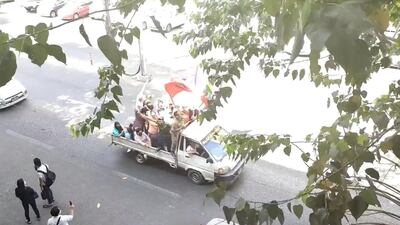
People wave flags as they ride on a vehicle in Yangon, Myanmar. Reuters -
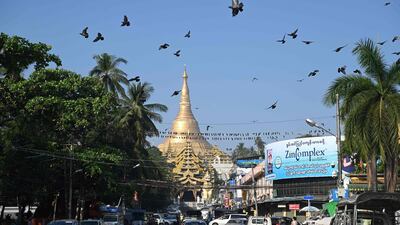
A view of Shwedagon Pagoda, a Buddhist religious landmark in Yangon, as Myanmar's military detained the country's de facto leader Aung San Suu Kyi and the country's president in a coup. AFP -
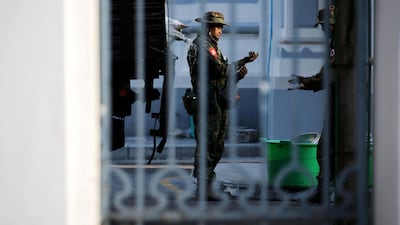
Myanmar soldiers are seen inside City Hall in Yangon, Myanmar. Reuters -

A woman leaves her house while being escorted by soldiers (unseen) at an unidentified location in Myanmar, in this picture obtained from social media. Reuters -
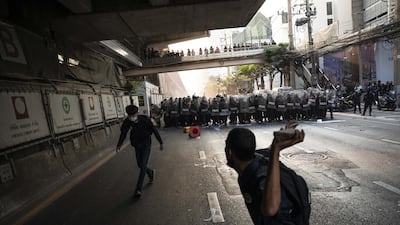
A demonstrator prepares to throw a rock towards riot police during a protest outside the Embassy of Myanmar in Bangkok, Thailand. Andre Malerba/Bloomberg -
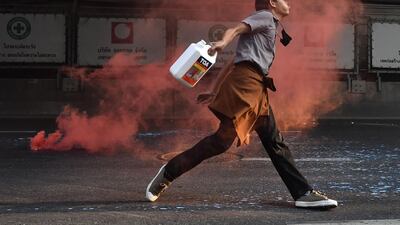
A Thai pro-democracy protestor confronts riot police in Bangkok, in the area where Myanmar migrants were demonstrating after Myanmar's military detained the country's de facto leader Aung San Suu Kyi and the country's president in a coup. AFP -
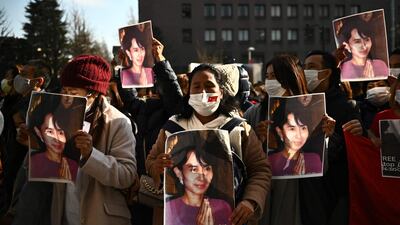
A group of Myanmar activists hold the portrait of Aung San Suu Kyi during a protest outside the United Nation university in Tokyo following a military coup in the country by a general after arresting civilian leader Aung San Suu Kyi and other senior officials. AFP -
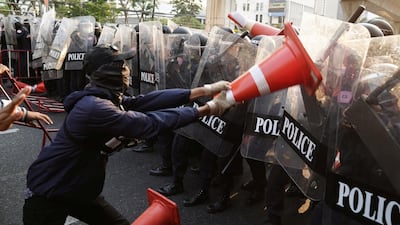
Anti-Thai government protester wields a traffic cone at riot police during a clash at a rally for Myanmar's democracy outside the embassy, in Bangkok, Thailand. Reuters



