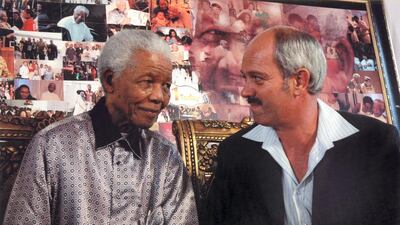
Christo Brand was only 19 when he started working at South Africa’s highest security prison. Now, 44 years later, he recalls how a job he had little choice in taking brought him face to face with a man then the country’s most notorious prisoner and led to a lifelong friendship with Nelson Mandela.
As a child of a farm foreman growing up two hours from the city, he knew little about the racial division in his country in the 1960s.
"Growing up on the farm, I didn't see anything about apartheid. I was the only white child on the farm, playing with African and coloured children," Mr Brand tells The National. He says his father always told him to respect people as human beings regardless of skin colour.
After finishing school, he faced the choice of military conscription or working for the prison service. He knew friends who died in military camps on the South African borders, so he chose to train as a prison warden.
Meeting Mandela
-

A file photo dated 1961 of South African anti-apartheid leader and African National Congress (ANC) member Nelson Mandela. AFP -

Mendi Msimang, chief representative of the African National Congress, meets Archbishop Trevor Huddleston and, President of the Anti-Apartheid Movement, at a Press conference in London, February 10, 1990, after the announcement of the release of Nelson Mandela, who is to be freed tomorrow, . PA Images -
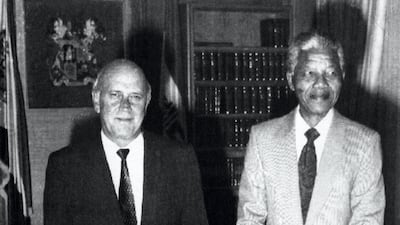
South Africa's president Frederik W. De Klerk (L) poses with the world most famous prisoner anti-apartheid leader and African National Congress (ANC) member Nelson Mandela, in Cape Town's government residence, 09 February 1990, two days before his release from jail. Frederik de Klerk announced Nelson Mandela his release from jail. AFP -
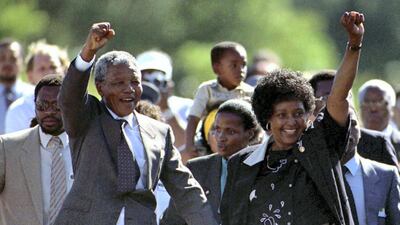
Nationalist leader Nelson Mandela (L) gestures as he is accompanied by his wife Winnie, moments after his release from Victor Verster prison in Western Cape in this February 11, 1990 file photo. Twenty years after Mandela was freed from prison, South Africa is a vibrant democracy but the millions still living in poverty are now looking for leadership that can tackle its economic problems. Mandela's release on Feb. 11, 1990, after 27 years in apartheid-era jails, set in motion the country's transformation to democracy which culminated in historic all-race elections in 1994 and his inauguration as the country's first black leader. REUTERS/Ulli Michel/Files (SOUTH AFRICA - Tags: POLITICS ANNIVERSARY) -

Former South African President Nelson Mandela (R) giving the clenched fist salute as he stands with his wife Winnie Mandela (L) during his 'Welcome Home Rally' in Soweto, South Africa, 13 February 1990. EPA -
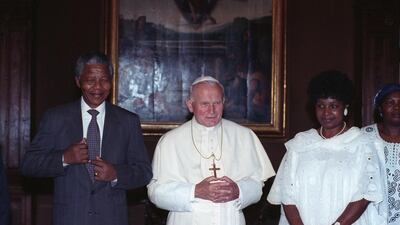
Pope John Paul meets with Nelson Mandela and his wife Winnie at the Vatican June 15, 1990. Mandela is mid-way through a tour aimed at persuading governments to maintain sanctions against South Africa until apartheid is abolished. Reuters -

African National Congress (ANC) Deputy-President Nelson Mandela holds his grandson Bambata November 9, 1990 as he arrives back at Johannesburg's Jan Smuts airport from an 18-day fundraising tour of the Far East, Australia, France and Britain. Reuters -

Nelson Mandela (L) is embraced by PLO leader Yasser Arafat as he arrives at Lusaka airport February 27, 1990. Reuters -

South African anti-apartheid leader and African National Congress (ANC) member Nelson Mandela smiles 22 June 1990 in New York, raising his arms over his head as he receives applause at the United Nations. Mandela urged the U.N . to maintain sanctions against South Africa until apartheid is abolished, June 22, 1990. AFP -

South African anti-apartheid leader and African National Congress (ANC) member Nelson Mandela (L) speaks to the press and fans 25 June 1990 after finishing his joint statement with U.S. President George Bush senior (R) on the White House South Lawn. AFP -

Former French Prime Minister Pierre Mauroy speaking with South African President Nelson Mandela (C) during a meeting, December 1993 in South Africa. AFP -
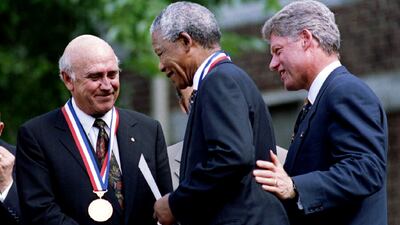
South African President F. W. DeKlerk (L) shakes hands with African National Congress leader Nelson Mandela (C) as US President Clinton looks on during Freedom Medal ceremonies in Philadelhpia July 4, 1993. Reuters -
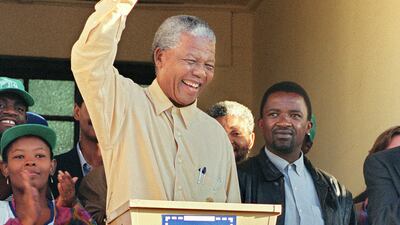
African National Congress (ANC) President Nelson Mandela smiles broadly 27 April 1994 in Oshlange, black township near Durban, as he casts his historic vote during South Africa's first democratic and all-race general elections. -
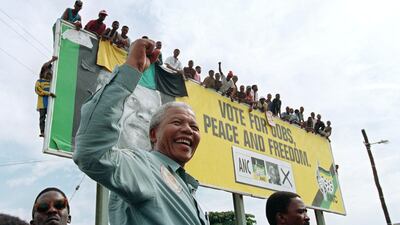
African National Congress (ANC) President Nelson Mandela greets young supporters who wait for atop a billboard in a township outside Durban, 16 April 1994 prior to an election rally. South Africans will vote 27 April 1994 in the country's first democratic and multiracial general elections. -

Nelson Mandela siting in his chair after he arrived on stage for the Nelson Mandela lecture in honour of his 90th birthday, Soweto, South Africa, 12 July 2008. EPA -

Former South African president Nelson Mandela's, (L) laughs beside his wife Graca Machel (R) from the parliament gallery in Cape Town on February 11, 2010 during a celebration for the 20th year of the icon's freedom from apartheid prison. AFP -

US Secretary of State Hillary Rodham Clinton meets with Nelson Mandela, 94, former president of South Africa, at his home in Qunu, South Africa, on August 6, 2012. Her private lunch with the Nobel Peace Prize winner was the first event of her South African visit, an indication of the prestige still enjoyed by the man who led the fight against white-minority rule. The two chatted in his home ahead of the meal, an honour that few receive as Mandela's health has become more fragile with age. AFP


When he arrived on Robben Island in 1978, Mr Brand says he had not heard of Mandela, but remembers being told on his first day he was about to meet some of South Africa’s most dangerous criminals.
“I suspected I was going to meet tattoo-faced gangsters and murderers, but when I opened up the first cell door that morning in the isolation section, I found old people sleeping on the floor in blankets. And when I saw how they were treated, I felt very sorry for them,” he says.
Twelve years and two prison transfers later, Mandela, the leader of the African National Congress (ANC) party, would finally walk free after spending 27 years behind bars.
His release on February 11, 1990, would lead to the collapse of the apartheid regime, a system of oppression that racially segregated white and non-white South African citizens.
Even after becoming the ANC leader and then South Africa’s first black head of state, Mandela would remain close to Mr Brand.
He recalls his first conversation with Mandela, who asked him about his upbringing and asked for gardening tips for the small plot where he grew chillies, tomatoes and onions when he found out Mr Brand had grown up on a farm.
Tears of joy
In the winter of 1980, Mr Brand knew he would be friends with Mandela for life.
Winnie Mandela came to visit her husband in prison and smuggled in their baby granddaughter under a blanket.
She begged Mr Brand to let her take the child into Mandela's cell, but prison rules prohibited it. Mr Brand says he felt bad for Mandela, who was allowed only one visitor for 30 minutes every three months that year.
“I then told Winnie I would hold the baby while she went to see Mandela for a few seconds. I snuck to one side and when Mr Mandela came out of that visit, I was waiting for him in the passage with the baby,” Mr Barnd says.
“He took the baby out of my arms and held it. When he kissed the child there were tears in his eyes, and he'd become quite emotional.”
Mandela later thanked Mr Brand.
“I should have been charged for smuggling a baby to a prisoner they called a terrorist. The minimum sentence they promised us was five to 10 years for smuggling to these prisoners. That secret was kept between me and Mandela for nearly 20 years until he became president of our country,” Mr Brand says with a smile.
Even as South Africa became more divided and violent under apartheid, the two men continued to help each other.
Mr Brand taught Mandela to read and write in Afrikaans, while Mandela, who had a background in law, gave his guard legal advice when he had a motorcycle accident.
Mr Brand says he saw Mandela as a fatherly figure who was always happy to help.
Road to freedom

In 1985, three years after the two men transferred to Pollsmoor Prison on the mainland, Mr Brand was put in a difficult position.
He was asked by South Africa’s National Intelligence Agency to wear a microphone and to convince the ANC leader to accept President P W Botha’s offer for his release.
Mr Brand knew deep down Mandela would not accept the offer, but feared reprisals if he did not appear to try to convince his friend.
He led Mandela out to the prison garden and silently gestured to him that the conversation was being recorded.
Mandela declined the offer, but Mr Brand continued to drive him from Pollsmoor during the evenings to meet South African politicians to negotiate his release.
It took another six years of negotiations, boycotts, political uprisings and another jail transfer before he left prison for good.
After his release, Mandela and president F W de Klerk led efforts to negotiate an end to apartheid.
When Mandela was voted in as South Africa’s president in May 1994, he invited his friend to parliament. Six months later, Mr Brand was hired in Mandela’s office as an administrative and logistics manager in the Constitutional Assembly.
Mr Brand returned to Robben Island once the new constitution was adopted in 1996 giving equal rights for whites and non-whites. This time, he worked as a tour guide.
Although he retired in July 2018, he continues to tell his story. Throughout the Covid-19 pandemic, he has held Zoom calls with schools and the occasional socially-distanced prison tour.
“If Mandela was alive today, he would encourage education and negotiation between both sides as a means to solve racial conflicts”, Mr Brand says.
Given his limited work options, Mr Brand never saw his job as a political one, despite playing a significant role in Mandela’s path to freedom.
He was delighted to see his friend become president and do away with the racist laws in South Africa.
He recalls visiting a school in Cape Town with Mandela in 1995. Watching black and white children playing together, Mr Brand recalls Mandela saying: “That is the rainbow nation I will see develop in my country.”
Christo Brand is the author of Doing life with Mandela: my prisoner, my friend

