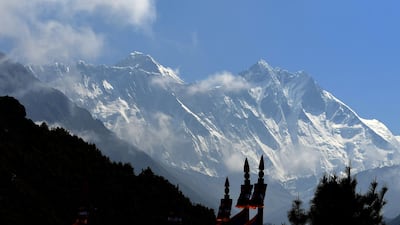
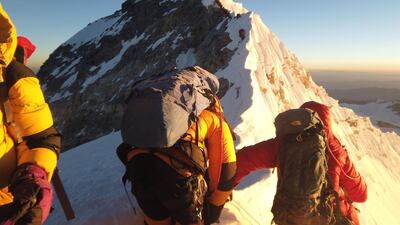
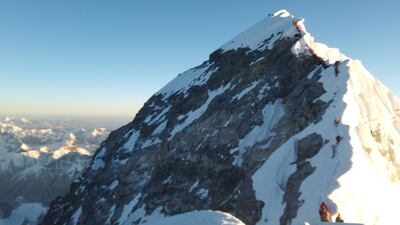
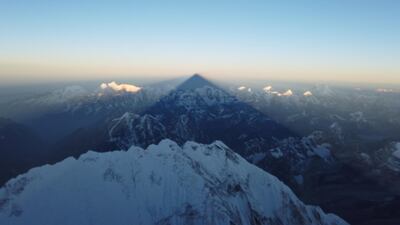
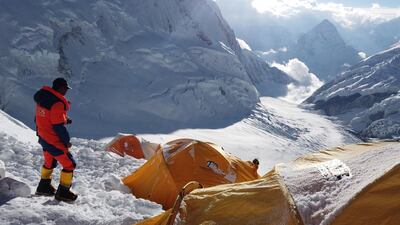
Two UAE-based mountaineers have told how they narrowly escaped death during their successful attempts to scale Mount Everest.
Jordanian Dolores Al Shelleh, 29, made history last Thursday by becoming the first Arab woman to reach the summit via its North Face.
Separately, Fatima Deryan, 26, also became the first Lebanese woman to reach the top last Wednesday from the Nepal side.
Both overcame high winds and sub-zero temperatures to complete the gruelling challenge, and both also witnessed other climbers die in their efforts to stand on top of the world.
Speaking to The National, Ms Al Shelleh revealed how her journey had been fraught with danger every step of the way.
She watched unable to help as a fellow climber died right in front of her. She herself suffered several fractured ribs in a fall.
“He died as we were making our climb down the mountain,” Ms Al Shelleh said.
“It all happened so quickly. It looked like he had an oxygen issue before he started struggling. He fell over and died.”
This year's Everest season has been the fourth-deadliest on record with 11 confirmed deaths as of Tuesday.
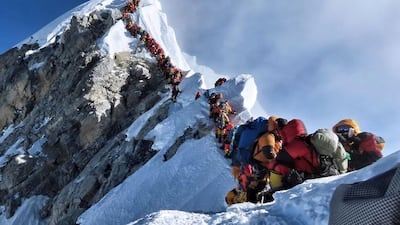
There has been criticism of the number of permits issued by the Nepalese government, with 820 climbers and sherpas trying to reach the summit in a short weather window. It has been claimed some climbers lacked experience and appeared unfamiliar with their own equipment.
Ms Al Shelleh said many of her family had feared for the worst when reports began emerging last week of 10 deaths on the mountain.
Images of queues of climbers awaiting their turn to ascend a narrow ridge to the summit did little to allay their fears.
But in an interview on Tuesday, Ms Al Shelleh said her route up the North Face, as opposed to the south-east ridge from Nepal, had avoided the bottlenecks.
In fact, she said was totally unaware so many people had died on the mountain last week until Sunday, when she made her descent.
“On the North Face there is no traffic, so I was not caught up in any of that,” she said in a brief phone call from China.
“I had to tell my family and friends that I was not part of those queues.”
Ms Al Shelleh’s climb was by no means lacking in traumatic moments, however.
“As well as the man dying in front of me, I saw bodies from people who had previously tried to climb Everest,” she said.
“Then one of our group was trying to get to the summit without oxygen, for the fourth time.
“He had to be taken to hospital in Kathmandu after he was coughing up blood.”
The North Face of Everest is notorious for its treacherous conditions and is considered an extremely tough climb in mountaineering circles.
It is often much colder and has higher winds than on other routes, leading to higher fatality rates.
Ms Al Shelleh, who works in marketing, said she hoped her expedition would raise awareness of gender inequality.
She said her success would not have been possible without the support of her main sponsor, Faris Saeed, CEO of Diamond Developers in Dubai’s Sustainable City, who is also her employer.
“I also wanted to shine a light on the importance of sustainability,” she said.
“I hope that the attention I now receive will give me a platform to raise these issues.”
Ms Deryan, who lives in Sharjah and runs a business in Dubai, revealed she had been stuck in a tailback of climbers for hours while making her way up the mountain from the Nepal side.
She also hit out at the number of climbing permits that were issued this year, adding that it was obvious many of those on the mountain were not qualified to take on Everest.
She described being knocked off her feet by a woman in the same line who was suffering the effects of exhaustion.
"I was stuck in the queue for hours and it was worrying because the winds were high and the temperature was minus 35," she told The National.
“At those temperatures you have to be constantly moving so standing still was a problem.
“I was very worried and spent that time fearing that I might have frostbite. It was so crowded that you could barely take a step.”
Ms Deryan also revealed that she too had witnessed another climber's death.
“He collapsed in front of me and died but we had no choice but to keep on climbing because it was so dangerous,” she said.
“When I was in the queue to get to the summit a woman passed out and fell against me. Because we were held together by rope, I was pulled off my feet. I thought I was going to die.”
Ms Deryan, who owns an online cleaning company, said the Nepalese government and tour companies have to do much more to ensure climbers have the training to tackle Everest.
“You had people who did not even know how to put on their own equipment, they had to get the sherpas to do it for them,” she said.
“Others had two or three sherpas with them and just seemed to expect them to do all the work and just carry them to the top.
“There were clearly too many permits issued and there should been much more stringent background checks on the people applying this year.”
She added that her achievement of being the first Lebanese woman to climb Everest had yet to sink in.
“There were two other Lebanese women who were climbing Everest and started a day before me, so I didn’t really give it a second thought,” she said.
“It wasn’t until afterwards that I was told I had been the first to complete the climb. I went up the mountain as plain old Fatima Deryan and came down as the first Lebanese woman to climb Everest.”

Ten tax points to be aware of in 2026
1. Domestic VAT refund amendments: request your refund within five years
If a business does not apply for the refund on time, they lose their credit.
2. E-invoicing in the UAE
Businesses should continue preparing for the implementation of e-invoicing in the UAE, with 2026 a preparation and transition period ahead of phased mandatory adoption.
3. More tax audits
Tax authorities are increasingly using data already available across multiple filings to identify audit risks.
4. More beneficial VAT and excise tax penalty regime
Tax disputes are expected to become more frequent and more structured, with clearer administrative objection and appeal processes. The UAE has adopted a new penalty regime for VAT and excise disputes, which now mirrors the penalty regime for corporate tax.
5. Greater emphasis on statutory audit
There is a greater need for the accuracy of financial statements. The International Financial Reporting Standards standards need to be strictly adhered to and, as a result, the quality of the audits will need to increase.
6. Further transfer pricing enforcement
Transfer pricing enforcement, which refers to the practice of establishing prices for internal transactions between related entities, is expected to broaden in scope. The UAE will shortly open the possibility to negotiate advance pricing agreements, or essentially rulings for transfer pricing purposes.
7. Limited time periods for audits
Recent amendments also introduce a default five-year limitation period for tax audits and assessments, subject to specific statutory exceptions. While the standard audit and assessment period is five years, this may be extended to up to 15 years in cases involving fraud or tax evasion.
8. Pillar 2 implementation
Many multinational groups will begin to feel the practical effect of the Domestic Minimum Top-Up Tax (DMTT), the UAE's implementation of the OECD’s global minimum tax under Pillar 2. While the rules apply for financial years starting on or after January 1, 2025, it is 2026 that marks the transition to an operational phase.
9. Reduced compliance obligations for imported goods and services
Businesses that apply the reverse-charge mechanism for VAT purposes in the UAE may benefit from reduced compliance obligations.
10. Substance and CbC reporting focus
Tax authorities are expected to continue strengthening the enforcement of economic substance and Country-by-Country (CbC) reporting frameworks. In the UAE, these regimes are increasingly being used as risk-assessment tools, providing tax authorities with a comprehensive view of multinational groups’ global footprints and enabling them to assess whether profits are aligned with real economic activity.
Contributed by Thomas Vanhee and Hend Rashwan, Aurifer
GAC GS8 Specs
Engine: 2.0-litre 4cyl turbo
Power: 248hp at 5,200rpm
Torque: 400Nm at 1,750-4,000rpm
Transmission: 8-speed auto
Fuel consumption: 9.1L/100km
On sale: Now
Price: From Dh149,900
Mercer, the investment consulting arm of US services company Marsh & McLennan, expects its wealth division to at least double its assets under management (AUM) in the Middle East as wealth in the region continues to grow despite economic headwinds, a company official said.
Mercer Wealth, which globally has $160 billion in AUM, plans to boost its AUM in the region to $2-$3bn in the next 2-3 years from the present $1bn, said Yasir AbuShaban, a Dubai-based principal with Mercer Wealth.
“Within the next two to three years, we are looking at reaching $2 to $3 billion as a conservative estimate and we do see an opportunity to do so,” said Mr AbuShaban.
Mercer does not directly make investments, but allocates clients’ money they have discretion to, to professional asset managers. They also provide advice to clients.
“We have buying power. We can negotiate on their (client’s) behalf with asset managers to provide them lower fees than they otherwise would have to get on their own,” he added.
Mercer Wealth’s clients include sovereign wealth funds, family offices, and insurance companies among others.
From its office in Dubai, Mercer also looks after Africa, India and Turkey, where they also see opportunity for growth.
Wealth creation in Middle East and Africa (MEA) grew 8.5 per cent to $8.1 trillion last year from $7.5tn in 2015, higher than last year’s global average of 6 per cent and the second-highest growth in a region after Asia-Pacific which grew 9.9 per cent, according to consultancy Boston Consulting Group (BCG). In the region, where wealth grew just 1.9 per cent in 2015 compared with 2014, a pickup in oil prices has helped in wealth generation.
BCG is forecasting MEA wealth will rise to $12tn by 2021, growing at an annual average of 8 per cent.
Drivers of wealth generation in the region will be split evenly between new wealth creation and growth of performance of existing assets, according to BCG.
Another general trend in the region is clients’ looking for a comprehensive approach to investing, according to Mr AbuShaban.
“Institutional investors or some of the families are seeing a slowdown in the available capital they have to invest and in that sense they are looking at optimizing the way they manage their portfolios and making sure they are not investing haphazardly and different parts of their investment are working together,” said Mr AbuShaban.
Some clients also have a higher appetite for risk, given the low interest-rate environment that does not provide enough yield for some institutional investors. These clients are keen to invest in illiquid assets, such as private equity and infrastructure.
“What we have seen is a desire for higher returns in what has been a low-return environment specifically in various fixed income or bonds,” he said.
“In this environment, we have seen a de facto increase in the risk that clients are taking in things like illiquid investments, private equity investments, infrastructure and private debt, those kind of investments were higher illiquidity results in incrementally higher returns.”
The Abu Dhabi Investment Authority, one of the largest sovereign wealth funds, said in its 2016 report that has gradually increased its exposure in direct private equity and private credit transactions, mainly in Asian markets and especially in China and India. The authority’s private equity department focused on structured equities owing to “their defensive characteristics.”
Company profile
Company: Eighty6
Date started: October 2021
Founders: Abdul Kader Saadi and Anwar Nusseibeh
Based: Dubai, UAE
Sector: Hospitality
Size: 25 employees
Funding stage: Pre-series A
Investment: $1 million
Investors: Seed funding, angel investors
GCC-UK%20Growth
%3Cp%3EAn%20FTA%20with%20the%20GCC%20would%20be%20very%20significant%20for%20the%20UK.%20%20%20%20%20%20%20%20%20%20%20%20%20%20%20%20%20%20%20%20%20%20%20%20%20%20%20%20%20%20%20%20%20%20%20%20%20%20%20%20%20%20%20%20%20%20%20%20%20%20%20%20%20%20%20%20%20%20%20%20%20%20%20%20%20%20%20%20%20%20%20%20%20%20%20%20%20%20%20My%20Department%20has%20forecast%20that%20it%20could%20generate%20an%20additional%20%C2%A31.6%20billion%20a%20year%20for%20our%20economy.%3Cbr%3EWith%20consumer%20demand%20across%20the%20GCC%20predicted%20to%20increase%20to%20%C2%A3800%20billion%20by%202035%20this%20deal%20could%20act%20as%20a%20launchpad%20from%20which%20our%20firms%20can%20boost%20their%20market%20share.%3C%2Fp%3E%0A
Company%20profile
%3Cp%3E%3Cstrong%3EName%3A%3C%2Fstrong%3E%20JustClean%3Cbr%3E%3Cbr%3E%3Cstrong%3EBased%3A%20%3C%2Fstrong%3EDubai%20with%20offices%20in%20other%20GCC%20countries%3Cbr%3E%3Cbr%3E%3Cstrong%3ELaunch%20year%3A%3C%2Fstrong%3E%202016%3Cbr%3E%3Cbr%3E%3Cstrong%3ENumber%20of%20employees%3A%3C%2Fstrong%3E%20160%2B%20with%2021%20nationalities%20in%20eight%20cities%3Cbr%3E%3Cstrong%3E%3Cbr%3ESector%3A%3C%2Fstrong%3E%20online%20laundry%20and%20cleaning%20services%3Cbr%3E%3Cbr%3E%3Cstrong%3EFunding%3A%20%3C%2Fstrong%3E%2430m%20from%20Kuwait-based%20Faith%20Capital%20Holding%20and%20Gulf%20Investment%20Corporation%3C%2Fp%3E%0A
In-demand jobs and monthly salaries
- Technology expert in robotics and automation: Dh20,000 to Dh40,000
- Energy engineer: Dh25,000 to Dh30,000
- Production engineer: Dh30,000 to Dh40,000
- Data-driven supply chain management professional: Dh30,000 to Dh50,000
- HR leader: Dh40,000 to Dh60,000
- Engineering leader: Dh30,000 to Dh55,000
- Project manager: Dh55,000 to Dh65,000
- Senior reservoir engineer: Dh40,000 to Dh55,000
- Senior drilling engineer: Dh38,000 to Dh46,000
- Senior process engineer: Dh28,000 to Dh38,000
- Senior maintenance engineer: Dh22,000 to Dh34,000
- Field engineer: Dh6,500 to Dh7,500
- Field supervisor: Dh9,000 to Dh12,000
- Field operator: Dh5,000 to Dh7,000
Company%20profile
%3Cp%3E%3Cbr%3E%3Cstrong%3EName%3A%3C%2Fstrong%3E%20Khodar%3Cbr%3E%3Cstrong%3EBased%3A%3C%2Fstrong%3E%20Cairo%20and%20Alexandria%2C%20in%20Egypt%3Cbr%3E%3Cstrong%3EFounders%3A%3C%2Fstrong%3E%20Ayman%20Hamza%2C%20Yasser%20Eidrous%20and%20Amr%20El%20Sheikh%3Cbr%3E%3Cstrong%3ESector%3A%3C%2Fstrong%3E%20agriculture%20technology%3Cbr%3E%3Cstrong%3EFunding%3A%3C%2Fstrong%3E%20%24500%2C000%3Cbr%3E%3Cstrong%3EInvestors%3A%3C%2Fstrong%3E%20Saudi%20Arabia%E2%80%99s%20Revival%20Lab%20and%20others%3Cbr%3E%3Cstrong%3EEmployees%3A%3C%2Fstrong%3E%2035%3C%2Fp%3E%0A
SPECS
%3Cp%3E%3Cstrong%3EEngine%3A%3C%2Fstrong%3E%206-cylinder%203-litre%2C%20with%20petrol%20and%20diesel%20variants%3Cbr%3E%3Cstrong%3ETransmission%3A%20%3C%2Fstrong%3E8-speed%20automatic%3Cbr%3E%3Cstrong%3EPower%3A%3C%2Fstrong%3E%20286hp%20(petrol)%2C%20249hp%20(diesel)%3Cbr%3E%3Cstrong%3ETorque%3A%20%3C%2Fstrong%3E450Nm%20(petrol)%2C%20550Nm%20(diesel)%3Cbr%3E%3Cstrong%3EPrice%3A%20%3C%2Fstrong%3EStarting%20at%20%2469%2C800%3Cbr%3E%3Cstrong%3EOn%20sale%3A%20%3C%2Fstrong%3ENow%3C%2Fp%3E%0A
The President's Cake
Director: Hasan Hadi
Starring: Baneen Ahmad Nayyef, Waheed Thabet Khreibat, Sajad Mohamad Qasem
Rating: 4/5
The bio
Date of Birth: April 25, 1993
Place of Birth: Dubai, UAE
Marital Status: Single
School: Al Sufouh in Jumeirah, Dubai
University: Emirates Airline National Cadet Programme and Hamdan University
Job Title: Pilot, First Officer
Number of hours flying in a Boeing 777: 1,200
Number of flights: Approximately 300
Hobbies: Exercising
Nicest destination: Milan, New Zealand, Seattle for shopping
Least nice destination: Kabul, but someone has to do it. It’s not scary but at least you can tick the box that you’ve been
Favourite place to visit: Dubai, there’s no place like home
Director: Jon Favreau
Starring: Donald Glover, Seth Rogen, John Oliver
Rating: 2 out of 5 stars
Living in...
This article is part of a guide on where to live in the UAE. Our reporters will profile some of the country’s most desirable districts, provide an estimate of rental prices and introduce you to some of the residents who call each area home.
Other must-tries
Tomato and walnut salad
A lesson in simple, seasonal eating. Wedges of tomato, chunks of cucumber, thinly sliced red onion, coriander or parsley leaves, and perhaps some fresh dill are drizzled with a crushed walnut and garlic dressing. Do consider yourself warned: if you eat this salad in Georgia during the summer months, the tomatoes will be so ripe and flavourful that every tomato you eat from that day forth will taste lacklustre in comparison.
Badrijani nigvzit
A delicious vegetarian snack or starter. It consists of thinly sliced, fried then cooled aubergine smothered with a thick and creamy walnut sauce and folded or rolled. Take note, even though it seems like you should be able to pick these morsels up with your hands, they’re not as durable as they look. A knife and fork is the way to go.
Pkhali
This healthy little dish (a nice antidote to the khachapuri) is usually made with steamed then chopped cabbage, spinach, beetroot or green beans, combined with walnuts, garlic and herbs to make a vegetable pâté or paste. The mix is then often formed into rounds, chilled in the fridge and topped with pomegranate seeds before being served.
Mumbai Indians 213/6 (20 ov)
Royal Challengers Bangalore 167/8 (20 ov)
BMW M5 specs
Engine: 4.4-litre twin-turbo V-8 petrol enging with additional electric motor
Power: 727hp
Torque: 1,000Nm
Transmission: 8-speed auto
Fuel consumption: 10.6L/100km
On sale: Now
Price: From Dh650,000
MATCH INFO
What: 2006 World Cup quarter-final
When: July 1
Where: Gelsenkirchen Stadium, Gelsenkirchen, Germany
Result:
England 0 Portugal 0
(Portugal win 3-1 on penalties)
The specs
- Engine: 3.9-litre twin-turbo V8
- Power: 640hp
- Torque: 760nm
- On sale: 2026
- Price: Not announced yet