• Learning to drive from scratch involves passing a theory course then at least 10 lessons lasting two-hours. You must pass a practical road test at the end to get your licence. Christopher Pike / The National
    Learning to drive from scratch involves passing a theory course then at least 10 lessons lasting two-hours. You must pass a practical road test at the end to get your licence. Christopher Pike / The National
  • An instructor pictured at Emirates Driving Institute's Al Qusais campus. Rory's tip is to book your lessons for rush hour so you get used to the hectic roads. Christopher Pike / The National
    An instructor pictured at Emirates Driving Institute's Al Qusais campus. Rory's tip is to book your lessons for rush hour so you get used to the hectic roads. Christopher Pike / The National
  • Part of the learning process involves manoeuvers in a closed car park, followed by lessons on the roads. Leslie Pableo for The National
    Part of the learning process involves manoeuvers in a closed car park, followed by lessons on the roads. Leslie Pableo for The National
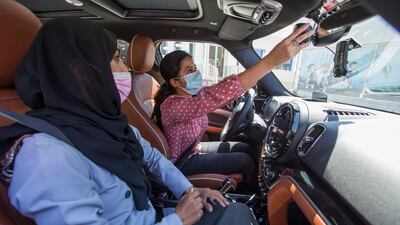
  • A masked instructor gives a student pointers. Going over the basics again and again is the key to passing the test. Leslie Pableo for The National
    A masked instructor gives a student pointers. Going over the basics again and again is the key to passing the test. Leslie Pableo for The National
  • The whole process takes about two months, depending on how many attempts it takes to pass. Most driving schools offer fast-track courses. Leslie Pableo for The National
    The whole process takes about two months, depending on how many attempts it takes to pass. Most driving schools offer fast-track courses. Leslie Pableo for The National
  • Taleb Mahmoud Ayub, head of operations at Emirates Driving Institute, talks to an instructor during a tour for The National. Leslie Pableo for The National
    Taleb Mahmoud Ayub, head of operations at Emirates Driving Institute, talks to an instructor during a tour for The National. Leslie Pableo for The National

UAE driving licence can now be exchanged for UK version


  • English
  • Arabic

Related: Learning to drive and getting your licence in Dubai and UAE

Drivers who pass their test in the UAE can now exchange their licence for a British one.

New rules mean that motorists are no longer required to repeat their driving test if they move to the UK.

The decision, which came into effect on May 20, follows an analysis and public consultation by the UK's Driver and Vehicle Licensing Agency (DVLA).

The same rules were extended to Taiwan, Ukraine and North Macedonia.

Testing standards are equivalent and so there is no value in requiring the driver to repeat a test to get a GB licence

Under previous rules, drivers who had a UAE licence could use it for a year in the UK, before having to take a British theory and practical test. The process can often cost £1,000 ($1,400), depending on a person's driving skills.

The move will mostly benefit Emirati and expat students, UAE residents visiting the UK for longer periods, and expats who learnt in the Emirates and return home.

Exchanging an Emirati licence for a British one costs £43.

British officials said they were satisfied that the level of instruction and examination was sufficiently rigorous to be on par with the UK.

"Testing standards for the specified vehicle categories are equivalent and so there is no value in requiring the driver to repeat a test to get a GB licence," DVLA said, summing up the responses to its consultation.

"The Driver and Vehicle Standards Agency has approved the standards for cars in respect of North Macedonia, Taiwan and Ukraine, and for cars and small motorcycles not exceeding 125cc in respect of United Arab Emirates."

Despite the change, Emiratis and UAE residents may face one clear hurdle – the vast majority of UAE licences are for automatic vehicles, whereas most UK cars are manual.

A driver with an automatic licence would have to find an automatic car, which have gradually grown in popularity, or take a small number of lessons and repeat the DVLA test.

Isabel Cadbury, 41, a British mother of two, has lived in Dubai for 13 years.

She learnt to drive and passed her test in Dubai and worried about having to relearn if she returns to the UK.

"This is great news. I was worried I wouldn't be able to pass my driving test in the UK, having driven in the Middle East for so many years," she said.

She failed tests in the UK several times and decided to learn in Dubai only when she moved from an apartment near the Metro line to a suburban villa.

"I think learning to drive in central London was more stressful than it is in Al Quoz," she said.

The cost of a driving course package in Dubai is in the region of Dh5,000 ($1,360), which includes 20 hours of lessons, theory test material and the fees for the theory and practical training.

The pass rate is about 45 per cent, Emirates Driving Institute says, similar to the UK level.

British expat Maria Alfarhan's daughter is due to leave home for university in the UK in September.

She would have had to learn to drive there, but can now spend her summer taking lessons in Dubai.

"This is excellent news. Our daughter can now make use of her time until she leaves in September and try to get her licence here instead of the UK," Ms Alfarhan said.

Dubai's luxury driving course – in pictures

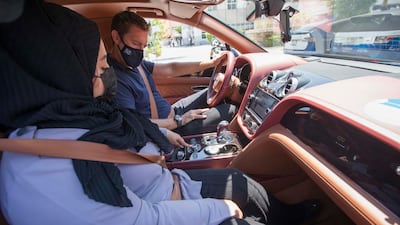
  • Driving instructor Zubeida with a Bentley car instructing Nick Webster at the Emirates Driving Institute, Dubai. Leslie Pableo for The National
    Driving instructor Zubeida with a Bentley car instructing Nick Webster at the Emirates Driving Institute, Dubai. Leslie Pableo for The National
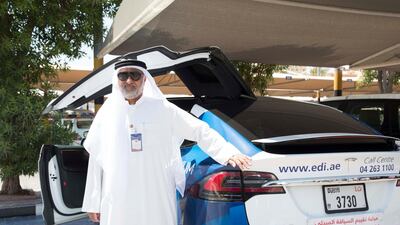
  • Taleb Mahmoud Ayub, Head of Operations next to a Tesla car at the Emirates Driving Institute, Dubai. Leslie Pableo for The National
    Taleb Mahmoud Ayub, Head of Operations next to a Tesla car at the Emirates Driving Institute, Dubai. Leslie Pableo for The National
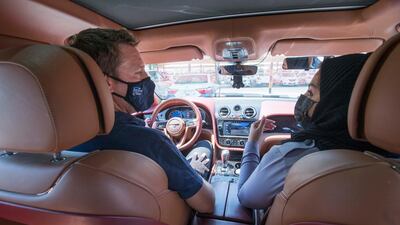
  • Driving instructor Zubeida inside a Bentley car instructing Nick Webster at the Emirates Driving Institute, Dubai. Leslie Pableo for The National
    Driving instructor Zubeida inside a Bentley car instructing Nick Webster at the Emirates Driving Institute, Dubai. Leslie Pableo for The National
  • Driving instructor Zubeida inside a Bentley car instructing Nick Webster at the Emirates Driving Institute, Dubai. Leslie Pableo for The National
    Driving instructor Zubeida inside a Bentley car instructing Nick Webster at the Emirates Driving Institute, Dubai. Leslie Pableo for The National
  • A Mini Cooper specially for women drivers at the Emirates Driving Institute, Dubai. Leslie Pableo for The National
    A Mini Cooper specially for women drivers at the Emirates Driving Institute, Dubai. Leslie Pableo for The National
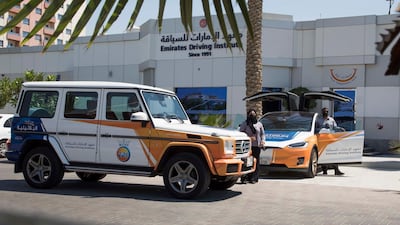
  • A Mercedes and Tesla at the Emirates Driving Institute, Dubai. Leslie Pableo for The National
    A Mercedes and Tesla at the Emirates Driving Institute, Dubai. Leslie Pableo for The National
  • Instructor Sabia teaching a students pointers in driving at the Emirates Driving Institute, Dubai. Leslie Pableo for The National
    Instructor Sabia teaching a students pointers in driving at the Emirates Driving Institute, Dubai. Leslie Pableo for The National
  • A Mercedes and Tesla at the Emirates Driving Institute, Dubai. Leslie Pableo for The National
    A Mercedes and Tesla at the Emirates Driving Institute, Dubai. Leslie Pableo for The National
How The Debt Panel's advice helped readers in 2019

December 11: 'My husband died, so what happens to the Dh240,000 he owes in the UAE?'

JL, a housewife from India, wrote to us about her husband, who died earlier this month. He left behind an outstanding loan of Dh240,000 and she was hoping to pay it off with an insurance policy he had taken out. She also wanted to recover some of her husband’s end-of-service liabilities to help support her and her son.

“I have no words to thank you for helping me out,” she wrote to The Debt Panel after receiving the panellists' comments. “The advice has given me an idea of the present status of the loan and how to take it up further. I will draft a letter and send it to the email ID on the bank’s website along with the death certificate. I hope and pray to find a way out of this.”

November 26:  ‘I owe Dh100,000 because my employer has not paid me for a year’

SL, a financial services employee from India, left the UAE in June after quitting his job because his employer had not paid him since November 2018. He owes Dh103,800 on four debts and was told by the panellists he may be able to use the insolvency law to solve his issue. 

SL thanked the panellists for their efforts. "Indeed, I have some clarity on the consequence of the case and the next steps to take regarding my situation," he says. "Hopefully, I will be able to provide a positive testimony soon."

October 15: 'I lost my job and left the UAE owing Dh71,000. Can I return?'

MS, an energy sector employee from South Africa, left the UAE in August after losing his Dh12,000 job. He was struggling to meet the repayments while securing a new position in the UAE and feared he would be detained if he returned. He has now secured a new job and will return to the Emirates this month.

“The insolvency law is indeed a relief to hear,” he says. "I will not apply for insolvency at this stage. I have been able to pay something towards my loan and credit card. As it stands, I only have a one-month deficit, which I will be able to recover by the end of December." 

Favourite book: ‘The Art of Learning’ by Josh Waitzkin

Favourite film: Marvel movies

Favourite parkour spot in Dubai: Residence towers in Jumeirah Beach Residence

Key findings of Jenkins report
  • Founder of the Muslim Brotherhood, Hassan al Banna, "accepted the political utility of violence"
  • Views of key Muslim Brotherhood ideologue, Sayyid Qutb, have “consistently been understood” as permitting “the use of extreme violence in the pursuit of the perfect Islamic society” and “never been institutionally disowned” by the movement.
  • Muslim Brotherhood at all levels has repeatedly defended Hamas attacks against Israel, including the use of suicide bombers and the killing of civilians.
  • Laying out the report in the House of Commons, David Cameron told MPs: "The main findings of the review support the conclusion that membership of, association with, or influence by the Muslim Brotherhood should be considered as a possible indicator of extremism."