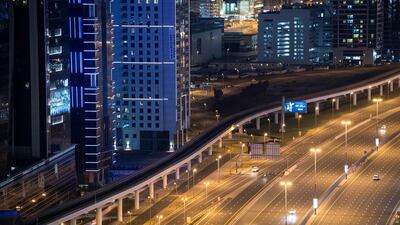
• Abu Dhabi traffic could be permanently reduced because of the pandemic with more companies offering flexible working hours. Pawan Singh / The National
    Abu Dhabi traffic could be permanently reduced because of the pandemic with more companies offering flexible working hours. Pawan Singh / The National
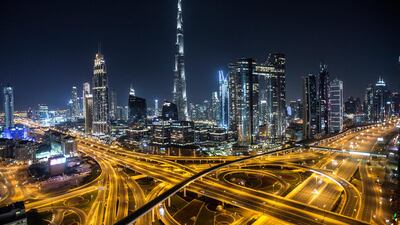
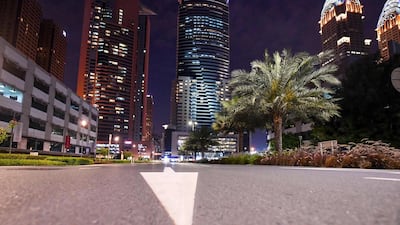
  • Road safety experts say flexible working hours will help reduce traffic congestion in Dubai. Antonie Robertson / The National
    Road safety experts say flexible working hours will help reduce traffic congestion in Dubai. Antonie Robertson / The National
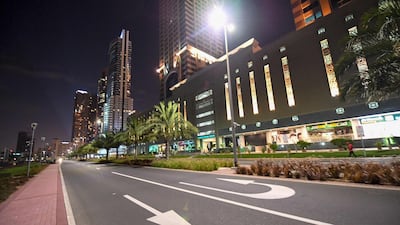
  • Rush hour traffic in Dubai could be permanently reduced due to the pandemic. Chris Whiteoak / The National
    Rush hour traffic in Dubai could be permanently reduced due to the pandemic. Chris Whiteoak / The National
  • Traffic congestion has risen in Berlin to pre-pandemic levels as more people avoid public transport and opt to travel by car. John MacDougall / AFP
    Traffic congestion has risen in Berlin to pre-pandemic levels as more people avoid public transport and opt to travel by car. John MacDougall / AFP
  • A woman crosses 42nd Street in New York in March during the early days of the pandemic. Traffic in the US city has now returned to the same levels as before the Covid-19 pandemic. Eduardo Munoz Alvarez/Getty Images/AFP
    A woman crosses 42nd Street in New York in March during the early days of the pandemic. Traffic in the US city has now returned to the same levels as before the Covid-19 pandemic. Eduardo Munoz Alvarez/Getty Images/AFP
  • This picture of an empty road leading to Linate Airport in Milan was taken in March. Traffic levels in the Italian city are now back to what they were before the pandemic. Piero Cruciatti / AFP
    This picture of an empty road leading to Linate Airport in Milan was taken in March. Traffic levels in the Italian city are now back to what they were before the pandemic. Piero Cruciatti / AFP

Flexible working hours spell end of rush-hour traffic for Dubai and Abu Dhabi


Patrick Ryan
  • English
  • Arabic

The Covid-19 outbreak could signal the end of rush-hour gridlock in Abu Dhabi and Dubai, a leading traffic expert said.

Global GPS provider TomTom found flexible working hours, already introduced in Dubai government offices, could mean the days of bumper-to-bumper jams are a thing of the past.

"More flexibility in the work place means we could be seeing the end of the typical rush-hour congestion," said Jonathan Americo, from the Amsterdam-based tech company.

“I expect Abu Dhabi and Dubai to be significantly lower because of a number of factors, including the widespread adoption of more flexible working hours."

Data has shown that the level of traffic in both emirates has reduced significantly compared with this time last year, before the outbreak.

We could be seeing the end of the typical rush hour congestion

However, an international study found that the opposite is true in other cities around the world that are experiencing higher levels of congestion than last year.

“A lot of cities that have seen a return to pre-quarantine levels of traffic congestion were previously reliant on public transport. A lot of people in those regions are avoiding public transport and are now taking cars to work,” said Mr Americo.

The UAE has traditionally been a car-centric country, even with the rise of more public transport options in the past decade.

Cities such as Berlin, New York, Rome and Milan have seen traffic return to similar pre-Covid levels.

Data provided by TomTom showed the level of rush hour congestion in Dubai at 5.30pm on Wednesday, November 4, was 21 per cent higher than during non-rush hour traffic.

That was a 15 per cent drop from the average rate of traffic in November 2019.

  • The main stretch of Sheikh Zayed Road near Downtown Dubai. Hundreds of thousands of vehicles would usually be on the roads on a Thursday night. EPA
    The main stretch of Sheikh Zayed Road near Downtown Dubai. Hundreds of thousands of vehicles would usually be on the roads on a Thursday night. EPA
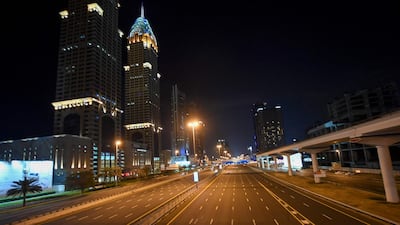
  • Defence Roundabout stands empty on Thursday night after the authorities ordered a 8pm to 6am curfew to allow for street cleaning. The curfew lifts during the day - but only absolutely essential travel is permitted. EPA
    Defence Roundabout stands empty on Thursday night after the authorities ordered a 8pm to 6am curfew to allow for street cleaning. The curfew lifts during the day - but only absolutely essential travel is permitted. EPA
  • The Internet City area usually a hive of activity. AFP
    The Internet City area usually a hive of activity. AFP
  • A handful of cars on the road ahead of the curfew. Only key workers including medical staff and supermarket assistants are allowed to travel. AFP
    A handful of cars on the road ahead of the curfew. Only key workers including medical staff and supermarket assistants are allowed to travel. AFP
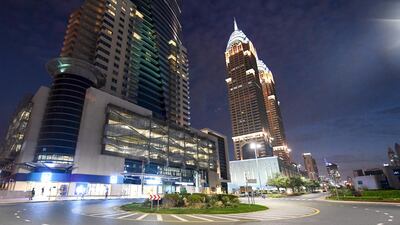
  • Pedestrian and cycling paths stand empty after people rushed home ahead the curfew. Business Central Towers near Media City can be seen on the right. AFP
    Pedestrian and cycling paths stand empty after people rushed home ahead the curfew. Business Central Towers near Media City can be seen on the right. AFP
  • Stay home orders are likely to last for weeks as the government works to drive down the number of new cases. AFP
    Stay home orders are likely to last for weeks as the government works to drive down the number of new cases. AFP
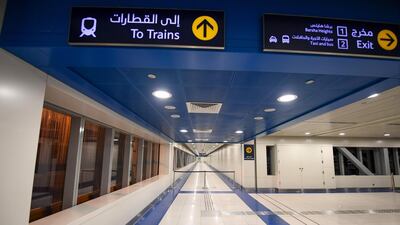
  • Dubai Metro will undergo deep cleaning this weekend. AFP
    Dubai Metro will undergo deep cleaning this weekend. AFP
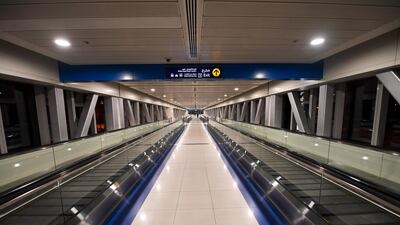
  • Once reopened, trains will run reduced numbers of passengers - about 170 down from a capacity of 650. AFP
    Once reopened, trains will run reduced numbers of passengers - about 170 down from a capacity of 650. AFP
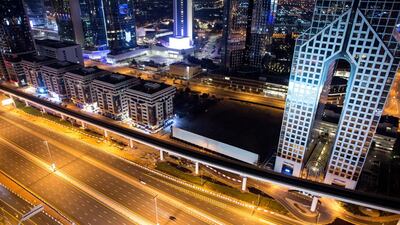
  • Dusit Thani hotel with the lights of Downtown in the background. EPA
    Dusit Thani hotel with the lights of Downtown in the background. EPA
  • Despite road closures, restaurants and supermarkets will continue to deliver food to homes. EPA
    Despite road closures, restaurants and supermarkets will continue to deliver food to homes. EPA
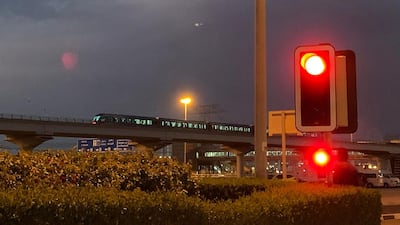
  • A metro train runs near Ibn Battuta Mall shortly before the curfew. Pawan Singh / The National
    A metro train runs near Ibn Battuta Mall shortly before the curfew. Pawan Singh / The National
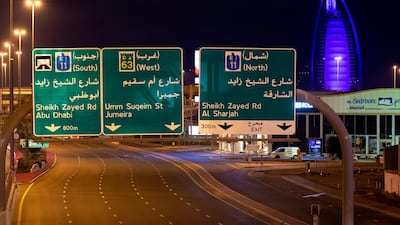
  • Umm Suqeim Road with Burj Al Arab in the background. Chris Whiteoak / The National
    Umm Suqeim Road with Burj Al Arab in the background. Chris Whiteoak / The National

The figure for Abu Dhabi was even lower with a congestion rate of 12 per cent, which was 15 per cent lower than the same week last year.

In contrast, traffic in London was 104 per cent at 5pm on the same date, twice what it would be outside rush hour.

It was also 34 per cent higher than November 2019, as some commuters appeared to shun the British capital's public transport system in favour of cars due to the pandemic.

Mr Americo said the fact that companies allow their employees to work from home throughout the week, or periodically go to the office on certain days, appeared to be the biggest factor behind the change.

In August, government workers in Dubai were told they could choose to start work any time between 6.30am and 8.30am.

The number of people who have left the UAE to return to their own country, since the start of the pandemic, may also have contributed to the reduction in traffic congestion, Mr Americo said.

Last week, the Indian Consulate in Dubai told The National that 650,000 of its citizens had left the UAE since the start of May, although 240,000 had already returned as the economy slowly got back on track.

Saleh Jafar, from road safety campaign group Gulf for Yasa, said congestion may return if flexible working eventually ends.

“A lot of companies have empty offices right now with long-term leases and they will want staff back when the pandemic dies down,” he said.

“There’s no question that traffic levels have been reduced but the economy relies on the likes of Salik [road toll charges] as well so I don’t think we’ll see a massive reduction in the long-term.”

Mr Jafar predicted Dubai’s roads would be busier in the winter as tourists arrive, even if they come in smaller numbers than before the pandemic.

“Dubai is going to continue to attract visitors – especially from countries where there is a lockdown,” he said.

“I can see the level of traffic reducing in the likes of Abu Dhabi but I’m not convinced it’s going to be much less in Dubai in the longer term.

“The level of traffic keeps creeping back up all the time and I think that’s only going to continue.”


THE SPECS


Engine: 1.5-litre


Transmission: 6-speed automatic


Power: 110 horsepower 


Torque: 147Nm 


Price: From Dh59,700 


On sale: now  

 
Short-term let permits explained

Homeowners and tenants are allowed to list their properties for rental by registering through the Dubai Tourism website to obtain a permit.

Tenants also require a letter of no objection from their landlord before being allowed to list the property.

There is a cost of Dh1,590 before starting the process, with an additional licence fee of Dh300 per bedroom being rented in your home for the duration of the rental, which ranges from three months to a year.

Anyone hoping to list a property for rental must also provide a copy of their title deeds and Ejari, as well as their Emirates ID.

Ten tax points to be aware of in 2026

1. Domestic VAT refund amendments: request your refund within five years

If a business does not apply for the refund on time, they lose their credit.

2. E-invoicing in the UAE

Businesses should continue preparing for the implementation of e-invoicing in the UAE, with 2026 a preparation and transition period ahead of phased mandatory adoption. 

3. More tax audits

Tax authorities are increasingly using data already available across multiple filings to identify audit risks. 

4. More beneficial VAT and excise tax penalty regime

Tax disputes are expected to become more frequent and more structured, with clearer administrative objection and appeal processes. The UAE has adopted a new penalty regime for VAT and excise disputes, which now mirrors the penalty regime for corporate tax.

5. Greater emphasis on statutory audit

There is a greater need for the accuracy of financial statements. The International Financial Reporting Standards standards need to be strictly adhered to and, as a result, the quality of the audits will need to increase.

6. Further transfer pricing enforcement

Transfer pricing enforcement, which refers to the practice of establishing prices for internal transactions between related entities, is expected to broaden in scope. The UAE will shortly open the possibility to negotiate advance pricing agreements, or essentially rulings for transfer pricing purposes. 

7. Limited time periods for audits

Recent amendments also introduce a default five-year limitation period for tax audits and assessments, subject to specific statutory exceptions. While the standard audit and assessment period is five years, this may be extended to up to 15 years in cases involving fraud or tax evasion. 

8. Pillar 2 implementation 

Many multinational groups will begin to feel the practical effect of the Domestic Minimum Top-Up Tax (DMTT), the UAE's implementation of the OECD’s global minimum tax under Pillar 2. While the rules apply for financial years starting on or after January 1, 2025, it is 2026 that marks the transition to an operational phase.

9. Reduced compliance obligations for imported goods and services

Businesses that apply the reverse-charge mechanism for VAT purposes in the UAE may benefit from reduced compliance obligations. 

10. Substance and CbC reporting focus

Tax authorities are expected to continue strengthening the enforcement of economic substance and Country-by-Country (CbC) reporting frameworks. In the UAE, these regimes are increasingly being used as risk-assessment tools, providing tax authorities with a comprehensive view of multinational groups’ global footprints and enabling them to assess whether profits are aligned with real economic activity. 

Contributed by Thomas Vanhee and Hend Rashwan, Aurifer