


Etihad Rail, the UAE’s megaproject to link the country’s centres of trade, industry and population, will grow from running heavy goods services to carrying millions of passengers between the major cities by 2030.
In a coastal village west of Abu Dhabi city, engineers, technicians and mechanics work day and night to keep the project on schedule.
The depot in Mirfa serves as the centre of operations that maintains and services all movement between the trains and track.
When complete, the network will stretch about 1,200 kilometres across the country and reduce carbon emissions by up to 80 per cent.
The railway line between Abu Dhabi and Dubai was joined up in March and connected to Ras Al Khaimah and Sharjah in October.
It has also been announced that the line will be extended into Oman. The agreement to build the Omani portion of rail network was signed on September 29 during the state visit of President Sheikh Mohamed to Oman.
The line will ultimately carry freight and passengers to connect Abu Dhabi with Sohar in the north of Muscat and more details are expected soon.
The Dh50 billion ($13.6bn) spent on the project is expected to contribute about Dh200bn to the economy.
Here's a glimpse of how the project will meet the global supply-demand needs of today:
What is Etihad Rail - and where does it go?
Etihad Rail was first established in 2009 and stage one of the project became operational in 2016.
Phase one is complete. Since 2016, two tracks spanning 264 kilometres have been in operation – with trains transporting granulated sulphur from gasfields in Shah and Habshan to an export point in Ruwais.
Every day, two trains run across the country, capable of carrying up to 22,000 tonnes of sulphur. Each train can pull up to 110 wagons.
When complete, the railway network will link the main centres of population and industry in the UAE and will form a vital part of the planned railway network across the Gulf region, connecting the seven emirates of the country to the five neighbouring GCC states.
On November 21, Etihad Rail said it had completed excavation work on nine tunnels over nearly seven kilometres, which involved blasting through sections of the Hajar mountain range on the east coast.
Phase two links the UAE and Saudi Arabia from Fujairah Port to Ghuwaifat, through Mussaffah, Khalifa Port and Jebel Ali Port with more than 600 kilometres of additional track. The two phases together will support more than 9,000 jobs, many of them for Emiratis.
-
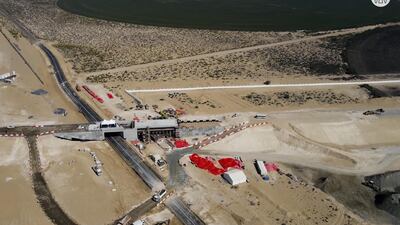
Sheikh Theyab enjoyed a 10km train journey across the fast-developing rail network -
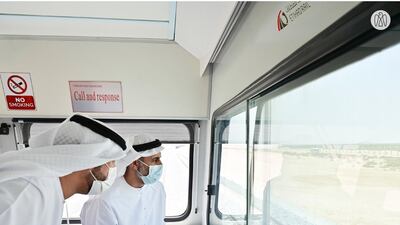
Sheikh Theyab checked the latest progress during a 10km trip aboard an inspection and supervision train. -
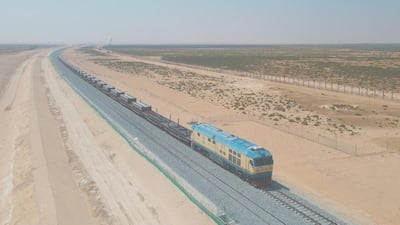
The Etihad Rail project aims to transform the UAE's transport sector and encourage economic growth. All pictures courtesy Abu Dhabi Media Office -

The vast rail network will help to connect the emirates -
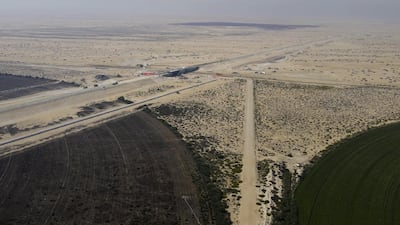
The national rail project will bolster links between ports and key manufacturing, production and residential centres. -
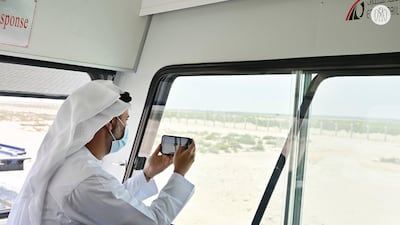
At Al Maha Forest area, Sheikh Theyab bin Mohamed bin Zayed was told how wildlife and natural habitats will be protected during construction work -

Sheikh Theyab joined officials at the Etihad Rail site in Seih Shuaib -
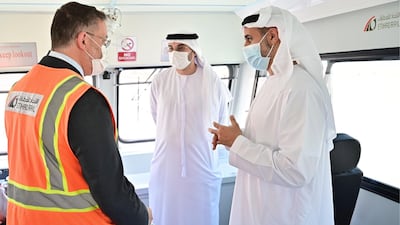
Sheikh Theyab was briefed on the rapid progress being made in the ambitious scheme -
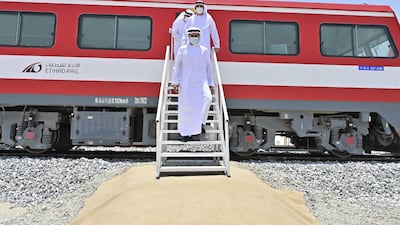
Sheikh Theyab, chairman of Etihad Rail, sampled the growing rail network -
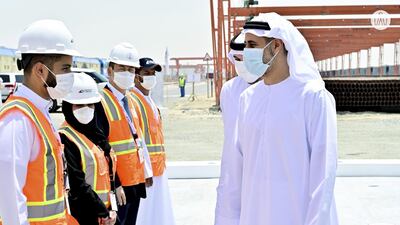
Stage two of the national rail project is now well under way -

Sheikh Theyab praised UAE leaders for backing the rail project


Trains and wagons
Seven locomotives are in operation along the tracks, which run through rural areas in Abu Dhabi, delivering sulphur to clients.
The state-of-the-art trains were supplied by US-based Electro-Motive Diesel and are equipped with in-cab European signalling systems.
Weighing 30 tonnes each unladen, and 130 tonnes loaded, the wagons are fully equipped with extended safety features, including electronically controlled pneumatic brakes and derailment protection.
For stage two of the project, the train fleet will increase to 45 locomotives and connect the emirates via Abu Dhabi, Khalifa Industrial Zone Abu Dhabi, Khalifa Port, Jebel Ali Port, Dubai, Sharjah, Ras Al Khaimah and Fujairah.
Last year, the first batch of Emirati students graduated with diplomas in railways specialities, through a programme introduced by Etihad Rail. Maithaa Al Remeithi also became the first female Emirati train controller in the country, at the age of 29.
One freight train replaces hundreds of lorries
Rail travel scores highly as far as its sustainability goes and that has to be celebrated.
Once fully operational, the fleet of trains and wagons running on the Etihad Rail network will replace 5,600 lorry trips per day. A fully loaded train also emits up to 80 per cent less carbon dioxide than lorries transporting the same tonnage.
Based on traffic volume forecasts, the Etihad Rail network will reduce greenhouse gases by more than 2.2 million tonnes annually once fully operational, the equivalent of taking up to 375,000 vehicles off the roads.
What can be transported on the trains?
By connecting a country’s trade centres, rail acts as a catalyst for economic growth. In the coming years, wagons running along the Etihad Rail tracks will move anything from consumer goods to perishable food and beverages.
Some of the typical products expected to move across the Emirates include hay, ceramics, polymers, sugar, metals, waste and shipping containers.
The type of wagons used will vary, depending on the cargo being transported. They include intermodal steel containers; flat-bed wagons; rail gondolas with low-side walls for loose bulk materials and temperature-controlled carriages.
Will passengers be able to ride on Etihad Rail?
In the future, yes. While increasing freight opportunities is the focus for now, passenger transport will become a key part of the project in the years to come.
Officials did not give a start date for the first service but said "by 2030, the number of passengers is expected to reach more than 36.5 million annually" in a statement in December last year.
New passenger services will run fast at about 200 kilometres per hour. Stations will stretch from Sila near the border with Saudi Arabia to Fujairah on the east coast.
The train will allow "passengers to travel from Abu Dhabi to Dubai in 50 minutes, and from Abu Dhabi to Fujairah in 100 minutes", the statement read.
Etihad Rail is working closely with the Federal Transport Authority and transport authorities across the Emirates to develop existing networks and hubs to improve passenger connections.

