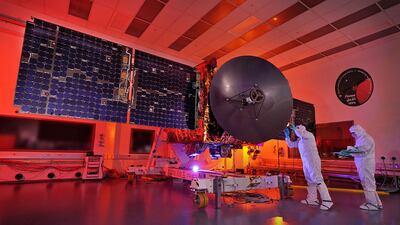
• The final version of UAE's Hope spacecraft, which launched to space on July 20. Courtesy: Dubai Media Office
    The final version of UAE's Hope spacecraft, which launched to space on July 20. Courtesy: Dubai Media Office
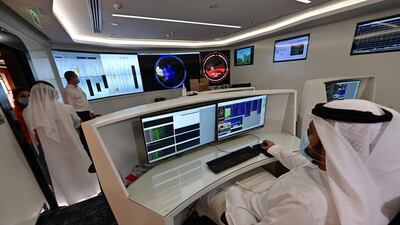
  • The operations control centre at Mohammed bin Rashid Space Centre in Dubai. Antonie Robertson / The National
    The operations control centre at Mohammed bin Rashid Space Centre in Dubai. Antonie Robertson / The National
  • The Hope probe has three scientific instruments. This is the Emirates Mars Infrared Spectrometre, which will measure the global distribution of dust, ice clouds, water vapour and the temperature of the Martian atmosphere. All photos courtesy of MBRSC
    The Hope probe has three scientific instruments. This is the Emirates Mars Infrared Spectrometre, which will measure the global distribution of dust, ice clouds, water vapour and the temperature of the Martian atmosphere. All photos courtesy of MBRSC
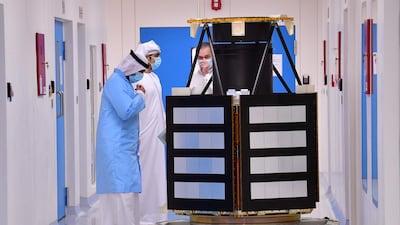
  • Engineers had installed the Mars infrared spectrometre on the Hope probe at Mohammed bin Rashid Space Centre' clean room
    Engineers had installed the Mars infrared spectrometre on the Hope probe at Mohammed bin Rashid Space Centre' clean room
  • The Emirates Eploration Imager will take high-resolution images of Mars and will study its lower atmosphere
    The Emirates Eploration Imager will take high-resolution images of Mars and will study its lower atmosphere
  • The exploration imager has an autonomous digital camera and will send back high-resolution colour images
    The exploration imager has an autonomous digital camera and will send back high-resolution colour images
  • The Emirates Mars Ultraviolet Spectrometer will study the upper atmosphere and traces of oxygen and hydrogen
    The Emirates Mars Ultraviolet Spectrometer will study the upper atmosphere and traces of oxygen and hydrogen
  • Emirati engineers have worked with three American universities for this mission
    Emirati engineers have worked with three American universities for this mission

UAE's mission to Mars is on time and on budget


Sarwat Nasir
  • English
  • Arabic

The relatively low cost of the UAE’s mission to Mars will help pave the way for the country to explore other planets in the future, experts have said.

The UAE has spent $200 million on the Hope probe, from its conception right the way through to its design, construction and launch.

Similar missions to the Red Planet have cost far more. Nasa's Maven orbiter, for example, which was sent to Mars in 2013, cost Dh2.46 billion ($671m).

“The UAE government was adamant in finding a relatively low mission cost and at the same time completing in a shorter time,” said Sarah Al Ameri, president of the UAE Space Agency and deputy project manager of the Emirates Mars Mission (EMM).

Ms Al Ameri said the EMM team had been given a strict budget by the government and a timeline of just six years to complete the launch of the Hope probe.

The final version of the UAE's Mars Hope probe has two solar panels that help power its systems. Courtesy: Emirates Mars Mission

Other countries have previously taken a decade to design and build more complex spacecraft and their necessary operating systems.

“To be able to meet those two constraints – the budget and timeline – we re-looked at how to design such missions and reduce design complexity,” said Ms Al Amiri.

“If you look at other missions, they have a multitude of science objectives that they would like to address, and at the same time they have several suites of instruments that go on board.

"To reduce the complexity, we had three instruments.”

The Hope probe aims to study the lower and upper atmosphere of Mars by using three key pieces of equipment.

Its infrared spectrometer will measure the distribution of dust, ice clouds and water vapour while a sophisticated camera will take high-resolution images of the planet.

An ultraviolet spectrometer will also study the upper atmosphere of the Red Planet and record traces of oxygen and hydrogen.

Other spacecraft launched to explore Mars in recent years include Nasa's Mars Reconnaissance Orbiter in 2005 and the Trace Gas Orbiter, a joint project by Russia's space agency and the European Space Agency that was launched in 2016.

The UAE’s Hope probe will be placed in a much higher orbit than previous craft, however, allowing it to capture broader images. Scientists calculate it will be able to make a full circle of Mars every 55 hours.

“It will give us a full understanding on how atmospheres evolve and how the weather systems impact atmospheric evolutions,” said Ms Al Amiri.

“This is very important for scientists to better understand climate change on Earth and to find all of the leading causes of it.”

The UAE has worked with three leading US universities - the University of Colorado, Arizona State University and University of California, Berkeley - to help develop the probe and its instruments.

Ms Al Amiri said the Emirates had worked with its partners to ensure the mission was cost-effective, but also that it offered the opportunity to collect substantial data on the planet.

Inside Mohammed bin Rashid Space Centre:

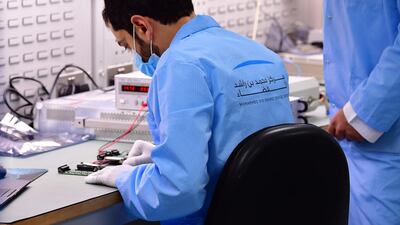
  • Technicians work at the Mohammed Bin Rashid Space Centre (MBRSC) in Dubai. MBRSC / AFP
    Technicians work at the Mohammed Bin Rashid Space Centre (MBRSC) in Dubai. MBRSC / AFP
  • An employee works at the control room of the Mars Mission at MBRSC. AFP
    An employee works at the control room of the Mars Mission at MBRSC. AFP
  • Employees work at the control room of the Mars Mission at the Mohammed Bin Rashid Space Centre. AFP
    Employees work at the control room of the Mars Mission at the Mohammed Bin Rashid Space Centre. AFP
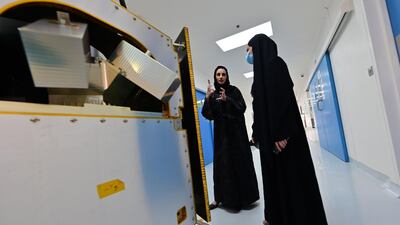
  • Engineers observe a KhalifaSat model at the Mohammed Bin Rashid Space Centre. AFP
    Engineers observe a KhalifaSat model at the Mohammed Bin Rashid Space Centre. AFP
  • An engineer walks toward a KhalifaSat model. AFP
    An engineer walks toward a KhalifaSat model. AFP
  • Scientists work at a laboratory in the Mohammed Bin Rashid Space Centre. AFP
    Scientists work at a laboratory in the Mohammed Bin Rashid Space Centre. AFP
  • Engineers observe a KhalifaSat model. AFP
    Engineers observe a KhalifaSat model. AFP
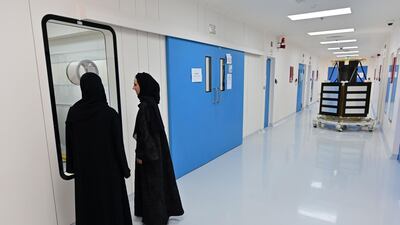
  • Engineers walk the corridors of Mohammed Bin Rashid Space Centre. AFP
    Engineers walk the corridors of Mohammed Bin Rashid Space Centre. AFP
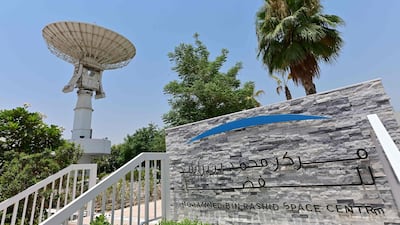
  • The entrance of the Mohammed Bin Rashid Space Centre in Dubai. AFP
    The entrance of the Mohammed Bin Rashid Space Centre in Dubai. AFP
  • The entrance of the Mohammed Bin Rashid Space Centre in Dubai. AFP
    The entrance of the Mohammed Bin Rashid Space Centre in Dubai. AFP
Landfill in numbers

• Landfill gas is composed of 50 per cent methane

• Methane is 28 times more harmful than Co2 in terms of global warming

• 11 million total tonnes of waste are being generated annually in Abu Dhabi

• 18,000 tonnes per year of hazardous and medical waste is produced in Abu Dhabi emirate per year

• 20,000 litres of cooking oil produced in Abu Dhabi’s cafeterias and restaurants every day is thrown away

• 50 per cent of Abu Dhabi’s waste is from construction and demolition

In numbers: PKK’s money network in Europe

Germany: PKK collectors typically bring in $18 million in cash a year – amount has trebled since 2010

Revolutionary tax: Investigators say about $2 million a year raised from ‘tax collection’ around Marseille

Extortion: Gunman convicted in 2023 of demanding $10,000 from Kurdish businessman in Stockholm

Drug trade: PKK income claimed by Turkish anti-drugs force in 2024 to be as high as $500 million a year

Denmark: PKK one of two terrorist groups along with Iranian separatists ASMLA to raise “two-digit million amounts”

Contributions: Hundreds of euros expected from typical Kurdish families and thousands from business owners

TV channel: Kurdish Roj TV accounts frozen and went bankrupt after Denmark fined it more than $1 million over PKK links in 2013 

if you go

The flights

Etihad and Emirates fly direct from the UAE to Seoul from Dh3,775 return, including taxes

The package

Ski Safari offers a seven-night ski package to Korea, including five nights at the Dragon Valley Hotel in Yongpyong and two nights at Seoul CenterMark hotel, from £720 (Dh3,488) per person, including transfers, based on two travelling in January

The info

Visit www.gokorea.co.uk

SPECS
%3Cp%3E%3Cstrong%3EEngine%3A%3C%2Fstrong%3E%202-litre%204-cylinder%20turbo%0D%3Cbr%3E%3Cstrong%3EPower%3A%20%3C%2Fstrong%3E268hp%0D%3Cbr%3E%3Cstrong%3ETorque%3A%20%3C%2Fstrong%3E380Nm%0D%3Cbr%3E%3Cstrong%3EPrice%3A%20%3C%2Fstrong%3EFrom%20Dh208%2C000%0D%3Cbr%3E%3Cstrong%3EOn%20sale%3A%20%3C%2Fstrong%3ENow%0D%3Cbr%3E%3C%2Fp%3E%0A
Haemoglobin disorders explained

Thalassaemia is part of a family of genetic conditions affecting the blood known as haemoglobin disorders.

Haemoglobin is a substance in the red blood cells that carries oxygen and a lack of it triggers anemia, leaving patients very weak, short of breath and pale.

The most severe type of the condition is typically inherited when both parents are carriers. Those patients often require regular blood transfusions - about 450 of the UAE's 2,000 thalassaemia patients - though frequent transfusions can lead to too much iron in the body and heart and liver problems.

The condition mainly affects people of Mediterranean, South Asian, South-East Asian and Middle Eastern origin. Saudi Arabia recorded 45,892 cases of carriers between 2004 and 2014.

A World Health Organisation study estimated that globally there are at least 950,000 'new carrier couples' every year and annually there are 1.33 million at-risk pregnancies.

Company name: Play:Date

Launched: March 2017 on UAE Mother’s Day

Founder: Shamim Kassibawi

Based: Dubai with operations in the UAE and US

Sector: Tech 

Size: 20 employees

Stage of funding: Seed

Investors: Three founders (two silent co-founders) and one venture capital fund