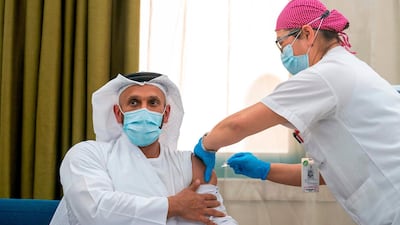
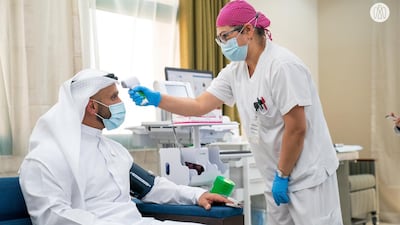
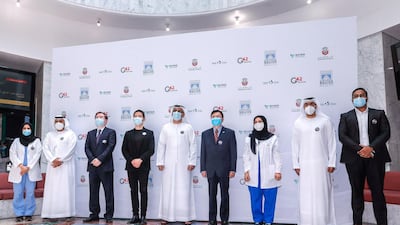
The news that Russia could approve a coronavirus vaccine for use in August has caused an international stir – but experts are not surprised the country is moving ahead fast.
Moscow officials hope their vaccine will gain approval for widespread use in the next two weeks with manufacturing to begin the following month, it was revealed in an interview with The National.
Development of the vaccine at the Gamaleya Research Institute of Epidemiology and Microbiology in the Russian capital has been financed by the government-controlled Russian Direct Investment Fund.
Prof John Oxford, co-author of the textbook Human Virology, said he was "impressed but not surprised" at how advanced the programme was.
“This is coming from the Gamaleya institute – a pretty big research institute in Moscow … They will make sure the testing is of international standards so it can be cross-licensed abroad as well as in Russia,” he said.
Like many others, the Russian vaccine programme uses existing vaccine technology tweaked for the new coronavirus.
It is based on versions of a common cold virus, called an adenovirus, genetically engineered to produce a surface protein or spike protein from the new coronavirus. This spike protein stimulates an immune response that should protect against the coronavirus.
Ian Jones, a professor of virology at the University of Reading in the UK, said the fact that the Russian vaccine was based on well-understood technology meant it was not likely to present a hazard.
“Because of all the work done on the [adenovirus] vectors, I think it’s probably safe,” he said. “I don’t see why it shouldn’t work.”
In an interview with The National, the Russian Direct Investment Fund's chief executive, Kirill Dmitriev, said he expected the vaccine to be the first of the more than 100 under development around the globe to be approved.
Mr Dmitriev said the vaccine, which he himself has been injected with, stimulated antibody production in all those it was tested on in phase 1 and 2 clinical trials.
The World Health Organisation’s latest update – released this week – indicates there are 25 potential vaccines undergoing clinical trials, plus 139 in preclinical evaluation.
Of those already in clinical trials, just four – one American, one British and two Chinese – are listed as already having reached stage 3 trials, which analyse real-world effectiveness.
One, developed by the University of Oxford, began phase 3 clinical trials in the UK in May, while an American vaccine, from the Massachusetts-based biotechnology company Moderna, started them this week.
One of the two Chinese vaccines, developed by the Wuhan Institute of Biological Products and the pharmaceutical company Sinopharm, is due to undergo phase 3 clinical trials in the Emirates through a tie-up with the UAE technology company Group 42. If the trials are successful, this vaccine could be manufactured in the UAE.
Phase 3 clinical trials of the Gamaleya institute’s vaccine are starting soon in Russia, the UAE and other nations, and reports indicate the aim is to secure approval by as early as August 10, allowing thousands of medical staff to be vaccinated. Large-scale vaccinations of the population could begin the following month.
Phase 3 trials are typically carried out in a few countries is to ensure testing is carried out on a genetically diverse range of people. Authorities in the UAE have said the Emirates is an ideal location for trials due to its diverse population.
As many as 30 million doses could reportedly be produced in Russia by the end of this year, with manufacturing capacity abroad reaching 170m thanks to agreements with five countries.
Another Russian-developed vaccine, from Siberia’s Vector institute, began clinical trials this week when the first volunteer was injected with the medicine.
Availability of coronavirus vaccines will vary from country to country depending in part on investments made by national governments or institutions such as the European Union.
Hundreds of millions of doses of as-yet-unapproved vaccines have already been bought up by authorities in developed countries, which have also funded research and invested in biotechnology companies to maximise their access to stocks as soon as manufacturing begins.
Production of the Gamaleya institute vaccine could take place in the UAE as well as Russia.
“One of the things Russia does have, and a number of ex-Soviet countries have, are things like manufacturing facilities. They’ve not been prioritised in recent years, but nevertheless, they exist,” said Prof Jones.
Whichever vaccine ends up as the first to be approved and manufactured at scale, observers are pleased at the speed at which the scientific community has reacted to the pandemic.
“You can imagine things happening quite quickly with some of these [vaccines],” said Prof Oxford, an emeritus professor of virology at the University of London.
“You can say … ‘We’ve got some immune response, let’s get moving.’ I would be content to have any of them. I’ve been very pleased and impressed at the speed at which things have been moving.”

A new relationship with the old country
Treaty of Friendship between the United Kingdom of Great Britain and Northern Ireland and the United Arab Emirates
The United kingdom of Great Britain and Northern Ireland and the United Arab Emirates; Considering that the United Arab Emirates has assumed full responsibility as a sovereign and independent State; Determined that the long-standing and traditional relations of close friendship and cooperation between their peoples shall continue; Desiring to give expression to this intention in the form of a Treaty Friendship; Have agreed as follows:
ARTICLE 1 The relations between the United Kingdom of Great Britain and Northern Ireland and the United Arab Emirates shall be governed by a spirit of close friendship. In recognition of this, the Contracting Parties, conscious of their common interest in the peace and stability of the region, shall: (a) consult together on matters of mutual concern in time of need; (b) settle all their disputes by peaceful means in conformity with the provisions of the Charter of the United Nations.
ARTICLE 2 The Contracting Parties shall encourage education, scientific and cultural cooperation between the two States in accordance with arrangements to be agreed. Such arrangements shall cover among other things: (a) the promotion of mutual understanding of their respective cultures, civilisations and languages, the promotion of contacts among professional bodies, universities and cultural institutions; (c) the encouragement of technical, scientific and cultural exchanges.
ARTICLE 3 The Contracting Parties shall maintain the close relationship already existing between them in the field of trade and commerce. Representatives of the Contracting Parties shall meet from time to time to consider means by which such relations can be further developed and strengthened, including the possibility of concluding treaties or agreements on matters of mutual concern.
ARTICLE 4 This Treaty shall enter into force on today’s date and shall remain in force for a period of ten years. Unless twelve months before the expiry of the said period of ten years either Contracting Party shall have given notice to the other of its intention to terminate the Treaty, this Treaty shall remain in force thereafter until the expiry of twelve months from the date on which notice of such intention is given.
IN WITNESS WHEREOF the undersigned have signed this Treaty.
DONE in duplicate at Dubai the second day of December 1971AD, corresponding to the fifteenth day of Shawwal 1391H, in the English and Arabic languages, both texts being equally authoritative.
Signed
Geoffrey Arthur Sheikh Zayed
Who's who in Yemen conflict
Houthis: Iran-backed rebels who occupy Sanaa and run unrecognised government
Yemeni government: Exiled government in Aden led by eight-member Presidential Leadership Council
Southern Transitional Council: Faction in Yemeni government that seeks autonomy for the south
Habrish 'rebels': Tribal-backed forces feuding with STC over control of oil in government territory
Important questions to consider
1. Where on the plane does my pet travel?
There are different types of travel available for pets:
- Manifest cargo
- Excess luggage in the hold
- Excess luggage in the cabin
Each option is safe. The feasibility of each option is based on the size and breed of your pet, the airline they are traveling on and country they are travelling to.
2. What is the difference between my pet traveling as manifest cargo or as excess luggage?
If traveling as manifest cargo, your pet is traveling in the front hold of the plane and can travel with or without you being on the same plane. The cost of your pets travel is based on volumetric weight, in other words, the size of their travel crate.
If traveling as excess luggage, your pet will be in the rear hold of the plane and must be traveling under the ticket of a human passenger. The cost of your pets travel is based on the actual (combined) weight of your pet in their crate.
3. What happens when my pet arrives in the country they are traveling to?
As soon as the flight arrives, your pet will be taken from the plane straight to the airport terminal.
If your pet is traveling as excess luggage, they will taken to the oversized luggage area in the arrival hall. Once you clear passport control, you will be able to collect them at the same time as your normal luggage. As you exit the airport via the ‘something to declare’ customs channel you will be asked to present your pets travel paperwork to the customs official and / or the vet on duty.
If your pet is traveling as manifest cargo, they will be taken to the Animal Reception Centre. There, their documentation will be reviewed by the staff of the ARC to ensure all is in order. At the same time, relevant customs formalities will be completed by staff based at the arriving airport.
4. How long does the travel paperwork and other travel preparations take?
This depends entirely on the location that your pet is traveling to. Your pet relocation compnay will provide you with an accurate timeline of how long the relevant preparations will take and at what point in the process the various steps must be taken.
In some cases they can get your pet ‘travel ready’ in a few days. In others it can be up to six months or more.
5. What vaccinations does my pet need to travel?
Regardless of where your pet is traveling, they will need certain vaccinations. The exact vaccinations they need are entirely dependent on the location they are traveling to. The one vaccination that is mandatory for every country your pet may travel to is a rabies vaccination.
Other vaccinations may also be necessary. These will be advised to you as relevant. In every situation, it is essential to keep your vaccinations current and to not miss a due date, even by one day. To do so could severely hinder your pets travel plans.
Source: Pawsome Pets UAE
UPI facts
More than 2.2 million Indian tourists arrived in UAE in 2023
More than 3.5 million Indians reside in UAE
Indian tourists can make purchases in UAE using rupee accounts in India through QR-code-based UPI real-time payment systems
Indian residents in UAE can use their non-resident NRO and NRE accounts held in Indian banks linked to a UAE mobile number for UPI transactions
Ten tax points to be aware of in 2026
1. Domestic VAT refund amendments: request your refund within five years
If a business does not apply for the refund on time, they lose their credit.
2. E-invoicing in the UAE
Businesses should continue preparing for the implementation of e-invoicing in the UAE, with 2026 a preparation and transition period ahead of phased mandatory adoption.
3. More tax audits
Tax authorities are increasingly using data already available across multiple filings to identify audit risks.
4. More beneficial VAT and excise tax penalty regime
Tax disputes are expected to become more frequent and more structured, with clearer administrative objection and appeal processes. The UAE has adopted a new penalty regime for VAT and excise disputes, which now mirrors the penalty regime for corporate tax.
5. Greater emphasis on statutory audit
There is a greater need for the accuracy of financial statements. The International Financial Reporting Standards standards need to be strictly adhered to and, as a result, the quality of the audits will need to increase.
6. Further transfer pricing enforcement
Transfer pricing enforcement, which refers to the practice of establishing prices for internal transactions between related entities, is expected to broaden in scope. The UAE will shortly open the possibility to negotiate advance pricing agreements, or essentially rulings for transfer pricing purposes.
7. Limited time periods for audits
Recent amendments also introduce a default five-year limitation period for tax audits and assessments, subject to specific statutory exceptions. While the standard audit and assessment period is five years, this may be extended to up to 15 years in cases involving fraud or tax evasion.
8. Pillar 2 implementation
Many multinational groups will begin to feel the practical effect of the Domestic Minimum Top-Up Tax (DMTT), the UAE's implementation of the OECD’s global minimum tax under Pillar 2. While the rules apply for financial years starting on or after January 1, 2025, it is 2026 that marks the transition to an operational phase.
9. Reduced compliance obligations for imported goods and services
Businesses that apply the reverse-charge mechanism for VAT purposes in the UAE may benefit from reduced compliance obligations.
10. Substance and CbC reporting focus
Tax authorities are expected to continue strengthening the enforcement of economic substance and Country-by-Country (CbC) reporting frameworks. In the UAE, these regimes are increasingly being used as risk-assessment tools, providing tax authorities with a comprehensive view of multinational groups’ global footprints and enabling them to assess whether profits are aligned with real economic activity.
Contributed by Thomas Vanhee and Hend Rashwan, Aurifer
More on Quran memorisation:
The specs
- Engine: 3.9-litre twin-turbo V8
- Power: 640hp
- Torque: 760nm
- On sale: 2026
- Price: Not announced yet
Heather, the Totality
Matthew Weiner,
Canongate
More from Neighbourhood Watch:
Volvo ES90 Specs
Engine: Electric single motor (96kW), twin motor (106kW) and twin motor performance (106kW)
Power: 333hp, 449hp, 680hp
Torque: 480Nm, 670Nm, 870Nm
On sale: Later in 2025 or early 2026, depending on region
Price: Exact regional pricing TBA
%20Ramez%20Gab%20Min%20El%20Akher
%3Cp%3E%3Cstrong%3ECreator%3A%3C%2Fstrong%3E%20Ramez%20Galal%3C%2Fp%3E%0A%3Cp%3E%3Cstrong%3EStarring%3A%3C%2Fstrong%3E%20Ramez%20Galal%3C%2Fp%3E%0A%3Cp%3E%3Cstrong%3EStreaming%20on%3A%20%3C%2Fstrong%3EMBC%20Shahid%3C%2Fp%3E%0A%3Cp%3E%3Cstrong%3ERating%3A%20%3C%2Fstrong%3E2.5%2F5%3C%2Fp%3E%0A
GIANT REVIEW
Starring: Amir El-Masry, Pierce Brosnan
Director: Athale
Rating: 4/5