


The growing prospect of a coronavirus vaccine may be raising hopes that life can return to normal, but testing individuals for infection continues to be important in preventing the pathogen’s spread.
Researchers in the UAE are among many around the globe to have developed new, rapid tests that can, in the case of one created at Khalifa University, give results in less than an hour.
While rapid tests are being increasingly used in screening programmes, the test of choice until now has typically been a longer RT-PCR test, or reverse transcriptase polymerase chain reaction test, a name that refers to the lab procedures involved in analysing samples.
The hidden problems with false positives and negatives
As is typical for laboratory tests, RT-PCR tests are not 100 per cent accurate, with one risk being false positives, when people are told they have the virus when they do not, which may cause them to isolate unnecessarily.
False positives can happen because of the methods used, according to Prof Anthony Brookes, bioinformatics group leader at the University of Leicester in the UK.
Usually beginning with a nasal or throat swab and looking for viral RNA, the test involves repeated cycles in which the genetic material is multiplied.
As many as 35 or 40 cycles may be carried out, which Prof Brookes said is too many because it increases the chance of a positive result even without coronavirus RNA being present in the original sample.
“At this level you would find things just because of the chemistry,” he said.
Such problems may reduce the test’s specificity – the proportion of people without the disease who test negative.
Another concern is a person testing positive because their sample contains coronavirus RNA even though they are not actually infectious. They may have fought off an infection but still host remnants of viral genetic material.
The opposite problem is false negatives, where people with the virus are told they do not have it, potentially resulting in infectious individuals failing to self-isolate.
A report by American and British doctors published this year in the British Medical Journal reported false negative results of between 2 per cent and 29 per cent for RT-PCR tests.
The test’s sensitivity – the proportion of people with the disease who test positive – may depend on where a swab is taken.
Research on people in Abu Dhabi who had tested positive for the coronavirus found that individuals with symptoms were more likely than those without symptoms to test positive on later tests.
What is more effective – mass testing or targeted testing of high-risk populations?
A possible lack of accuracy is one reason why some researchers argue against mass testing, where the authorities test as many people as possible, symptomatic or not.
It was carried out in China, Slovakia and, more recently, the UK, where it is being rolled out after trials in Liverpool in the north-west of England.
On a smaller scale, it is used to screen people such as incoming travellers.
Dr Angela Raffle, an honorary senior lecturer in population health sciences at the University of Bristol in the UK, views mass testing as “a really bad use of resources” and said targeted testing of high-risk populations, coupled with effective contact tracing, is more effective.
“If you just say, ‘We’ve got 14 mass testing centres, come and have a test’, the chances of making any difference to transmission is vanishingly small,” she said.
Instead of mass testing, she suggested rigorous test, trace and isolate programmes centred on people who are symptomatic and their contacts.
Testing focused on people with a high likelihood of being infected will, she said, have greater predictive value and a more favourable ratio of true positives to false positives.
The Liverpool trials, part of a wider planned screening operation called Operation Moonshot, which will cost tens of billions of pounds, use a lateral flow test on a saliva sample instead of the RT-PCR test.

Looking for particular viral proteins or antigens, it gives results in just 30 minutes but may fail to identify some infected individuals because the sensitivity, while 76.8 per cent in ideal conditions, could be as low as 56 per cent in field settings, according to some doctors.
The British government said the lateral flow test identified more than 95 per cent of people who had high levels of the virus in their bodies and were most likely to infect others.
Tying in with this, research in Germany on seven other rapid antigen tests published this week found that five could detect 95 per cent of samples with high viral levels.
The programme in Liverpool is being assisted by the University of Liverpool, which is carrying out statistical analysis.
Prof Louise Kenny, executive pro-vice-chancellor of the university, said mass testing is most effective in places with relatively high coronavirus prevalence, such as Liverpool.
But for it to be effective, she said people should not abandon measures such as social distancing, hand washing and mask wearing.
In countries like New Zealand, where there are very few cases, there would be “absolutely no point” in mass testing.
“I believe there’s a certain threshold where mass testing is of very little value because you’re searching for a needle in a haystack,” Prof Kenny said.
The lateral flow methods used in Liverpool create few false positives, she said, with hundreds of people identified in the city who were asymptomatic but positive in the lateral flow test – and therefore potentially infectious.
Prof Kenny said mass testing can also be useful for particularly at-risk communities, such as frontline healthcare workers, people in care homes, or students.
-
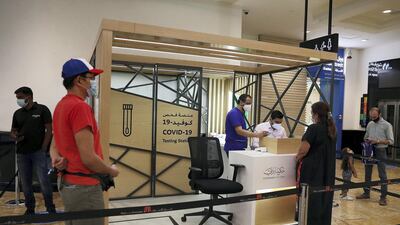
Covid-19 PCR testing stations inside three Majid Al Futtaim malls in Dubai are now open to public. All photos by Pawan Singh / The National -
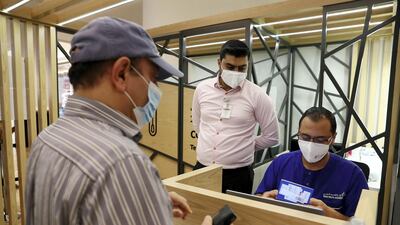
Testing stations are also open in City Centre Deira and Mirdif City Centre. At Mall of the Emirates, a single booth is placed near an entrance, where certified staff give swab tests -
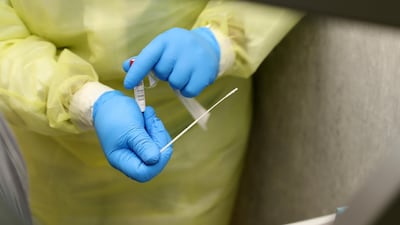
PCR tests costs Dh150 and are only for those who need it for travel or non-medical purposes. Members of public with Covid-19 symptoms, including fever or cough, should not get tested at the mall. -
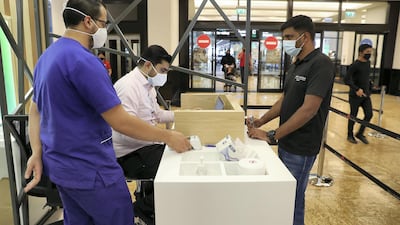
The test is free for people aged 50 and above, those with chronic illnesses, Emiratis and GCC nationals, people with disabilities and anyone with an Emirati mother. -
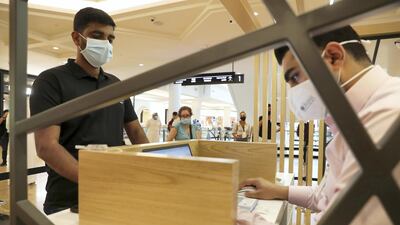
The stations were introduced as part of UAE’s efforts to increase testing across the country. -
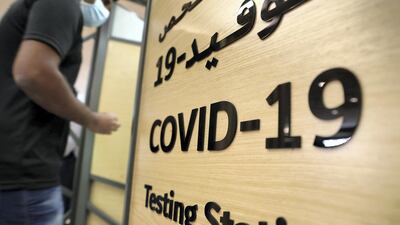
A PCR testing centre opens at Mall of the Emirates in Dubai. -
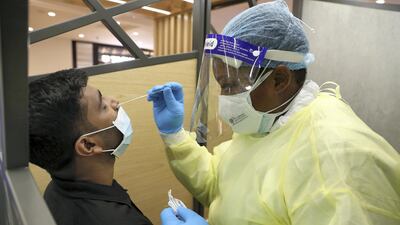
Bookings can be made via the Dubai Health Authority mobile app or by calling 800342. Walk-ins are no longer accepted


In a closed institution, such as a university, it is easier to deliver what Dr Raffle describes as a “systematic approach” when testing.
“You absolutely have to be certain of your test performance. You need to be clear it’s not a test for infectiousness,” she said.
Even in such circumstances, Dr Raffle said there were potential downsides to testing, because people with positive tests may isolate even though they are not infectious, perhaps because the test picked up the remnants of an old infection. There may also be a risk of infectious people testing negative.
At New York University Abu Dhabi, Dr Xin Xie, a research scientist, and his colleagues developed a test that is more sensitive than the standard RT-PCR test, so is better at identifying people with a low viral load.
“I believe our method can significantly reduce the rate of false negatives,” he said.
“About 18 per cent of negative samples have been detected positive with our method.
“In our community, most of the people are asymptomatic; they don’t show symptoms of any infection ... we need a very sensitive method because asymptomatic carriers can have very low viral load that could be missed by the regular methods.”
Looking for viral RNA, the test is more sensitive because of a preamplification step and by using it the university can, he said, continue to function through the pandemic.
The laboratory steps mean that false positives are not a problem with the method, which gives a result in five to six hours and is being used to test people at the university every two weeks.
“I think our screening programme, together with our method, helps the university a lot, especially during the summer time,” Dr Xie said.
“We can have a limited number of people coming to work because we have the facility to test them."

