


A traditional Emirati dhow that was hand-built on Dubai Creek has been named the biggest of its kind.
Guinness World Records formally recognised the Obaid, which at 91-metres is almost the length of a football pitch, on Wednesday.
It was named after Obaid Jumaa bin Majid Al Falasi, an Emirati shipbuilder who began an apprenticeship at the age of 9 in the mid-1940s.
As The National reported in 2018, when work got under way, his descendants sought to celebrate their family's and Emiratis' seafaring traditions.
According to Obaid's son, Majid Obaid Al Falasi, 52, it was not prestige that drove him to build the largest dhow, he did it for his late father.
"Our forefathers were divers, our ancestors worked in the sea and my own father pursued this craftsmanship for almost all his life," said Mr Al Falasi.
"This is a gratitude to my father, and my country which always aims for the forefront positions.
"We tried to get the longest pieces of log available. We are born as dhow builders and can build dhows using other material, but wood keeps its identity. This achievement is just the inevitable continuation for building dhows in the world."
The majestic dhow measures 91.47 metres in length and 20.41 metres in width.
It stands at a height of 11 metres and weighs 2,500 tonnes. It has been built from material sourced locally and abroad and will have an estimated load capacity of up to 6,000 tonnes.
The vessel is powered by two 1,850-horsepower engines and will be used to transport cargo from the UAE to Yemen, Somalia, Sudan, Egypt, Kenya, Pakistan, India and possibly Iraq.
“At a speed of 14 knots, it will be enough for this dhow to operate and achieve its desired ROI [return on investment]," Mr Al Falasi said.
"Who knows, you might see this dhow docking at different ports all around the world.”
-

From left to right, Majid Obeid Bin Suloom Al Falasi, with son Obaid Majid Obaid Bin Majid Al Falasi and brother Ahmed Al Falasi, pictured in July 2018. All photos by Chris Whiteoak / The National -

The dhow is 91 metres long and 20 metres wide -

The vessel was constructed in the Al Jadaf area of Dubai Creek, near Festival City -

Traditional methods were used to construct the dhow and materials were locally-sources and important where needed -
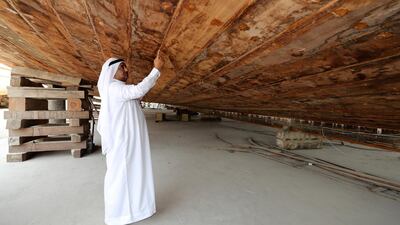
Majid Obeid Bin Suloom Al Falasi inspects the hull during construction in the summer of 2018. Chris Whiteoak / The National -

The Al Falasi family built the mighty vessel in honour of their father and grandfather, an Emirati shipbuilder who began work as a child in the 1940s -

Obaid Juma bin Suloom Establishment dhow building company on the Dubai Creek. Chris Whiteoak / The National -
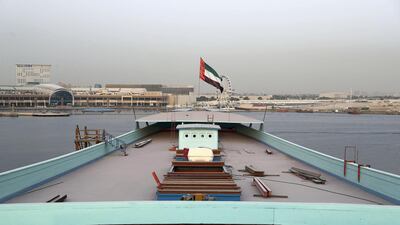
Obaid Juma bin Suloom Establishment dhow building company on the Dubai Creek. Chris Whiteoak / The National -

Obaid Juma bin Suloom Establishment dhow building company on the Dubai Creek. Chris Whiteoak / The National -

An archival picture of Obaid Majid Jumaa Abdullah bin Majid Al Falasi. Chris Whiteoak/The National



