
When Sheikh Zayed became President of the UAE in 1971, one of his first acts was to ensure his “children” would live comfortably for ever.
His dedication to Emiratis by seeking to provide for them all they could ever want, as a father would to his children, earned him the nickname Baba Zayed.
From free housing and education to subsidised food, Sheikh Zayed built the UAE into a welfare state to support his country’s citizens.
When asked if he worried about “spoiling Emiratis” or causing them to become too dependent on him he said “my wealth is for my children”.
His aptitude for giving was said to be so great that the Islamic anniversary of his death, Ramadan 19, was declared Zayed Humanitarian Day in the UAE – to encourage charitable giving among future generations.
-
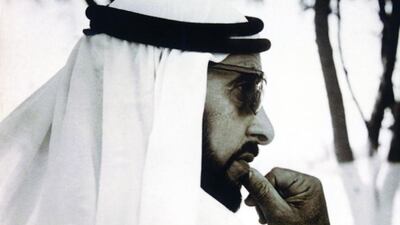
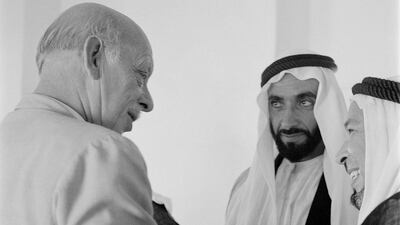
Sheikh Zayed, the Father of the Nation, left an impact on all who met him. National Archives -
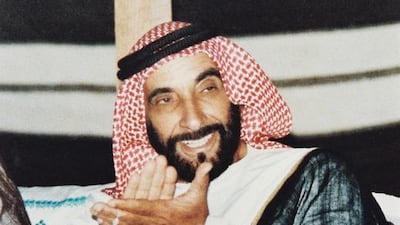
Sheikh Zayed was renowned for championing humanitarian causes. Courtesy Aletihad -
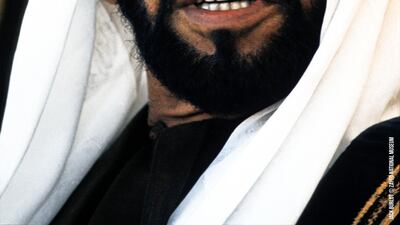
Close up shot of Sheikh Zayed -Credit Jack Burlot © Zayed National Museum -
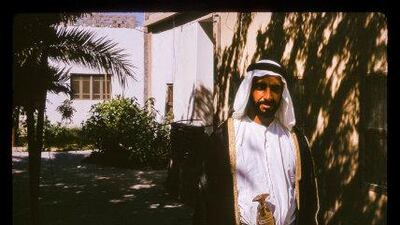
Sheikh Zayed at Qasr Al Hosn in the shade of palm trees, 1966. Courtesy Nick Cochrane-Dyet -
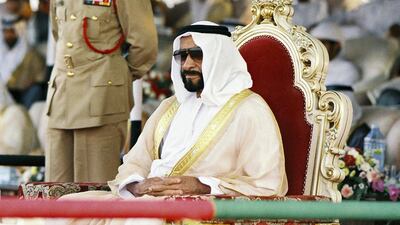
Sheikha Shamma bint Sultan bin Khalifa Al Nahyan reflected on the environmental legacy of her great-grandfather, Sheikh Zayed. Courtesy Al Ittihad -
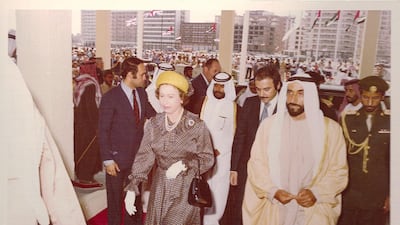
Sheikh Zayed and Queen Elizabeth II at the 1979 inauguration of Le Meridien Abu Dhabi. Courtesy Le Meridien -

Sheikh Zayed with the then South Korean prime minister Lee Han-Dong in Abu Dhabi in 2001. AFP Photo / Wam -
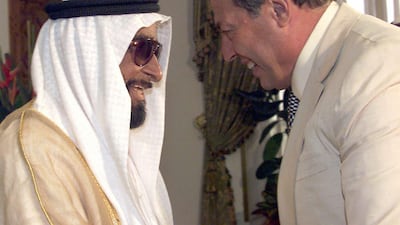
Sheikh Zayed, the Founding Father, left, welcomes Lebanese president Emile Lahoud in Abu Dhabi, in April 2000. AFP -
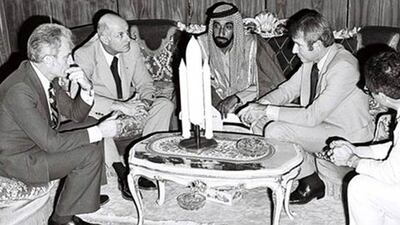
The UAE's Founding Father Sheikh Zayed meets with three American astronauts in February 1976. -
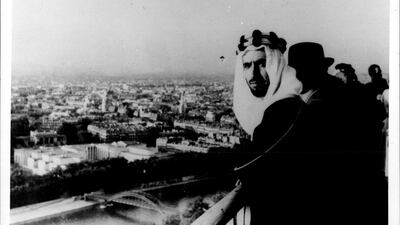
Sheikh Zayed on the Eiffel Tower in 1951 -
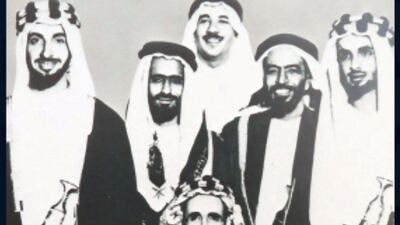
The Abu Dhabi delegation: centre (sitting) the then Ruler of Abu Dhabi, Sheikh Shakhbut bin Sultan Al Nahyan. From left to right, his brother Sheikh Zayed bin Sultan Al Nahyan, the then Ruler’s Representative in Abu Dhabi’s Eastern Region, Khalifa bin Yousef, Victor Hashem, Abdullah bin Ghanoum and Sheikh Saeed bin Shakhbut Al Nahyan, son of Sheikh Shakhbut.The late Victor Hashem was a close companion to the Sheikhs. Courtesy The Victor Hashem Family Collection -

Hollywood production house STX Films will be making a biography of the late Sheikh Zayed, who was the Founding Father of the UAE and a world statesman. Getty -

Sheikh Zayed signs the Federation Agreement on December 2, 1971, creating the UAE. On his left is Sheikh Rashid, then Ruler of Dubai. Behind them are Mehdi Al Tajir, Sheikh Maktoum bin Rashid and Sheikh Hamdan bin Rashid. -
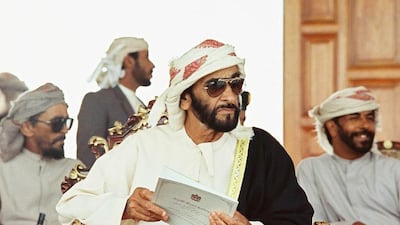
Six Z number plates paying homage to the life of Sheikh Zayed have helped raise vital charity cash. -
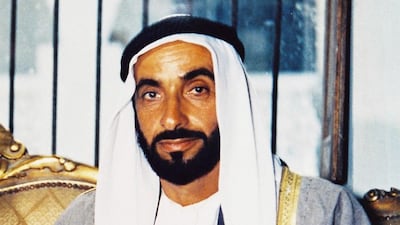
Sheikh Zayed, the founding father of the UAE. Photo courtesy Al Ittihad -
Sheikh Zayed meets with a senior official from BP in late 1957, as the concession prepares to begin drilling for oil


On the 15th anniversary of his death on Friday, Emiratis remember the work of their “father” to transform the UAE from a barren desert into a thriving metropolis.
Mohammed Al Ameri, a former army general, said when Sheikh Zayed first became Ruler of Abu Dhabi, and then the UAE, the country was still developing, as were its people.
Mr Al Ameri was a pupil when he first met Sheikh Zayed but would go on to become part of the prince’s private guard.
“There was no education, no infrastructure or means to raise and develop nationals educationally and financially but he began to educate them without affecting their customs or moving them,” said Mr Al Ameri, who is now a Federal National Council member.
Sheikh Zayed famously said people are a country’s greatest asset, then sought to invest in those people by opening schools near Emirati communities – even in remote areas such as Sila and Ghyathi in Al Dhafra region of Abu Dhabi.
“He established schools in the desert without moving Emiratis to other places at a time when nationals didn’t know what education was so that parents could send their children to school.
“He began building the human being. He gave each Emirati a farm so that they could sustain themselves. He dug wells, levelled the land, and built the infrastructure and roads,” Mr Al Ameri said.
Each Emirati was entitled to land and a farm. Those who did not want or have a farm where given commercial plots on which to build instead.
Emiratis with farms were given seeds to plant and the municipality would supervise the growth of their produce, which they in turn would sell on their behalf and return the profits.
“Sheikh Zayed ruled the people while he was among them, not from the top. He shared their happiness, their sorrows and got to know their needs while he was among them.”

Yousef Al Hamadi, 57, began falcon hunting with Sheikh Zayed when he was 18 years old, hired to help keep the Founding Father’s birds. He remained close to Sheikh Zayed until his final days.
“He always asked Emiratis what they needed, he didn’t want for them to ask him for anything,” he said.
He recalls when he was young Sheikh Zayed asking him if he was married.
“When you decide to get married, tell me so I can help you,” the Ruler told him. “He asked me if I had a house and when I said ‘no’, he lifted my chin up and said as soon as the houses are ready, he would give me one. He loved to help everyone, everywhere,” said Mr Al Hamadi, who lives in Al Ain.

“We would see a house in the desert and he would tell us to go and ask them if they needed anything. He was there for Emiratis and non-Emiratis.”
Mr Al Hamadi said Sheikh Zayed had more than 200 falcons but would only use three to hunt with. When asked why he did not give the rest away to cut down on costs Sheikh Zayed said: “See how many people benefit from caring for these falcons. The person who buys them, sells them, trains them and feeds them and how many people these individuals are supporting.”
“He wanted people to benefit out of everything, even his hobbies,” Mr Al Hamadi said.

Businessman Saddque Al Khaja, 76, worked as a translator at Qasr Al Hosn.
He said the Founding Father would constantly ask his people if they needed anything.
“There was nothing we needed. We were all his children. He never differentiated between the different tribes and nationalities,” Mr Al Khaja said.

Sheikh Zayed’s dedication to providing benefits for Emiratis has persisted to this day with the governments of each emirate providing social welfare to their citizens.
In Abu Dhabi, it has culminated in a vision of the Founding Father’s son, Sheikh Mohamed bin Zayed, Crown Prince of Abu Dhabi and Deputy Supreme Commander of the Armed Forces, to introduce sweeping reforms aimed at improving the overall quality of life in the capital.
It includes a social benefit scheme to support low-income Emiratis, offering housing support, free health care at private and government hospitals, and subsidies for food and services to those who are eligible – carrying on the legacy put in place by Sheikh Zayed.

