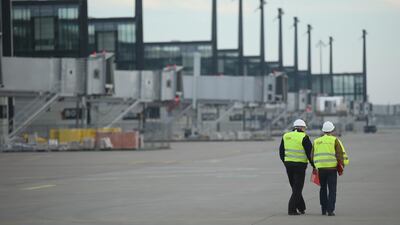
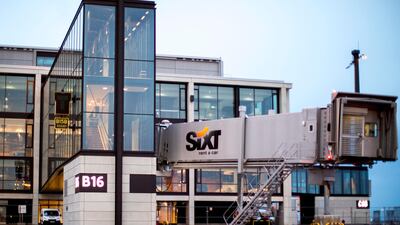
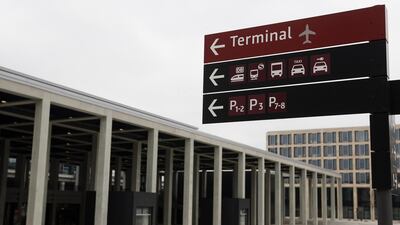
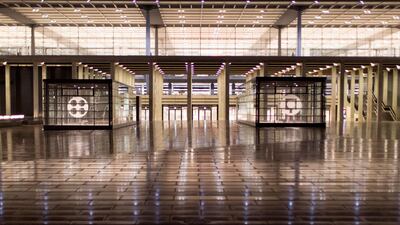
Proximity to the city, drop off at departure gates and on the plane within half an hour of arriving. It sounds like a dream.
This is what Berlin’s Tegel Airport offered when its iconic hexagonal terminal opened in 1974.
It was a triumph of function and passenger efficiency.
Tegel cut through the Cold War gloom to represent the jet set age of the future but on November 8, it closes for good.
Tegel’s long goodbye has prompted an outpouring of nostalgia among Berliners. The relic has become part of the city’s identity, representing freedom in a time of blockades, the Berlin Wall and superpower rivalry.
This was Germany's first drive-in airport. It was all utterly cinematic
It has a history stretching back about 100 years. Tegel originally hosted Prussian airships and during the 1930s, a team under Wernher von Braun used the site for early rocket experiments.
A modern runway opened in 1948 to help with the Berlin airlift and Tegel as we know it was born.
But Terminal A set Tegel apart. Travellers today expect long walks to departure gates through a relentless and infuriating array of shops.
Tegel’s concrete hexagon allowed passengers to pull up in a car, be dropped off at their departure gate and step onto their flight within minutes. It was a bold vision.
Terminal A was designed to get people through the airport as quickly as possible. Modern airports are doing the opposite.
Buildings that once championed flight now champion commerce.
"Tegel … [created] ballet-like interactions between cars and planes," wrote Nicky Gardner and Susanne Kries in the Hidden Europe magazine.
"The highway from the heart of Berlin sweeps northwest over grand bridges, gliding into a tunnel - with planes taxiing above - to emerge in the interior of an open hexagon where passengers could be dropped off right at their departure gate.
"This was Germany's first drive-in airport … It was all utterly cinematic."
Tegel did have defects. Public transport links were poor, it struggled to cope with rising passenger numbers and modern extras such as charge points were hard to find. Arriving there – particularly in later years - really did feel like landing in the 1970s.
"I headed for the designated 'charging point' to restore my phone," wrote Financial Times business journalist Michael Skapinker, on a return visit to the airport in 2019.
“There were two wall plugs, probably originally installed for the cleaners’ Hoovers.”
Tegel was also creaking under the rising passenger numbers. Designed to handle about 2.5 million passengers a year, around 24 million people used the airport last year.
The addition of terminals that felt like large warehouses did not help. It survived over the past few years only because of delays to Berlin Brandenburg, which finally opens on Saturday.
Yet Tegel outlived Tempelhof, one of Europe’s famed pre-World War II airports and base for the Berlin airlift. It closed in 2008. Schonefeld, the airport of the former East Berlin, closed on Monday.
The grim Soviet-era edifice, which has now become a mere terminal at Berlin Brandenburg, evokes few of the warm memories that Tegel does.
Berliners even tried to keep Tegel open. In a non-binding vote in 2017, 56 per cent of residents voted in favour of retaining it.
The result was ignored and the site is to be redeveloped as a residential and business park. Nostalgia was not enough to save Tegel. Airports and passengers have moved on. Tegel was the future...once.
______________________
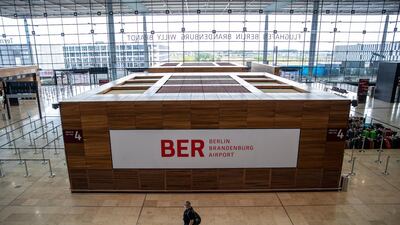
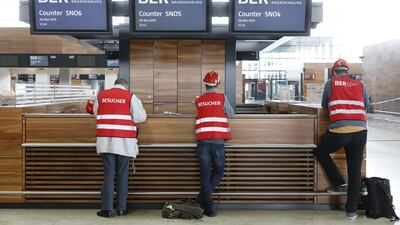
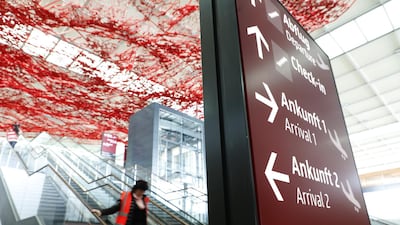
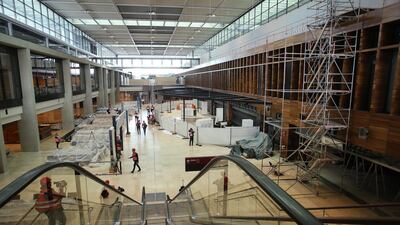
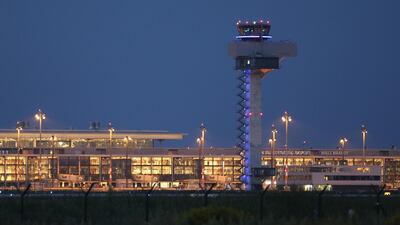
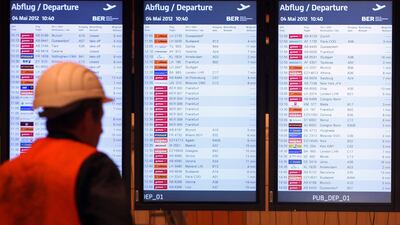
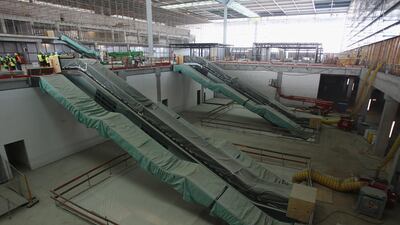
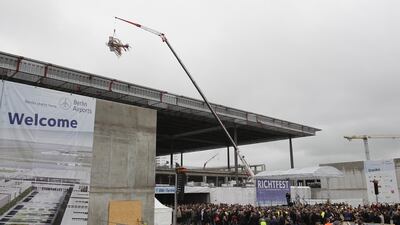
Inside Berlin's new Brandenburg airport
How does ToTok work?
The calling app is available to download on Google Play and Apple App Store
To successfully install ToTok, users are asked to enter their phone number and then create a nickname.
The app then gives users the option add their existing phone contacts, allowing them to immediately contact people also using the application by video or voice call or via message.
Users can also invite other contacts to download ToTok to allow them to make contact through the app.
More on Quran memorisation:
Ten tax points to be aware of in 2026
1. Domestic VAT refund amendments: request your refund within five years
If a business does not apply for the refund on time, they lose their credit.
2. E-invoicing in the UAE
Businesses should continue preparing for the implementation of e-invoicing in the UAE, with 2026 a preparation and transition period ahead of phased mandatory adoption.
3. More tax audits
Tax authorities are increasingly using data already available across multiple filings to identify audit risks.
4. More beneficial VAT and excise tax penalty regime
Tax disputes are expected to become more frequent and more structured, with clearer administrative objection and appeal processes. The UAE has adopted a new penalty regime for VAT and excise disputes, which now mirrors the penalty regime for corporate tax.
5. Greater emphasis on statutory audit
There is a greater need for the accuracy of financial statements. The International Financial Reporting Standards standards need to be strictly adhered to and, as a result, the quality of the audits will need to increase.
6. Further transfer pricing enforcement
Transfer pricing enforcement, which refers to the practice of establishing prices for internal transactions between related entities, is expected to broaden in scope. The UAE will shortly open the possibility to negotiate advance pricing agreements, or essentially rulings for transfer pricing purposes.
7. Limited time periods for audits
Recent amendments also introduce a default five-year limitation period for tax audits and assessments, subject to specific statutory exceptions. While the standard audit and assessment period is five years, this may be extended to up to 15 years in cases involving fraud or tax evasion.
8. Pillar 2 implementation
Many multinational groups will begin to feel the practical effect of the Domestic Minimum Top-Up Tax (DMTT), the UAE's implementation of the OECD’s global minimum tax under Pillar 2. While the rules apply for financial years starting on or after January 1, 2025, it is 2026 that marks the transition to an operational phase.
9. Reduced compliance obligations for imported goods and services
Businesses that apply the reverse-charge mechanism for VAT purposes in the UAE may benefit from reduced compliance obligations.
10. Substance and CbC reporting focus
Tax authorities are expected to continue strengthening the enforcement of economic substance and Country-by-Country (CbC) reporting frameworks. In the UAE, these regimes are increasingly being used as risk-assessment tools, providing tax authorities with a comprehensive view of multinational groups’ global footprints and enabling them to assess whether profits are aligned with real economic activity.
Contributed by Thomas Vanhee and Hend Rashwan, Aurifer
The biog
Name: Abeer Al Bah
Born: 1972
Husband: Emirati lawyer Salem Bin Sahoo, since 1992
Children: Soud, born 1993, lawyer; Obaid, born 1994, deceased; four other boys and one girl, three months old
Education: BA in Elementary Education, worked for five years in a Dubai school
Mercer, the investment consulting arm of US services company Marsh & McLennan, expects its wealth division to at least double its assets under management (AUM) in the Middle East as wealth in the region continues to grow despite economic headwinds, a company official said.
Mercer Wealth, which globally has $160 billion in AUM, plans to boost its AUM in the region to $2-$3bn in the next 2-3 years from the present $1bn, said Yasir AbuShaban, a Dubai-based principal with Mercer Wealth.
“Within the next two to three years, we are looking at reaching $2 to $3 billion as a conservative estimate and we do see an opportunity to do so,” said Mr AbuShaban.
Mercer does not directly make investments, but allocates clients’ money they have discretion to, to professional asset managers. They also provide advice to clients.
“We have buying power. We can negotiate on their (client’s) behalf with asset managers to provide them lower fees than they otherwise would have to get on their own,” he added.
Mercer Wealth’s clients include sovereign wealth funds, family offices, and insurance companies among others.
From its office in Dubai, Mercer also looks after Africa, India and Turkey, where they also see opportunity for growth.
Wealth creation in Middle East and Africa (MEA) grew 8.5 per cent to $8.1 trillion last year from $7.5tn in 2015, higher than last year’s global average of 6 per cent and the second-highest growth in a region after Asia-Pacific which grew 9.9 per cent, according to consultancy Boston Consulting Group (BCG). In the region, where wealth grew just 1.9 per cent in 2015 compared with 2014, a pickup in oil prices has helped in wealth generation.
BCG is forecasting MEA wealth will rise to $12tn by 2021, growing at an annual average of 8 per cent.
Drivers of wealth generation in the region will be split evenly between new wealth creation and growth of performance of existing assets, according to BCG.
Another general trend in the region is clients’ looking for a comprehensive approach to investing, according to Mr AbuShaban.
“Institutional investors or some of the families are seeing a slowdown in the available capital they have to invest and in that sense they are looking at optimizing the way they manage their portfolios and making sure they are not investing haphazardly and different parts of their investment are working together,” said Mr AbuShaban.
Some clients also have a higher appetite for risk, given the low interest-rate environment that does not provide enough yield for some institutional investors. These clients are keen to invest in illiquid assets, such as private equity and infrastructure.
“What we have seen is a desire for higher returns in what has been a low-return environment specifically in various fixed income or bonds,” he said.
“In this environment, we have seen a de facto increase in the risk that clients are taking in things like illiquid investments, private equity investments, infrastructure and private debt, those kind of investments were higher illiquidity results in incrementally higher returns.”
The Abu Dhabi Investment Authority, one of the largest sovereign wealth funds, said in its 2016 report that has gradually increased its exposure in direct private equity and private credit transactions, mainly in Asian markets and especially in China and India. The authority’s private equity department focused on structured equities owing to “their defensive characteristics.”
At a glance - Zayed Sustainability Prize 2020
Launched: 2008
Categories: Health, energy, water, food, global high schools
Prize: Dh2.2 million (Dh360,000 for global high schools category)
Winners’ announcement: Monday, January 13
Impact in numbers
335 million people positively impacted by projects
430,000 jobs created
10 million people given access to clean and affordable drinking water
50 million homes powered by renewable energy
6.5 billion litres of water saved
26 million school children given solar lighting
GAC GS8 Specs
Engine: 2.0-litre 4cyl turbo
Power: 248hp at 5,200rpm
Torque: 400Nm at 1,750-4,000rpm
Transmission: 8-speed auto
Fuel consumption: 9.1L/100km
On sale: Now
Price: From Dh149,900
Bangladesh tour of Pakistan
January 24 – First T20, Lahore
January 25 – Second T20, Lahore
January 27 – Third T20, Lahore
February 7-11 – First Test, Rawalpindi
April 3 – One-off ODI, Karachi
April 5-9 – Second Test, Karachi
Lexus LX700h specs
Engine: 3.4-litre twin-turbo V6 plus supplementary electric motor
Power: 464hp at 5,200rpm
Torque: 790Nm from 2,000-3,600rpm
Transmission: 10-speed auto
Fuel consumption: 11.7L/100km
On sale: Now
Price: From Dh590,000
Who's who in Yemen conflict
Houthis: Iran-backed rebels who occupy Sanaa and run unrecognised government
Yemeni government: Exiled government in Aden led by eight-member Presidential Leadership Council
Southern Transitional Council: Faction in Yemeni government that seeks autonomy for the south
Habrish 'rebels': Tribal-backed forces feuding with STC over control of oil in government territory
Pakistanis%20at%20the%20ILT20%20
%3Cp%3EThe%20new%20UAE%20league%20has%20been%20boosted%20this%20season%20by%20the%20arrival%20of%20five%20Pakistanis%2C%20who%20were%20not%20released%20to%20play%20last%20year.%20%0D%3Cbr%3E%0D%0D%0D%3Cbr%3E%3Cstrong%3EShaheen%20Afridi%20(Desert%20Vipers)%20%3C%2Fstrong%3E%0D%3Cbr%3ESet%20for%20at%20least%20four%20matches%2C%20having%20arrived%20from%20New%20Zealand%20where%20he%20captained%20Pakistan%20in%20a%20series%20loss.%20%0D%3C%2Fp%3E%0A%3Cp%3E%3Cstrong%3EShadab%20Khan%20(Desert%20Vipers)%20%3C%2Fstrong%3E%0D%3Cbr%3E%0DThe%20leg-spin%20bowling%20allrounder%20missed%20the%20tour%20of%20New%20Zealand%20after%20injuring%20an%20ankle%20when%20stepping%20on%20a%20ball.%20%0D%3C%2Fp%3E%0A%3Cp%3E%3Cstrong%3EAzam%20Khan%20(Desert%20Vipers)%20%3C%2Fstrong%3E%0D%3Cbr%3EPowerhouse%20wicketkeeper%20played%20three%20games%20for%20Pakistan%20on%20tour%20in%20New%20Zealand.%20He%20was%20the%20first%20Pakistani%20recruited%20to%20the%20ILT20.%20%0D%3C%2Fp%3E%0A%3Cp%3E%3Cstrong%3EMohammed%20Amir%20(Desert%20Vipers)%20%3C%2Fstrong%3E%0D%3Cbr%3EHas%20made%20himself%20unavailable%20for%20national%20duty%2C%20meaning%20he%20will%20be%20available%20for%20the%20entire%20ILT20%20campaign.%20%0D%3C%2Fp%3E%0A%3Cp%3E%3Cstrong%3EImad%20Wasim%20(Abu%20Dhabi%20Knight%20Riders)%20%3C%2Fstrong%3E%0D%3Cbr%3EThe%20left-handed%20allrounder%2C%2035%2C%20retired%20from%20international%20cricket%20in%20November%20and%20was%20subsequently%20recruited%20by%20the%20Knight%20Riders.%26nbsp%3B%3C%2Fp%3E%0A
Key 2013/14 UAE Motorsport dates
October 4: Round One of Rotax Max Challenge, Al Ain (karting)
October 1: 1 Round One of the inaugural UAE Desert Championship (rally)
November 1-3: Abu Dhabi Grand Prix (Formula One)
November 28-30: Dubai International Rally
January 9-11: 24Hrs of Dubai (Touring Cars / Endurance)
March 21: Round 11 of Rotax Max Challenge, Muscat, Oman (karting)
April 4-10: Abu Dhabi Desert Challenge (Endurance)
Bombshell
Director: Jay Roach
Stars: Nicole Kidman, Charlize Theron, Margot Robbie
Four out of five stars