


More than 20.5 million years of life have been lost around the world since the Covid-19 outbreak began, a study has shown.
The report, based on data from 81 countries, lays bare the devastating loss caused by the pandemic and estimated that an average of 16 years of life have been lost from each death from Covid-19.
While highlighting the scale of the pandemic, the study may underestimate years of life lost (YLL) – calculated by comparing a person's age at death with their expected lifespan – because it uses figures from early January and excludes dozens of nations.
Published in the journal Scientific Reports, the research looked at life expectancy information and country-by-country projections of total Covid-19 fatalities when considering 1,279,866 deaths.
An estimated 20,507,518 years of life were lost in the 81 countries by early January, according to the research, which was led by the Centre for Research in Health and Economics in Barcelona.
The researchers calculated that in the worst-hit nations the pandemic caused the loss of between two and nine times as many years of life as seasonal influenza.

While older people are more likely to die from Covid-19, the study indicates that younger patients have been heavily affected in actual years of life lost, because each death of a younger person exacts a greater toll in YLL.
As a result, almost one third of YLL lost – 30.2 per cent – are in people aged less than 55, while 44.9 per cent are those between 55 and 75 and 25 per cent are in over-75s.
"Most deaths at younger ages are occurring in less developed countries, due to the fact that there is a higher prevalence of comorbidities at younger ages," said the study's lead author, Dr Hector Arolas.
“The overall result (one third of YLL have been in under-55s) is in fact the combination of less developed countries, with a high proportion of YLL attributed to younger ages, and developed countries, for which most YLL are concentrated in the oldest age group (75+).”
Men have been more heavily affected, with a 44 per cent higher number of years of life lost than women, the researchers found.
The amount of years of life lost because of the pandemic is estimated to be between one quarter and half that caused by heart conditions, the world's biggest killer.
Prof John Oxford, an infectious diseases expert from the University of London not connected to the study, said he thought the effect of the pandemic could have been lessened if some countries acted more quickly to control the spread of infection.
“Countries that reacted fast have had fewer deaths overall,” he said.
“There’s a lot to be gone over when this outbreak begins to die down and we look at what happened in an objective way.
“We’re going to find some countries need a good, hard kick and others less so. We can all probably learn from each other.”
While Covid-19 has caused significant loss of life, Prof Oxford said its effect in years of life lost has been much smaller than the Spanish flu pandemic between 1918 and 1920, which killed an estimated 50 million people.
“It doesn’t even approach the Spanish flu, because most people who died were young. If you’re a young person, you’re going to lose 60 years of life,” he said.
In recent times, HIV/Aids – officially classified as a global epidemic – has killed more than 30 million people over several decades, according to UN estimates.
The Covid-19 study is based on data up to January 6, by which time World Health Organisation figures indicated that more than 1.8 million people had lost their lives from the disease, almost 50 per cent more than the total included in the study.
Since then, the pandemic has been blamed for more than half a million more deaths, bringing the global death toll to more than 2.4 million, according to WHO data.
The effect of the pandemic has varied widely between continents.
The Americas have recorded in excess of 1.1 million deaths, Europe more than 823,000 and South-East Asia about 203,000.
The WHO said that in the Eastern Mediterranean more than 140,000 people have died and in Africa the death toll is slightly above 69,000.
In the Western Pacific about 27,500 people have lost their lives.
Covid-19 deaths in the UK – in pictures
-

As the UK passes 100,000 deaths, here's a look back at some of the most poignant moments of the pandemic. Photographs and memorials for those who died during the pandemic sit outside Riverside Church in Burton-on-Trent, England. The 13 crosses include three members from the same family: Jayne Harvey, 62, died from Covid-19 after nursing her parents Keith and Jean McVicar through the virus. Getty Images -

Daniel, the son of the late Eric Stonestreet, and daughter Victoria embrace after the service for their father at Ipswich Crematorium in May. Eric Stonestreet was a British Army veteran with the 1st Battalion Royal Green Jackets. He served in Guyana, Hong Kong, Germany and did five tours of duty in Northern Ireland. Though Eric had suffered from PTSD, his family said he had no underlying health problems. He left behind his son Daniel and daughter Victoria. Getty Images -
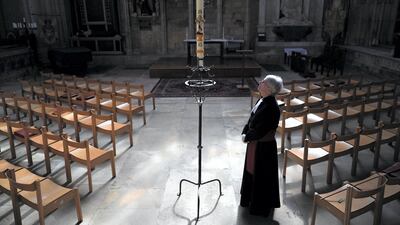
Canon Maggie McLean, the canon missioner at York Minster, lights the Paschal Candle in memory of victims of coronavirus in May. York Minster launched a new initiative for worshipers to email a request for their loved one to be remembered in a prayer that would be said by clergy at the Paschal Candle. Getty Images -

Darrell Blakely, 88, a church choir singer from Alkrington, Greater Manchester. Darrell died after contracting coronavirus at a restaurant when he came into contact with a skier returning from northern Italy. His son Jonathan has told of his heartbreak that he could not be with his father in his "direst hour" due to strict rules surrounding the respiratory disease. Rex/Shutterstock -
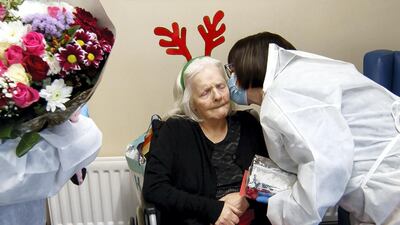
Mary Orme embraces her mother Rose McKimm, during a Christmas Day visit at Aspen Hill Village care home in Hunslet, Leeds. The care home was able to host almost 50 visits for family members during the Christmas period. Getty Images -

Queen Elizabeth II awards Captain Sir Thomas Moore with the insignia of Knight Bachelor at Windsor Castle in July. British World War II veteran Captain Tom Moore raised over £32 million for the NHS during the coronavirus pandemic. Getty Images -

A nurse at Aintree University Hospital in Liverpool sheds a tear as she pays tribute to 'Captain Tom'. Getty Images -

Craig Ruston, 45, who was at the time the youngest coronavirus patient to die in the UK, in March 2020. Mr Rushton, a father of two from Kettering, had motor neuron disease. His wife Sally wrote on Facebook: "My amazing Craig passed away yesterday morning at 6.20am. We are truly heartbroken." Rex/Shutterstock -
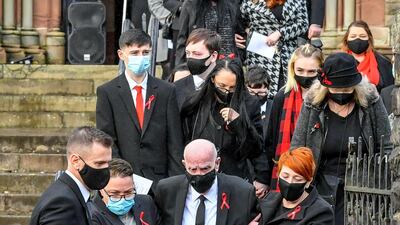
David Lewis, centre, husband to Gladys and father to Darren and Dean Lewis, is helped out of church by mourners during the funeral of Gladys, Dean, and Darren at St Peter's Church in Pentre, South Wales. Mrs Lewis and her two sons all died of Covid-19 within five days of each other. Getty Images -
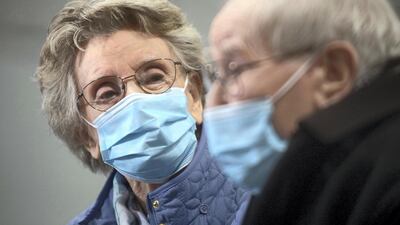
Geoff Holland, 90, and Jenny Holland, 86, are seen after receiving their injections of the Oxford/AstraZeneca vaccine in Mansfield. The couple, who met in a sheltered housing complex, were due to be married in April but had to postpone their wedding twice due to lockdown restrictions. They eventually held their ceremony in August. Reuters -

Pilot John Romain stands with his NHS Spitfire aircraft. The plane is covered in handwritten names of people nominated for acts of kindness during the coronavirus pandemic. After taking off from its home base at Duxford Airfield in Cambridgeshire, its flight path takes it over hospitals and local communities around the country. Getty Images -

Heart transplant patient Richard Priest is clapped out by staff as he leaves Royal Papworth Hospital, Cambridge. Mr Priest had been in the hospital waiting for the transplant for more than 200 days, throughout the entire coronavirus pandemic. Getty Images -

Donna Campbell, 54, died after testing positive for coronavirus while working as a nurse in the intensive care unit at University Hospital of Wales. Rex/Shutterstock -

A memorial service for the victims of coronavirus at Manchester Cathedral in July. The service was held with social distancing measures and streamed online to honour those who have died. Getty Images -

Ann Clapham, the sister of Covid-19 victim Dennis Clapham, her son Andrew and niece Ellie attend Mr Clapham's funeral and celebration service in Shipley, West Yorkshire. Ann cared for her brother at home during his illness. Getty Images -

People wearing face masks and holding lanterns attend a vigil for the victims of the coronavirus on Westminster Bridge in London. Getty Images -

Margaret Keenan, 90, is applauded by staff as she returns to her ward after becoming the first person in the United Kingdom to receive the Pfizer-BioNtech Covid-19 vaccine on December 8, 2020 in Coventry. Getty Images -
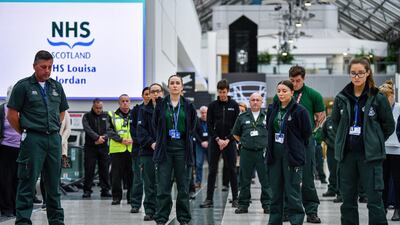
Medical staff at Louisa Jordan Hospital stand during a UK-wide moment of silence to commemorate workers who have died from coronavirus in April in Glasgow. Getty Images -

NHS staff applaud themselves and their colleagues at the entrance of the Royal Liverpool Hospital as part of the "Clap for Our Carers" campaign in April. Getty Images -
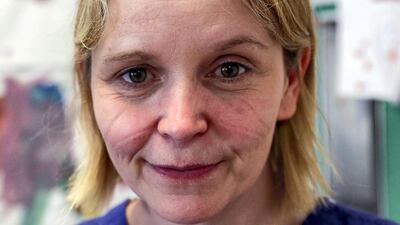
Marks made from wearing PPE are pictured on the face of nurse Susie Jewsbury, who works on the intensive care unit at Frimley Park Hospital in Frimley, south-west England. AFP -

Care home resident Albert Rose, 98, looks on as carers and staff applaud him outside Richden Park care home in Scunthorpe. There was an appeal for people to come forward and help the resident celebrate his birthday, after his only surviving relative was not able to visit due to the pandemic. AFP -
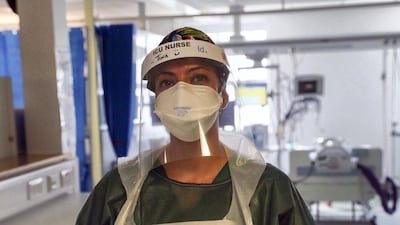
Nurse Tina has her name on her visor and a picture of herself on her apron in an intensive care unit where she is treating victims of the coronavirus in Frimley Park Hospital in Surrey. Getty Images -

A trained volunteer walks past coffins stacked next to refrigeration units inside the temporary mortuary set up in the car park of Central Jamia Mosque Ghamkol Sharif in Birmingham in April. The temporary mortuary was set up to deal with the pressure of the Covid 19 outbreak. AFP -

A member of staff looks at artwork by street artist Banksy called 'Game Changer', showing a boy playing with a nurse superhero toy, on a wall at the University Hospital Southampton. AFP -

Prime Minister Boris Johnson and Chancellor of the Exchequer Rishi Sunak stand inside the Cabinet Room of 10 Downing Street, London, to observe a minute's silence in tribute to the NHS staff and key workers who have died during the coronavirus outbreak. Getty Images -

A nurse takes a video of a newborn baby in the maternity ward at Frimley Park Hospital in Surrey to send to the parents, as visiting hours are restricted because of the pandemic. Getty Images -

Chloe Middleton, 21, died after contracting coronavirus in March 2020. Her mother, Diane Middleton, issued a warning to others on Facebook following her daughter's death. She wrote: "To all the people out there that thinks it's just a virus please think again speaking from a personal experience this so called virus has taken the life of my 21 year old daughter". Rex/Shutterstock -

Ellis Tustin, the grandson of Berrice Moore, holds up his grandfather's name as he stages a personal protest against Prime Minister Boris Johnson outside the Houses of Parliament in May. Mr Tustin believes that the government is forgetting that each of the figures listed in the daily death toll update is a real person. He is displaying the name as Mr Johnson passes on the way to and from the weekly PMQ session. Getty Images -

Dental nurses embrace before treating a possible Covid-19 positive patient at the Dental Unit at Coed Celyn Hospital in Wrexham. It is the only time the nurses can embrace and have a team hug after fully dressing in their full personal protection equipment. Getty Images



