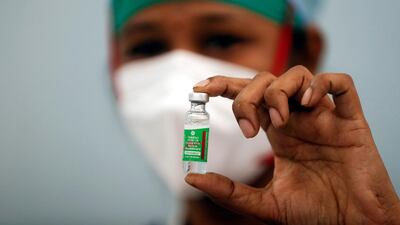
A nurse holds a vial of the Oxford/AstraZeneca Covid-19 vaccine manufactured by Serum Institute of India, which has been given emergency approval by the World Health Organisation. Reuters

Oxford/AstraZeneca Covid-19 vaccine gets World Health Organisation emergency approval


Paul Carey
  • English
  • Arabic

The World Health Organisation gave the Oxford/AstraZeneca coronavirus vaccine emergency approval, widening access to the low-cost inoculation in the developing world.

The WHO's review found that the vaccine met the criteria for safety, and its efficacy benefits outweighed its risks.

The vaccine has been praised because it is cheaper and easier to distribute than some rivals, including Pfizer/BioNTech's, which was listed for emergency use by the WHO late in December.

"We now have all the pieces in place for the rapid distribution of vaccines. But we still need to scale up production," said WHO director general Tedros Adhanom Ghebreyesus.

A WHO statement said that it had approved the vaccine as produced by AstraZeneca/SKBio (Republic of Korea) and the Serum Institute of India.

Although both companies are producing the same vaccine, because they are made in different production plants, they required separate reviews and approvals.

The listing was completed in just under four weeks from the time WHO received the full dossiers from the manufacturers.

The listing by the UN health agency came days after a WHO panel provided interim recommendations on the vaccine, saying two doses with an interval of around eight to 12 weeks must be given to all adults, and can be used in countries with the South African variant of the coronavirus as well.

Dr Tedros said: "Every day with fewer infections means lives saved, suffering prevented, and the burden on health systems eased just a little bit. And today we have even more reason to be hopeful of bringing the Covid-19 pandemic under control."

He sounded a note of concern on vaccine take-up.

"We must continue to build the demand for vaccines by ensuring people have the right information," he said. "A year ago, I said that we were not only fighting a pandemic, we were fighting an infodemic.

"In the past year, we have seen the real harm that can be caused when people are overwhelmed by information, misinformation and disinformation.

"The answer is not just to fight misinformation and delete false or misleading statements. It’s to listen to the real concerns and questions people have, and to answer those questions with good information," Dr Tedros said.

Doses of the Oxford/AstraZeneca vaccine make up the lion's share in the Covax coronavirus vaccine sharing scheme, with more than 330 million shots to begin use by poorer countries from the end of February.

The WHO established its emergency use listing process to help poorer countries without their own regulatory resources quickly approve medicines for new diseases like the coronavirus, which otherwise could lead to delays.

The Covax Facility, which is co-led by Gavi, the WHO, the Coalition for Epidemic Preparedness Innovations and the UN Children’s Fund, said that doses would cover an average of 3.3 per cent of total populations of 145 participating countries.

"Countries with no access to vaccines to date will finally be able to start vaccinating their health workers and populations at risk, contributing to the Covax facility's goal of equitable vaccine distribution," Dr Mariangela Simao, WHO assistant director general for access to medicines said.

"But we must keep up the pressure to meet the needs of priority populations everywhere and facilitate global access. To do that, we need two things – a scale-up of manufacturing capacity and developers' early submission of their vaccines for WHO review."

Nearly 109 million people are reported to have been infected by the novel coronavirus globally and more than 2.5 million have died.

Infections have been reported in more than 210 countries and territories since the first cases were identified in China in December 2019.

The number of reported cases globally has now declined for the fifth consecutive week. Last week, the lowest number of weekly cases since October was reported.

So far this year, the number of weekly reported cases has fallen by almost half, from more than five million cases in the week of January 4 to 2.6 million cases in the week starting February 8.

Dr Tedros said: "What matters now is how we respond to this trend. The fire is not out, but we have reduced its size. If we stop fighting it on any front, it will come roaring back."


Four%20scenarios%20for%20Ukraine%20war
%3Cp%3E1.%20Protracted%20but%20less%20intense%20war%20(60%25%20likelihood)%3C%2Fp%3E%0A%3Cp%3E2.%20Negotiated%20end%20to%20the%20conflict%20(30%25)%3C%2Fp%3E%0A%3Cp%3E3.%20Russia%20seizes%20more%20territory%20(20%25)%3C%2Fp%3E%0A%3Cp%3E4.%20Ukraine%20pushes%20Russia%20back%20(10%25)%3C%2Fp%3E%0A%3Cp%3E%3Cem%3EForecast%20by%20Economist%20Intelligence%20Unit%3C%2Fem%3E%3C%2Fp%3E%0A
MOUNTAINHEAD REVIEW

Starring: Ramy Youssef, Steve Carell, Jason Schwartzman

Director: Jesse Armstrong

Rating: 3.5/5

Developer: Ubisoft Montreal / Ubisoft Toronto
Publisher: Ubisoft
Platforms: Playstation 4, Xbox One, Windows
​​​​​​​Release Date: April 10

Ten tax points to be aware of in 2026

1. Domestic VAT refund amendments: request your refund within five years

If a business does not apply for the refund on time, they lose their credit.

2. E-invoicing in the UAE

Businesses should continue preparing for the implementation of e-invoicing in the UAE, with 2026 a preparation and transition period ahead of phased mandatory adoption. 

3. More tax audits

Tax authorities are increasingly using data already available across multiple filings to identify audit risks. 

4. More beneficial VAT and excise tax penalty regime

Tax disputes are expected to become more frequent and more structured, with clearer administrative objection and appeal processes. The UAE has adopted a new penalty regime for VAT and excise disputes, which now mirrors the penalty regime for corporate tax.

5. Greater emphasis on statutory audit

There is a greater need for the accuracy of financial statements. The International Financial Reporting Standards standards need to be strictly adhered to and, as a result, the quality of the audits will need to increase.

6. Further transfer pricing enforcement

Transfer pricing enforcement, which refers to the practice of establishing prices for internal transactions between related entities, is expected to broaden in scope. The UAE will shortly open the possibility to negotiate advance pricing agreements, or essentially rulings for transfer pricing purposes. 

7. Limited time periods for audits

Recent amendments also introduce a default five-year limitation period for tax audits and assessments, subject to specific statutory exceptions. While the standard audit and assessment period is five years, this may be extended to up to 15 years in cases involving fraud or tax evasion. 

8. Pillar 2 implementation 

Many multinational groups will begin to feel the practical effect of the Domestic Minimum Top-Up Tax (DMTT), the UAE's implementation of the OECD’s global minimum tax under Pillar 2. While the rules apply for financial years starting on or after January 1, 2025, it is 2026 that marks the transition to an operational phase.

9. Reduced compliance obligations for imported goods and services

Businesses that apply the reverse-charge mechanism for VAT purposes in the UAE may benefit from reduced compliance obligations. 

10. Substance and CbC reporting focus

Tax authorities are expected to continue strengthening the enforcement of economic substance and Country-by-Country (CbC) reporting frameworks. In the UAE, these regimes are increasingly being used as risk-assessment tools, providing tax authorities with a comprehensive view of multinational groups’ global footprints and enabling them to assess whether profits are aligned with real economic activity. 

Contributed by Thomas Vanhee and Hend Rashwan, Aurifer