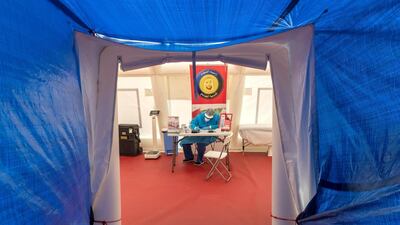
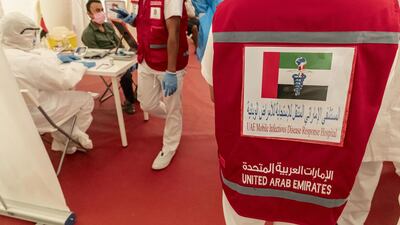
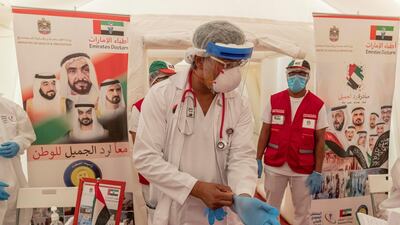
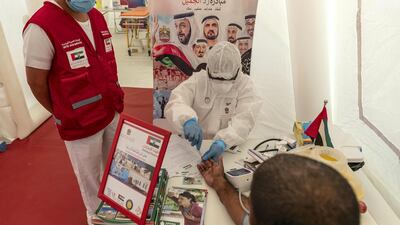
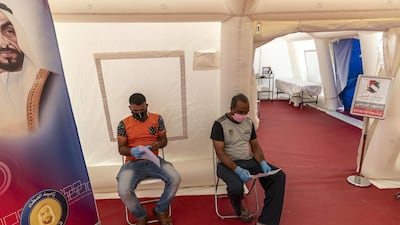
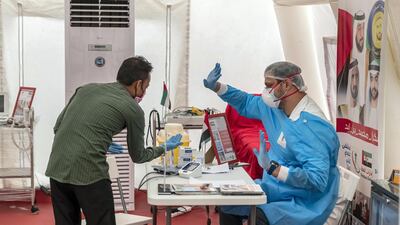
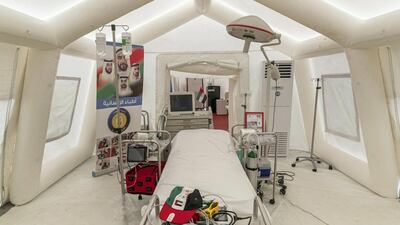
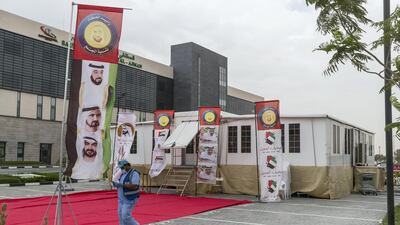
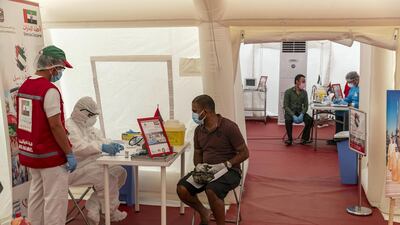
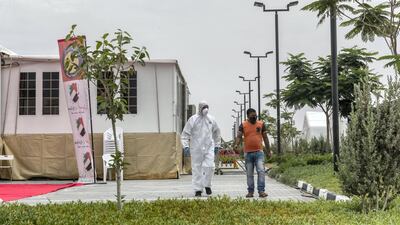
International Nurses Day on Wednesday focuses on the professionals at the sharp end of the global coronavirus pandemic, acknowledges the survivors of Covid-19, and remembers those who lost their lives.
For most nurses, it has not been an easy 12 months.
They risked their lives on the front line of health care every working day during the pandemic, caring not only for strangers struck down by the virus, but for their own families.
I would cry worrying if I would unknowingly transfer the infection to my loving boy
May 12 marks the birthday of Florence Nightingale, the Italian-born English social reformer who established the great pillars of care which became the norm for modern nursing.
According to the International Council of Nurses, more than 1.6 million healthcare workers in 34 countries were infected by the coronavirus in 2020.
One was Resmi Nair, a 35-year-old registered nurse at Bareen International Hospital in MBZ City, Abu Dhabi.
Ms Nair, from India, caught the virus on January 26, and was forced to stay apart from her family, including her two-year-old daughter. They ended up contracting the virus.
“I had severe body ache, headaches and fever,” Ms Nair said.
“It was a very stressful situation for me, as we were all uncertain about what would happen next.
"I was also overly concerned about post-Covid-19 syndrome.
“I was having trouble sleeping, followed by severe mood swings, difficulty in concentrating, loss of smell and taste, severe body pain and stomach problems.
“I felt very miserable, both physically and mentally.”
Ms Nair refused to quit, and after recovering she embarked on a journey of revitalisation, with more exercise and a healthy diet.
“I trained myself to develop a positive mindset and was able to recover within 26 days,” she said.
“Surviving this road full of hurdles would not have been possible if I did not have the support of my work and family.
"I returned to professional life stronger than before, mentally and physically, and was ready to do my duty.
“I hope that one day soon, my kids look back and feel proud of their mother as a nurse on the front line.”
Loss of a new life
Sruthy, a nurse at NMC Royal Hospital at Dubai Investments Park, was not so lucky.
Although she recovered from the virus, Sruthy was pregnant and suffered a miscarriage.
She described what felt like never-ending days dressed in full personal protective equipment, as the hospital faced a growing toll of Covid casualties.
“The patient numbers kept mounting,” Sruthy said.
“The perspiration and humidity accumulating in the mask got heavier, making it harder to draw breath, warranting me to be speaking louder to be heard.
“I was pregnant with my first child and was well into the second trimester.
“There were overwhelming concerns from my family on my own and my child’s safety.
"I walked daily into the unit to take care of at least half a dozen patients assigned to me," she said.
“The patients were young adults to grand old men and women, all having their own unique profiles and variable requirements, ranging from just the oxygen to ventilators and other life support equipment.”
Sruthy co-ordinated video calls between patients and their families, so they felt in touch during their treatment and that helped them to deal with their situations.
She would hurry between wards, managing critical care plans of each of the patients under her care.
As the days passed and the pandemic worsened, exhaustion set in. Shifts lengthened and the challenges piled up.
“Being first-time pregnant, a lack of rest and care for my nutrition was weighing on my mind,” Sruthy said.
“Going home every day to my loved ones was comforting, yet it brought the dangers of spreading the infection.
“Finally, the inevitable happened. I came out Covid-positive in routine testing and within 24 hours I had bleeding and, unfortunately, I had a miscarriage. I was devastated.
“I tried to gain confidence and comfort, not to look back but to think of the contributions to the patients I cared for," she said.
"The sense of satisfaction in doing my best possible – as it was very rewarding to see my patients heal and recover – gave me the sense and purpose to continue and take it each day as it came."
Like all health workers, nurses are continuously providing high-quality care, often working without a break.
Sometimes nurses are the only health workers people see in a crisis, yet the profession is facing a global shortage.
According to the World Health Organisation, nurses account for more than half of all the world's health workers, yet 5.9 million more are needed, especially in low- and middle-income countries.
Children give mother hope
Harsha Pushpan, a registered Nurse at Bareen International Hospital, MBZ City, Abu Dhabi, was eight months pregnant when she discovered she had the coronavirus.
I had never felt so emotionally broken before, but thinking about my daughter's face kept me going
“I was really struggling for oxygen," she said.
“I could not walk or eat and did not see my loved ones for a long time.
“I was worried about my unborn baby and two-year-old daughter.
“I had never felt so emotionally broken before, but thinking about my daughter’s face kept me going. It gave me the courage to live.”
Ms Pushpan waited a month before she tested clear of the virus, but her condition took a further two months to stabilise.
She has since given birth to a healthy boy.
Nurse haunted by loneliness of the dying
Anju Balachandran, 31, led a team of nurses in the coronavirus ward at NMC Royal Hospital Sharjah.
Like others, she was also expecting a baby at the start of the outbreak and give birth in May last year.
Ms Balachandran continued to work on the ward throughout her pregnancy, giving emergency care to those most in need.
“We were ready to handle anything that came our way, but we barely knew how to deal with the situation,” she said.
“It was the fear of the unknown and the damage it could cause that was most worrying.
“I had a newborn baby and as much as it was meant to be a precious experience, I was on my guard each time I returned home after hospital.
“I wondered if it was safe to cuddle, safe to kiss my child, and I would cry worrying if I would unknowingly transfer the infection to my loving boy.”
Read More
Coronavirus: frontline nurse returns to work after recovering from virus
Pandemic could affect mental health of frontline staff and patients for years, Abu Dhabi study warns
Magnificent seven: the brave frontline workers who gave their lives for Covid-19 patients
The experienced nurse described the esprit de corps on her ward as colleagues pulled together to fight the infection.
She also witnessed the desperation and loneliness of those facing the virus.
“The disease isolates you,” she said.
“There was a fear of staying away from the family with no one to talk to. The biggest responsibility was to sound positive in the worst of situations.
“The feedback from our recovered patients makes this entire experience worthwhile, but we carry the memories of the ones we lost and that will stay with me forever.
“The loneliness of the patients near the brink of death haunts me even today.”

Russia's Muslim Heartlands
Dominic Rubin, Oxford
3%20Body%20Problem
%3Cp%3E%3Cstrong%3ECreators%3A%3C%2Fstrong%3E%20David%20Benioff%2C%20D%20B%20Weiss%2C%20Alexander%20Woo%3C%2Fp%3E%0A%3Cp%3E%3Cstrong%3EStarring%3A%20%3C%2Fstrong%3EBenedict%20Wong%2C%20Jess%20Hong%2C%20Jovan%20Adepo%2C%20Eiza%20Gonzalez%2C%20John%20Bradley%2C%20Alex%20Sharp%3C%2Fp%3E%0A%3Cp%3E%3Cstrong%3ERating%3A%3C%2Fstrong%3E%203%2F5%3C%2Fp%3E%0A
Ten tax points to be aware of in 2026
1. Domestic VAT refund amendments: request your refund within five years
If a business does not apply for the refund on time, they lose their credit.
2. E-invoicing in the UAE
Businesses should continue preparing for the implementation of e-invoicing in the UAE, with 2026 a preparation and transition period ahead of phased mandatory adoption.
3. More tax audits
Tax authorities are increasingly using data already available across multiple filings to identify audit risks.
4. More beneficial VAT and excise tax penalty regime
Tax disputes are expected to become more frequent and more structured, with clearer administrative objection and appeal processes. The UAE has adopted a new penalty regime for VAT and excise disputes, which now mirrors the penalty regime for corporate tax.
5. Greater emphasis on statutory audit
There is a greater need for the accuracy of financial statements. The International Financial Reporting Standards standards need to be strictly adhered to and, as a result, the quality of the audits will need to increase.
6. Further transfer pricing enforcement
Transfer pricing enforcement, which refers to the practice of establishing prices for internal transactions between related entities, is expected to broaden in scope. The UAE will shortly open the possibility to negotiate advance pricing agreements, or essentially rulings for transfer pricing purposes.
7. Limited time periods for audits
Recent amendments also introduce a default five-year limitation period for tax audits and assessments, subject to specific statutory exceptions. While the standard audit and assessment period is five years, this may be extended to up to 15 years in cases involving fraud or tax evasion.
8. Pillar 2 implementation
Many multinational groups will begin to feel the practical effect of the Domestic Minimum Top-Up Tax (DMTT), the UAE's implementation of the OECD’s global minimum tax under Pillar 2. While the rules apply for financial years starting on or after January 1, 2025, it is 2026 that marks the transition to an operational phase.
9. Reduced compliance obligations for imported goods and services
Businesses that apply the reverse-charge mechanism for VAT purposes in the UAE may benefit from reduced compliance obligations.
10. Substance and CbC reporting focus
Tax authorities are expected to continue strengthening the enforcement of economic substance and Country-by-Country (CbC) reporting frameworks. In the UAE, these regimes are increasingly being used as risk-assessment tools, providing tax authorities with a comprehensive view of multinational groups’ global footprints and enabling them to assess whether profits are aligned with real economic activity.
Contributed by Thomas Vanhee and Hend Rashwan, Aurifer
Mercer, the investment consulting arm of US services company Marsh & McLennan, expects its wealth division to at least double its assets under management (AUM) in the Middle East as wealth in the region continues to grow despite economic headwinds, a company official said.
Mercer Wealth, which globally has $160 billion in AUM, plans to boost its AUM in the region to $2-$3bn in the next 2-3 years from the present $1bn, said Yasir AbuShaban, a Dubai-based principal with Mercer Wealth.
“Within the next two to three years, we are looking at reaching $2 to $3 billion as a conservative estimate and we do see an opportunity to do so,” said Mr AbuShaban.
Mercer does not directly make investments, but allocates clients’ money they have discretion to, to professional asset managers. They also provide advice to clients.
“We have buying power. We can negotiate on their (client’s) behalf with asset managers to provide them lower fees than they otherwise would have to get on their own,” he added.
Mercer Wealth’s clients include sovereign wealth funds, family offices, and insurance companies among others.
From its office in Dubai, Mercer also looks after Africa, India and Turkey, where they also see opportunity for growth.
Wealth creation in Middle East and Africa (MEA) grew 8.5 per cent to $8.1 trillion last year from $7.5tn in 2015, higher than last year’s global average of 6 per cent and the second-highest growth in a region after Asia-Pacific which grew 9.9 per cent, according to consultancy Boston Consulting Group (BCG). In the region, where wealth grew just 1.9 per cent in 2015 compared with 2014, a pickup in oil prices has helped in wealth generation.
BCG is forecasting MEA wealth will rise to $12tn by 2021, growing at an annual average of 8 per cent.
Drivers of wealth generation in the region will be split evenly between new wealth creation and growth of performance of existing assets, according to BCG.
Another general trend in the region is clients’ looking for a comprehensive approach to investing, according to Mr AbuShaban.
“Institutional investors or some of the families are seeing a slowdown in the available capital they have to invest and in that sense they are looking at optimizing the way they manage their portfolios and making sure they are not investing haphazardly and different parts of their investment are working together,” said Mr AbuShaban.
Some clients also have a higher appetite for risk, given the low interest-rate environment that does not provide enough yield for some institutional investors. These clients are keen to invest in illiquid assets, such as private equity and infrastructure.
“What we have seen is a desire for higher returns in what has been a low-return environment specifically in various fixed income or bonds,” he said.
“In this environment, we have seen a de facto increase in the risk that clients are taking in things like illiquid investments, private equity investments, infrastructure and private debt, those kind of investments were higher illiquidity results in incrementally higher returns.”
The Abu Dhabi Investment Authority, one of the largest sovereign wealth funds, said in its 2016 report that has gradually increased its exposure in direct private equity and private credit transactions, mainly in Asian markets and especially in China and India. The authority’s private equity department focused on structured equities owing to “their defensive characteristics.”
Who's who in Yemen conflict
Houthis: Iran-backed rebels who occupy Sanaa and run unrecognised government
Yemeni government: Exiled government in Aden led by eight-member Presidential Leadership Council
Southern Transitional Council: Faction in Yemeni government that seeks autonomy for the south
Habrish 'rebels': Tribal-backed forces feuding with STC over control of oil in government territory
The Bloomberg Billionaire Index in full
1 Jeff Bezos $140 billion
2 Bill Gates $98.3 billion
3 Bernard Arnault $83.1 billion
4 Warren Buffett $83 billion
5 Amancio Ortega $67.9 billion
6 Mark Zuckerberg $67.3 billion
7 Larry Page $56.8 billion
8 Larry Ellison $56.1 billion
9 Sergey Brin $55.2 billion
10 Carlos Slim $55.2 billion
SPECS
%3Cp%3E%3Cstrong%3EEngine%3A%3C%2Fstrong%3E%20Dual%20electric%20motors%20with%20102kW%20battery%20pack%3C%2Fp%3E%0A%3Cp%3E%3Cstrong%3EPower%3A%20%3C%2Fstrong%3E570hp%3C%2Fp%3E%0A%3Cp%3E%3Cstrong%3ETorque%3A%3C%2Fstrong%3E%20890Nm%3C%2Fp%3E%0A%3Cp%3E%3Cstrong%3ERange%3A%3C%2Fstrong%3E%20Up%20to%20428km%3C%2Fp%3E%0A%3Cp%3E%3Cstrong%3EOn%20sale%3A%3C%2Fstrong%3E%20Now%3C%2Fp%3E%0A%3Cp%3E%3Cstrong%3EPrice%3A%20%3C%2Fstrong%3EFrom%20Dh1%2C700%2C000%3C%2Fp%3E%0A
Planes grounded by coronavirus
British Airways: Cancels all direct flights to and from mainland China
Hong Kong-based Cathay Pacific: Cutting capacity to/from mainland China by 50 per cent from Jan. 30
Chicago-based United Airlines: Reducing flights to Beijing, Shanghai, and Hong Kong
Ai Seoul: Suspended all flights to China
Finnair: Suspending flights to Nanjing and Beijing Daxing until the end of March
Indonesia's Lion Air: Suspending all flights to China from February
South Korea's Asiana Airlines, Jeju Air and Jin Air: Suspend all flights
The specs: 2018 Volkswagen Teramont
Price, base / as tested Dh137,000 / Dh189,950
Engine 3.6-litre V6
Gearbox Eight-speed automatic
Power 280hp @ 6,200rpm
Torque 360Nm @ 2,750rpm
Fuel economy, combined 11.7L / 100km
NINE WINLESS GAMES
Arsenal 2-2 Crystal Palace (Oct 27, PL)
Liverpool 5-5 Arsenal (Oct 30, EFL)
Arsenal 1-1 Wolves (Nov 02, PL)
Vitoria Guimaraes 1-1 Arsenal (Nov 6, Europa)
Leicester 2-0 Arsenal (Nov 9, PL)
Arsenal 2-2 Southampton (Nov 23, PL)
Arsenal 1-2 Eintracht Frankfurt (Nov 28, Europa)
Norwich 2-2 Arsenal (Dec 01, PL)
Arsenal 1-2 Brighton (Dec 05, PL)
The%20Little%20Mermaid%20
%3Cp%3E%3Cstrong%3EDirector%3A%3C%2Fstrong%3E%20Rob%20Marshall%3Cbr%3E%3Cstrong%3EStars%3A%20%3C%2Fstrong%3EHalle%20Bailey%2C%20Jonah%20Hauer-King%2C%20Melissa%20McCarthy%2C%20Javier%20Bardem%3Cbr%3E%3Cstrong%3ERating%3A%20%3C%2Fstrong%3E2%2F5%3Cbr%3E%3Cbr%3E%3C%2Fp%3E%0A
War
Director: Siddharth Anand
Cast: Hrithik Roshan, Tiger Shroff, Ashutosh Rana, Vaani Kapoor
Rating: Two out of five stars
Key facilities
- Olympic-size swimming pool with a split bulkhead for multi-use configurations, including water polo and 50m/25m training lanes
- Premier League-standard football pitch
- 400m Olympic running track
- NBA-spec basketball court with auditorium
- 600-seat auditorium
- Spaces for historical and cultural exploration
- An elevated football field that doubles as a helipad
- Specialist robotics and science laboratories
- AR and VR-enabled learning centres
- Disruption Lab and Research Centre for developing entrepreneurial skills
Fifa Club World Cup quarter-final
Esperance de Tunis 0
Al Ain 3 (Ahmed 02’, El Shahat 17’, Al Ahbabi 60’)
Results
2.30pm: Expo 2020 Dubai – Conditions (PA) Dh80,000 (Dirt) 1,600m; Winner: Barakka, Ray Dawson (jockey), Ahmad bin Harmash (trainer)
3.05pm: Now Or Never – Maiden (TB) Dh82,500 (Turf) 1,600m; Winner: One Idea, Andrea Atzeni, Doug Watson
3.40pm: This Is Our Time – Handicap (TB) Dh82,500 (D) 1,600m; Winner: Perfect Balance, Tadhg O’Shea, Bhupat Seemar
4.15pm: Visit Expo 2020 – Handicap (TB) Dh87,500 (T) 1,600m; Winner: Kaheall, Richard Mullen, Salem bin Ghadayer
4.50pm: The World In One Place – Handicap (TB) Dh95,000 (T) 1.900m; Winner: Castlebar, Adrie de Vries, Helal Al Alawi
5.25pm: Vision – Handicap (TB) Dh95,000 (D) 1,200m; Winner: Shanty Star, Richard Mullen, Rashed Bouresly
6pm: Al Wasl Plaza – Handicap (TB) Dh95,000 (T) 1,200m; Winner: Jadwal, Dane O’Neill, Doug Watson
Company profile
Company: Eighty6
Date started: October 2021
Founders: Abdul Kader Saadi and Anwar Nusseibeh
Based: Dubai, UAE
Sector: Hospitality
Size: 25 employees
Funding stage: Pre-series A
Investment: $1 million
Investors: Seed funding, angel investors
Who was Alfred Nobel?
The Nobel Prize was created by wealthy Swedish chemist and entrepreneur Alfred Nobel.
- In his will he dictated that the bulk of his estate should be used to fund "prizes to those who, during the preceding year, have conferred the greatest benefit to humankind".
- Nobel is best known as the inventor of dynamite, but also wrote poetry and drama and could speak Russian, French, English and German by the age of 17. The five original prize categories reflect the interests closest to his heart.
- Nobel died in 1896 but it took until 1901, following a legal battle over his will, before the first prizes were awarded.
Three ways to boost your credit score
Marwan Lutfi says the core fundamentals that drive better payment behaviour and can improve your credit score are:
1. Make sure you make your payments on time;
2. Limit the number of products you borrow on: the more loans and credit cards you have, the more it will affect your credit score;
3. Don't max out all your debts: how much you maximise those credit facilities will have an impact. If you have five credit cards and utilise 90 per cent of that credit, it will negatively affect your score.