

Eman Jamal no longer wakes up feeling sick every day.
But eight months after contracting Covid-19 in Dubai, she has still not fully recovered.
The 35-year-old had what was classified as a mild case of the virus, with a cough and initial difficulty breathing.
But weeks later, the symptoms lingered, and she is still to this day suffering from bouts of chest pain and shortness of breath.
She is one of a small subset of former Covid-19 patients known as long-haulers, who suffer lasting effects of the virus.
The last time The National checked in on Ms Jamal, in September, she was recovering – but the symptoms flare up every now and then.
The Dubai resident is plagued by ongoing health problems.
“I will be okay for sometimes an entire week at a time, and then suddenly I wake up with a breathing difficulty,” she said.
“I try to rest for a bit and then a couple of days later, I might feel better.”
Extensive tests revealed Ms Jamal, who is Palestinian-American, has an obstruction in her airways.
“But we don’t know if this is going to be a short-term or long-term asthma, or a chronic pulmonary lung disease that is progressive and more dangerous,” she said.

“They don’t know how this is going to play out.”
Ms Jamal manages her symptoms with an inhaler and other medicine, so she feels good for longer.
“I am a lot more functional. But I am definitely not back to where I used to be,” she said.
Ms Jamal is not alone and there are many long-haulers left with lasting health problems after becoming infected.
Seema Mary Rajan, 39, a nurse working in Sharjah, also experienced continuing health problems since testing positive for the virus in May.
The Al Zahra Hospital employee said she felt constant pain in her joints for months before she was told a few weeks ago that she had osteoarthritis.
“The doctor told me it was likely to have been caused by Covid-19 as I never experienced the symptoms before that,” she said.
“The joints in my fingers get really sore when they are cold. That happens a lot because I work in a hospital and I have to run cold water quite a bit.
“It is not curable and I will have it for the rest of my life.”
Ms Rajan said she was always healthy before testing positive earlier this year.
After becoming infected, she experienced some heaviness in her chest and in breathing for several months.

Other sufferers in the UAE said their symptoms have improved over time.
Ahmad Zahalqa, 28, a site engineer in Dubai, who caught the virus in mid-April, does not feel any after-effects.
When interviewed by The National in September, he still suffered from lingering shortness of breath, particularly while exercising at the gym.
“Now I do not feel any shortness of breath or fatigue. I am performing better than before at the gym and I can see the difference in my body. I am leaner and my muscles are more defined,” said Mr Zahalqa, a Palestinian-Jordanian bodybuilder.
He came in contact with two positive cases after he had recovered but tested negative.
“I had two encounters when I should have caught the virus again, for sure, but surprisingly I did not,” he said.
He was in the car with a friend who tested positive a few hours later.
“We were sharing the same space, air and AC. He was even smoking in the car, and after discovering he had Covid-19. I tested but I was negative,” he said.
One of his colleagues tested positive but Mr Zahalqa was negative, which could be because of the immunity he had developed the first time.
“We worked in the same office for four days and he coughed and sneezed the whole time. Then he tested positive but I remained negative,” he said.
“Normally, this time of year, I always go down with a heavy flu that lasts for two weeks, but this year I did not.”
First Pfizer-BioNTech vaccines arrive in Dubai – in pictures
-
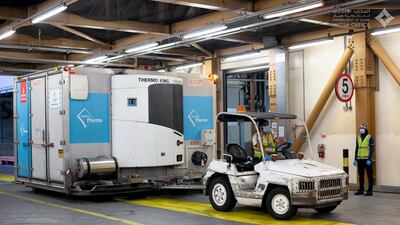
Pfizer-BioNTech's Covid-19 vaccines must be kept at temperatures of -70 °C. Here, they are being transported in a special trailer from the plane to Emirates Sky Pharma for storage. Courtesy: Dubai Media Office -

The ultra-cold storage is necessary to prevent the mRNA in them – the technology used to deliver the vaccines – from breaking down. -

The vaccine will be given free of cost in Dubai. -

Keeping the vaccines at -70 °C maintains the structure of the mRNA for up to six months. -

There has never been a vaccine or drug that has required such cold storage before, which meant Pfizer had to develop a special method to transport the doses. -

Pfizer's reusable boxes, which can store up to 5,000 doses, are packed with dry ice and installed with trackers to monitor the location and temperature of the frozen vials. -
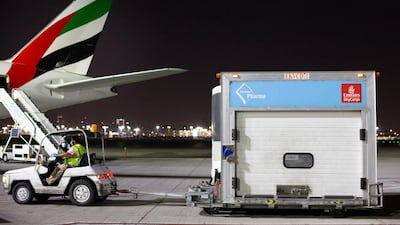
They can be opened twice a day for less than three minutes at a time while maintaining the temperature. Once opened for longer, the vials can be kept at 2-7°C for five days.



