
Pioneering scientists in Abu Dhabi have unveiled new cutting-edge technology which is set to provide vital support to patients battling Covid-19.
The Abu Dhabi Stem Cell Centre (ADSCC) has invested Dh3.6 million on a Helios Mass Cytometer, a state-of-the-art tool which experts say will help bolster the body’s defence against the virus.
The cytometer, the only one of its kind in the Middle East, will enable scientists at the centre to quickly and accurately profile individual human cells, allowing them to study and monitor a patient’s immune response to the virus.
"With this tool, the ADSCC can study clinical outcomes and changes in inflammatory or immune function from blood samples of Covid-19 patients,’’ an ADSCC spokesperson said.
"This will allow us to address some of the pressing questions that remain unanswered regarding Covid-19.’’
Staff at the centre are currently receiving training on the operation of the new machine, which they have affectionately dubbed ''The Lamborghini''.
Scientists leading efforts to stem the spread of Covid-19 are seeking to assess whether those most at risk of severe symptoms can be identified early, what interventions can reduce its severity and what vaccines will prove most effective in staving off the virus.
The centre recently introduced a new therapy to treat the effects of Covid-19, which has proved fruitful for a number of patients with severe symptoms.
It involves isolating then activating stem cells taken from the patient's blood before they are nebulised into a fine mist so they can be inhaled into the lungs.
The first UAE patient to recover from Covid-19 after undergoing the stem-cell therapy told The National last month of his gruelling journey to "full health" after being placed in a coma to stop his organs shutting down.
-

Members of a Palestinian team called ''Bella Ciao", dressed as actors of "La Casa de Papel (Money Heist)" series, perform in Gaza City. Reuters -
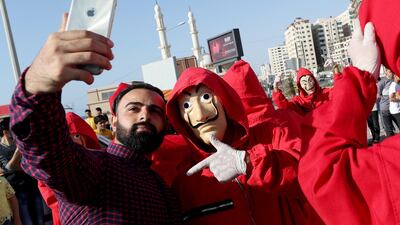
A man takes a selfie with a member of ''Bella Ciao". Reuters -
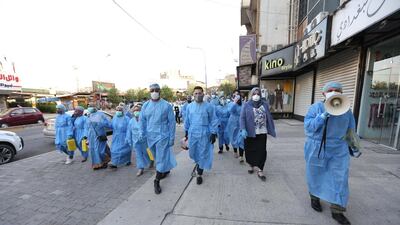
Iraqi medical specialists take part in a testing process for the coronavirus in Baghdad's Karada district. EPA -
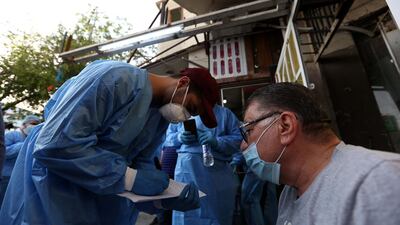
Iraqi medical specialists take a blood sample from a man for a coronavirus test in Baghdad's Karada district. EPA -
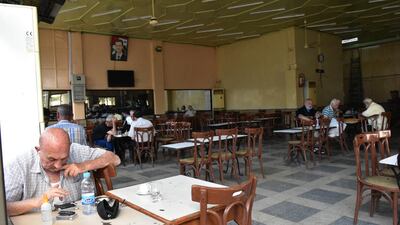
Customers sit at a cafe in Damascus, Syria. EPA -
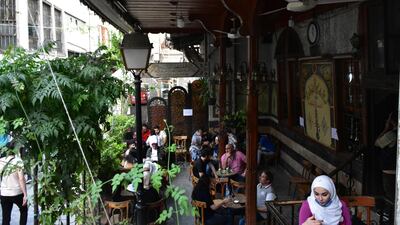
Customers sit on the terrace of a cafe in Damascus, Syria. EPA -

Iranians walk past in a street, in Tehran. EPA -
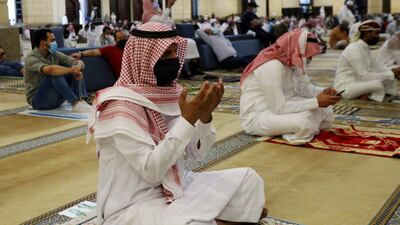
A Muslim performs the Friday prayers inside the Al-Rajhi Mosque, Riyadh, Saudi Arabia. Reuters -

Muslims perform the Friday prayers inside the Al-Rajhi Mosque, Riyadh, Saudi Arabia. Reuters -
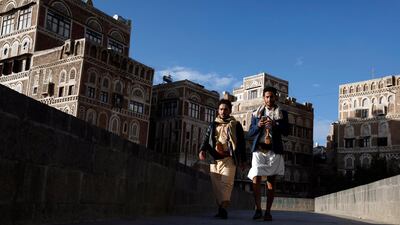
Yemenis walk past historic buildings in the old quarter of Sanaa. EPA -
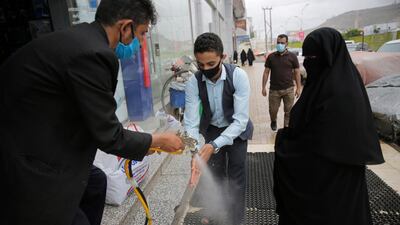
A worker disinfects a shopper's hands before they enter a mall in Sanaa, Yemen. AP Photo -
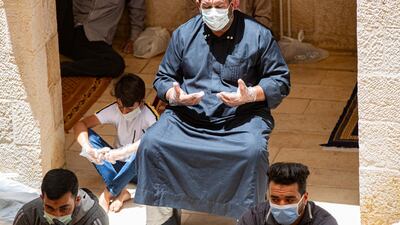
Jordanians perform their first Friday prayers since the start of the pandemic at a mosque in Amman. EPA -
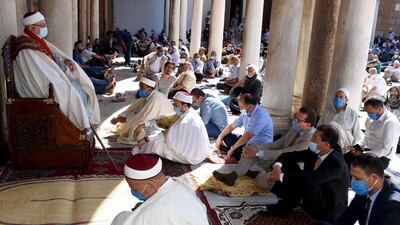
Believers gather in a mosque in Tunis. Tunisia. AP Photo -
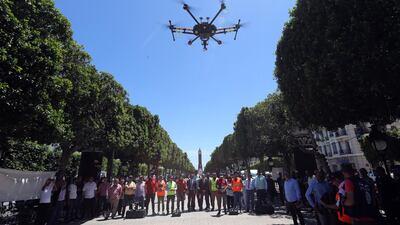
A drone with a thermal camera flies over Habib Burgiba Street in Tunis, Tunisia. EPA -
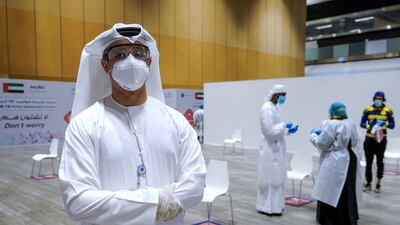
Mohamed Hawas Al Sadid, CEO of Ambulatory Healthcare Services, at the the new Covid-19 Prime Assessment Centre at ADNEC, Abu Dhabi. Victor Besa -
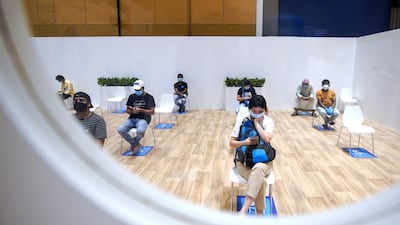
Covid-19 positive residents in the waiting room at the new Prime Assessment Center at ADNEC, Abu Dhabi. Victor Besa


Abdullahi Rodhile, 50, from Somalia, contracted the virus on March 30 and, because of an existing heart condition, his health deteriorated quickly.
The virus attacked his kidneys and lungs so badly that doctors rushed him into the intensive care unit at Sheikh Khalifa Medical City in Abu Dhabi and put him in an induced coma for 20 days.
“I was brought back to life. I was dead and now I am alive,” said Mr Rodhile, who works as a cargo clerk.
“I have never been better. Thank God."
He spent 40 days in intensive care but only after he started the stem cell therapy did his lungs begin to improve slightly.
Mr Rodhile eventually healed enough to gradually awaken from the coma.
Scientists at Abu Dhabi Stem Cell Centre are continuing to harness latest technologies in order to aid patients in ill health.
The centre announced on Saturday it is to begin offering Minimal Residual Disease tests for cancer patients – a first in the UAE.
The highly specialised test allows physicians to spot residual, potentially-resistant cells that can lead to a relapse in patients. Currently such a test is not available in the Emirates and cancer patients have to travel abroad to be tested because the test requires the use of a fresh sample to be accurate.

