
On Monday, Abu Dhabi announced it had launched its Phase 3 trial of Russia’s Covid-19 vaccine.
Initially open to 500 volunteers, the study involves two doses of Sputnik V, administered 20 days apart.
To be eligible, volunteers should live in Abu Dhabi and be at least 18 years old.
In addition, they must neither have been infected with Covid-19 in the past, nor suffered any communicable or respiratory diseases in the past 14 days.
It is the second trial of its kind in the UAE, after a large-scale ongoing study of two vaccines by Sinopharm that involved more than 30,000 people.
Russia aims to produce a billion doses of the Sputnik V vaccine next year and sell it for less than $20 per person on the international market.
The Gamaleya National Research Institute of Epidemiology and Microbiology developed the vaccine and it was registered by the Russian Ministry of Health on August 11, 2020.
That made it the first registered Covid-19 vaccine out of about 200 that are being tested.
How does it differ to the rest? And what sort of side effects can volunteers expect?
The National explains:
How does it work?
Sputnik V is an adenoviral vector-based vaccine.
A vector is a virus that has been engineered – in this case a harmless cold-causing adenovirus – to carry the Sars-CoV-2 coronavirus gene to cells.
That provokes the production of the virus’s crown-like spikes, resembling a natural infection. This theoretically generates a robust immune response.
Like many of the other vaccines against Sars-CoV-2, Sputnik V requires two shots.
Each of the shots uses a different strain of adenovirus, to ensure that if immunity develops to the first, adenovirus 26, the second booster jab, containing adenovirus 5, is still effective.
“To form a powerful immune response against Sars-CoV-2, it is important that a booster vaccination is provided,” said Denis Logunov of the Gamaleya institute.
“However, booster vaccinations that use the same adenovirus vector might not produce an effective response, because the immune system may recognise and attack the vector.”
The use of two vectors makes Sputnik V different to the other adenovirus vector-based vaccines, such as the one produced by AstraZeneca and the University of Oxford.
At least eight of the about 200 vaccines in development against Sars-CoV-2 use adenovirus vectors.
-
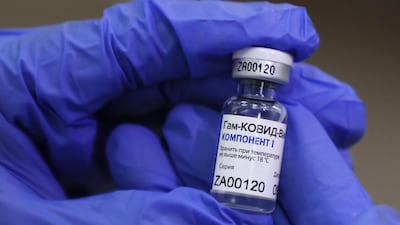
A Russian medic holds a dose of Sputnik V vaccine. The UAE clinical trials into the Russian Sputnik V vaccine have moved into the final monitoring phase. EPA -
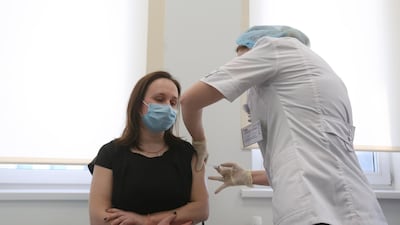
The next step in the UAE trial involves monitoring volunteers’ immune response over 180 days. Bloomberg -
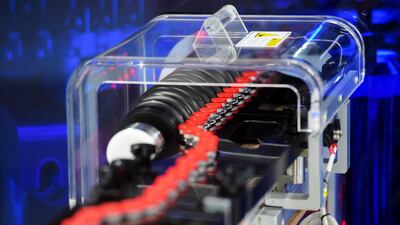
In the UAE 1,000 trial volunteers have received their second dose.The vaccine is produced at Russia's biotech company Biocad in Strelna outside Saint Petersburg. AFP -
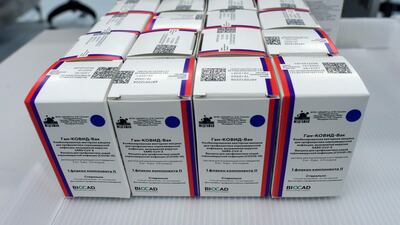
Recent interim results from Phase III of clinical trials into the Sputnik V have shown a high efficacy of 91.6%. AFP -
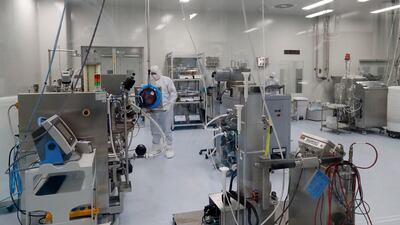
Sputnik V is developed by the Gamaleya Research Institute of Epidemiology and Microbiology in co-ordination with the Russian Defence Ministry. It is tested at Russia's biotechnology company Biocad in Strelna, outside Saint Petersburg. EPA -
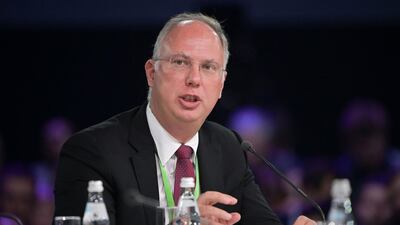
Kirill Dmitriev expects vaccines to be mixed in an attempt to boost dose numbers and tackle new strains. Sputnik / AFP -

A vial of the Sputnik V Covid-19 vaccine. Data published in The Lancet showed the vaccine is safe, and provides strong immunogenicity. Bloomberg -
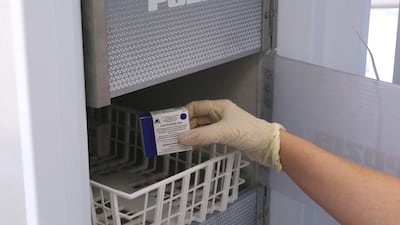
A health worker removes a box containing vials of the Sputnik V Covid-19 vaccine, developed by the Gamaleya National Research Center for Epidemiology and Microbiology, and the Russian Direct Investment Fund. Bloomberg -
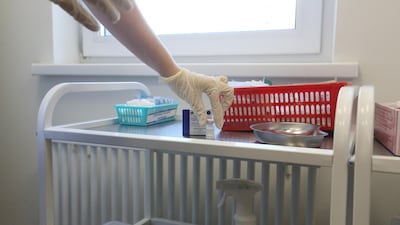
Sputnik V was initially registered for use in Russia in August 2020, making it the first registered Covid-19 vaccine out of 165 being developed across the world. Bloomberg


Is it effective?
Its developers recently announced it was 92 per cent effective, based on early data involving a handful of volunteers.
The results of the combined Phase 1 and 2 trial, which were published in The Lancet, showed all 40 participants produced antibodies against the Sars-CoV-2 spike protein on day 42. All participants also developed neutralising antibodies.
There were no “unexpected adverse events”.
More antibodies appeared to be produced in the group vaccinated with Sputnik V compared with the blood plasma of recovered Covid-19 patients. They both developed the same level of neutralising antibodies.
Phase 3 trials involved 40,000 volunteers.
Interim results – which have not yet been independently reviewed – claimed it had an efficacy of 95 per cent, similar to the Pfizer/BioNTech, Moderna and Oxford/AstraZeneca vaccines.
Are there any side effects?
As with any vaccine, there is a risk of side effects. Its developers said about 15 per cent of people develop a fever of 38°C, headaches and muscle pain.
Who has taken it?
The vaccine was approved in Russia in August, making it the first inoculation against Covid-19 to be registered anywhere.
“I know [the vaccine] works quite effectively, helps to develop strong immunity, and has gone through all the necessary tests," said the country's president, Vladimir Putin.
At the time, only small Phase 1 and 2 trials had been completed – although the results had not been published – and larger Phase 3 studies to determine its effectiveness had not yet begun.
Clinical trials of the Sputnik V have since been announced in the UAE, India, Venezuela and Belarus.
More than 100,000 people have been vaccinated in Russia and mass voluntary vaccinations will begin next week in the country.
In August, it was the first to be registered for emergency use.
Now doctors, teachers and social workers are being given priority.
Russia's military has also launched a coronavirus vaccine campaign to inoculate nearly half a million of its soldiers on active duty, Sergei Shoigu, the country’s defence minister, said on Friday.
More than 2,500 Russian soldiers have been vaccinated so far and nearly 80,000 are expected to get the shot by the end of the year.
Has this process been used before to develop a vaccine?
Yes. An adenovirus vector vaccine against Ebola was developed in 2014, and approved by China in 2017 for emergency use and national stockpiling.
But a Phase 2 study did not prove the vaccine prevented infection with Ebola, and antibody responses plummeted within six months of receiving the shot. Experts said that could be because most of the participants had pre-exisitng immunity to the strain used, adenovirus 5.
It was the only vaccine of its type to be approved before Sputnik V received the go-ahead in August in Russia.
Why is it called Sputnik V?
The name is a nod to the world’s first artificial Earth satellite, which was developed by Russia.
It launched into orbit on October 1957, signalling the beginning of the space age, according to Nasa.
There were three sputnik satellites.

