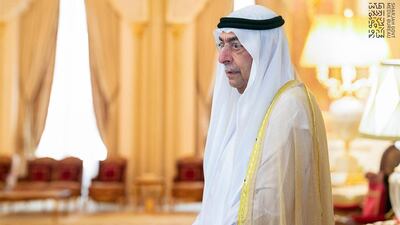
Tributes have been paid to Sheikh Ahmed bin Sultan Al Qasimi, the Deputy Ruler of Sharjah, who died on Thursday.
Messages of condolence were shared by the UAE's leadership and rulers across the Arab world, offering prayers to the Al Qasimi family.
King Salman of Saudi Arabia and Crown Prince Mohammed bin Salman offered their condolences to Sheikh Dr Sultan bin Muhammad Al Qasimi, Ruler of Sharjah, in a statement carried by the Saudi Press Agency.
Oman's Sultan Haitham bin Tariq also sent a message of condolence to the Sharjah Ruler on the death of Sheikh Ahmed.
Sheikh Sabah, emir of Kuwait, sent cables of condolence to President Sheikh Khalifa and Sheikh Dr Sultan. In his message, Sheikh Sabah expressed his sympathy on the death of the Sharjah Deputy Ruler and prayed for the family to be granted solace.
Locally, tributes were paid by the rulers of each emirate.
Sheikh Mohammed bin Rashid, Vice President and Ruler of Dubai, said on Twitter: "Our condolences to His Highness Sheikh Dr Sultan bin Muhammad Al Qasimi and the people of the UAE on the death of Sheikh Ahmed bin Sultan Al Qasimi. May God rest his soul."
Sheikh Mohammed prayed for the family to be granted patience and solace.
"We belong to Allah and to Him we shall return," he said.
Sheikh Mohamed bin Zayed, Crown Prince of Abu Dhabi and Deputy Supreme Commander of the Armed Forces, also paid his respects.
"My sincere condolences to my brother Sheikh Sultan bin Muhammad Al Qasimi and his family on the passing of Sheikh Ahmed bin Sultan Al Qasimi," he said.
"I pray they are granted patience and solace during these difficult and trying times. May he rest in peace."
Similar messaged were shared by the Rulers of Fujairah, Ajman, Ras Al Khaimah and Umm Al Quwain.
Sheikh Hamdan bin Mohammed, Crown Prince of Dubai, and Sheikh Hazza bin Zayed,,Vice Chairman of Abu Dhabi Executive Council, each shared their condolences to the Al Qasimi family on Twitter.
"My sincere condolences to His Highness the Ruler of Sharjah Sheikh Dr Sultan bin Muhammad Al Qasimi on the death of Sheikh Ahmed bin Sultan Al Qasimi, Deputy Ruler of Sharjah. We ask God to have mercy on him and accommodate him in his spacious gardens [in heaven] and to grant his family patience and solace", said Sheikh Hamdan.
Sheikh Ahmed died in the UK and a three-day mourning period will be held when his body is returned to the Emirates.
Funeral prayers will be held but the Court of Sheikh Dr Sultan bin Muhammad Al Qasimi, Ruler of Sharjah, said condolences would be received through phone calls to avoid gatherings during the coronavirus outbreak.
The court said phone numbers would be made public in due course.
Sheikh Ahmed was born in Sharjah in 1948. He was the son of the former ruler of Sharjah, Sheikh Sultan bin Saqr Al Qasimi.
In addition to his position as deputy ruler he was also chairman of the Sharjah Oil Council, honorary chairman of Dana Gas and sat on the board of directors for Sharjah Liquefaction Gas Company (Shalco).
Sheikh Ahmed was known as a "sincere patriot" who dedicate his life from a young age to national action with the goal of promoting progress and development, reported state news agency Wam.
Described as a "figure of giving, loyalty and tolerance," he faithfully served UAE Federation from 1971.
Sheikh Ahmed was elected Minister of Justice in the first UAE government ministerial formation, a post he occupied until 1977. He held the same position in the third ministerial formation until 1990, after which he was appointed deputy ruler to Sheikh Dr Sultan. He held that position for more than 30 years, working to serve Sharjah, its citizens and residents.

COMPANY%20PROFILE%20
%3Cp%3EName%3A%20DarDoc%3Cbr%3EBased%3A%20Abu%20Dhabi%3Cbr%3EFounders%3A%20Samer%20Masri%2C%20Keswin%20Suresh%3Cbr%3ESector%3A%20HealthTech%3Cbr%3ETotal%20funding%3A%20%24800%2C000%3Cbr%3EInvestors%3A%20Flat6Labs%2C%20angel%20investors%20%2B%20Incubated%20by%20Hub71%2C%20Abu%20Dhabi's%20Department%20of%20Health%3Cbr%3ENumber%20of%20employees%3A%2010%3C%2Fp%3E%0A
The%20Crown%20season%205
%3Cp%3E%3Cstrong%3EStars%3A%20%3C%2Fstrong%3EImelda%20Staunton%2C%20Jonathan%20Pryce%2C%20Lesley%20Manville%2C%20Jonny%20Lee%20Miller%2C%20Dominic%20West%2C%20Elizabeth%20Debicki%2C%20Salim%20Daw%20and%20Khalid%20Abdalla%3C%2Fp%3E%0A%3Cp%3E%3Cstrong%3EWritten%20by%3A%20%3C%2Fstrong%3EPeter%20Morgan%3C%2Fp%3E%0A%3Cp%3E%3Cstrong%3ERating%3A%3C%2Fstrong%3E%204%2F5%20stars%3C%2Fp%3E%0A
Stage result
1. Pascal Ackermann (GER) Bora-Hansgrohe, in 3:29.09
2. Caleb Ewan (AUS) Lotto-Soudal
3. Rudy Barbier (FRA) Israel Start-Up Nation
4. Dylan Groenewegen (NED) Jumbo-Visma
5. Luka Mezgec (SLO) Mitchelton-Scott
6. Alberto Dainese (ITA) Sunweb
7. Jakub Mareczko (ITA) CCC
8. Max Walscheid (GER) NTT
9. José Rojas (ESP) Movistar
10. Andrea Vendrame (ITA) Ag2r La Mondiale, all at same time
Mercer, the investment consulting arm of US services company Marsh & McLennan, expects its wealth division to at least double its assets under management (AUM) in the Middle East as wealth in the region continues to grow despite economic headwinds, a company official said.
Mercer Wealth, which globally has $160 billion in AUM, plans to boost its AUM in the region to $2-$3bn in the next 2-3 years from the present $1bn, said Yasir AbuShaban, a Dubai-based principal with Mercer Wealth.
“Within the next two to three years, we are looking at reaching $2 to $3 billion as a conservative estimate and we do see an opportunity to do so,” said Mr AbuShaban.
Mercer does not directly make investments, but allocates clients’ money they have discretion to, to professional asset managers. They also provide advice to clients.
“We have buying power. We can negotiate on their (client’s) behalf with asset managers to provide them lower fees than they otherwise would have to get on their own,” he added.
Mercer Wealth’s clients include sovereign wealth funds, family offices, and insurance companies among others.
From its office in Dubai, Mercer also looks after Africa, India and Turkey, where they also see opportunity for growth.
Wealth creation in Middle East and Africa (MEA) grew 8.5 per cent to $8.1 trillion last year from $7.5tn in 2015, higher than last year’s global average of 6 per cent and the second-highest growth in a region after Asia-Pacific which grew 9.9 per cent, according to consultancy Boston Consulting Group (BCG). In the region, where wealth grew just 1.9 per cent in 2015 compared with 2014, a pickup in oil prices has helped in wealth generation.
BCG is forecasting MEA wealth will rise to $12tn by 2021, growing at an annual average of 8 per cent.
Drivers of wealth generation in the region will be split evenly between new wealth creation and growth of performance of existing assets, according to BCG.
Another general trend in the region is clients’ looking for a comprehensive approach to investing, according to Mr AbuShaban.
“Institutional investors or some of the families are seeing a slowdown in the available capital they have to invest and in that sense they are looking at optimizing the way they manage their portfolios and making sure they are not investing haphazardly and different parts of their investment are working together,” said Mr AbuShaban.
Some clients also have a higher appetite for risk, given the low interest-rate environment that does not provide enough yield for some institutional investors. These clients are keen to invest in illiquid assets, such as private equity and infrastructure.
“What we have seen is a desire for higher returns in what has been a low-return environment specifically in various fixed income or bonds,” he said.
“In this environment, we have seen a de facto increase in the risk that clients are taking in things like illiquid investments, private equity investments, infrastructure and private debt, those kind of investments were higher illiquidity results in incrementally higher returns.”
The Abu Dhabi Investment Authority, one of the largest sovereign wealth funds, said in its 2016 report that has gradually increased its exposure in direct private equity and private credit transactions, mainly in Asian markets and especially in China and India. The authority’s private equity department focused on structured equities owing to “their defensive characteristics.”
