


With much of the world steeped in data, where everything from refrigerators and watches to cars and surgical tools are connected to the internet via cloud computing, cryptography – the basic building block of digital security – has never been more important.
Encryption is one of the fundamental applications of cryptography, which converts information into what should be an unbreakable code, typically to prevent unauthorised access.
However, the rise of quantum computers, which are capable of breaking today's encryption protocols "at a speed and scale beyond anything we've ever seen", according strategy advisory company the Future Today Institute, threatens to upend decades of encryption, posing unprecedented national security threats worldwide.
The UAE, which announced plans to build a quantum computer last month, has joined some of the world's biggest economies in prioritising cryptography research – the first country in the Middle East to do so.
The woman leading the UAE’s cryptography plans says the level of research being conducted at the Abu Dhabi-based Technology Innovation Institute is unlike anywhere else in the world.
Speaking to The National, Dr Najwa Aaraj, who was appointed chief researcher at the Cryptography Research Centre at the Technology Innovation Institute last year, outlined her plans for the cutting-edge initiative that will give the UAE "sovereignty" over the future of its digital security.
“I want the country to be known for this field,” she said.
The Cryptography Research Centre is part of the Technology Innovation Institute in Masdar City, which focuses on applied research for Abu Dhabi government's Advanced Technology Research Council.
It is also one of the few centres of its kind to bring together theoretical and applied cryptographers from the public and private sector and from around the world.

Ms Aaraj, who got her PhD in information security from Princeton University in New Jersey, US, oversees the team of 50 and is actively hiring for about a dozen positions.
"We assembled a team of professionals from across the global cryptography community to investigate the current and future challenges of digital society and to respond with practical solutions," Ms Aaraj said.
She said the qualities of the lab in Abu Dhabi “cannot be found anywhere else” in the world.
"You get connected to the east, to the west, to the US, to Europe, and you can have really good collaboration.
"So at the end, the intellectual environment that I've had in Abu Dhabi and the UAE, I can confidently say, I haven't had it anywhere else,” she said.
TII recently announced partnerships with Yale University in Connecticut, US, and a board of advisors from Radboud University in Nijmegen, the Netherlands, the University of Toulouse and Computer Science at Ecole Normale Superieure de Lyon in France, plusRuhr-University Bochum in Germany.
"I still work with Princeton with my adviser on a few research topics," she added.

Last month, Ms Aaraj's team introduced a software library to store algorithms capable of fighting off attacks in a post-quantum world.
Abu Dhabi's new library is a collection of algorithms to safeguard confidential data and information that aims to advance digital data security in the capital and the broader UAE.
TII's work focused on data confidentiality, integrity, authentication and privacy.
It was the second library of algorithms Ms Aaraj's team has introduced. The first was the "national sovereign" crypto library, which is currently being integrated into digital infrastructure and multiple systems in the country.
Ms Aaraj said it is critical these algorithms, which can safeguard the UAE's data in sectors such as finance, defence and healthcare, are developed in-country and owned exclusively by the UAE.
Not having control over these data safeguards leaves countries vulnerable to an ever-increasing number of threats.
Abu Dhabi, which holds about 5.6 per cent of the world’s proven oil reserves, is positioning itself as a technology and industrial hub.
Earlier this month, Rashed Al Blooshi, undersecretary of Abu Dhabi Department of Economic Development, said the emirate is focused on a number of non-oil sectors – including industry, agriculture, tourism, health and technology – to diversify its economy away from hydrocarbons.
Ms Aaraj is keen to support that mission, and confident she can deliver on growing the emirate’s technology sector.
“We have a very strong team here from Emirati talent and also global talent. To actually be a hub and attract top experts in the field to come and work from here – I’m sure this will happen.”
Global post-quantum future plans
Countries like the US, France, the UK and China are pouring billions of dollars into preparing for a post-quantum future.
Governments are vying to attract talent and investment ahead of the first real-world quantum use cases, according to the Future Today Institute, which outlined national efforts.
The US passed the National Quantum Initiative Act in 2018, earmarking $1.2 billion for quantum research, and last year it rolled out five new quantum computing centres, including one at Brookhaven National Laboratory, in New York, to build new nuclear, chemical and physics applications.
Ahead of the curve is the UK, which launched its National Quantum Technologies Programme in 2013 and is now in its second phase, with $1.3bn in investment.
Germany’s programme is funded at $2.4bn, according to the Future Today Institute.
In China, researchers from the University of Science and Technology of China, in Hefei, published a paper in the journal Science describing their quantum computer achieving speeds 10 billion times faster than Google's Sycamore quantum processor, which was the first to achieve "quantum supremacy", in October 2019.
Physicists at Google said at the time that their 53-bit quantum computer calculated something that an ordinary computer – even a very powerful one – simply could not have completed.
Sycamore performed a challenging calculation in 200 seconds. On the world’s current fastest traditional computer, that same calculation would have taken 10,000 years.
In February 2021, researchers from Google and Canadian quantum computing company D-Wave Systems solved a real-world challenge 3 million times faster than a classical computer.
Supercomputers of the future
-
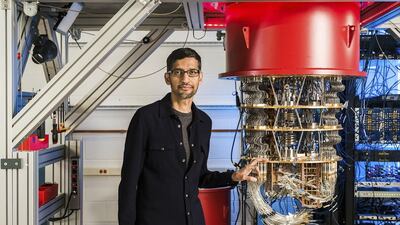
Sundar Pichai with one of Google's quantum computers in the Santa Barbara lab. A quantum computer can reduce a calculation that would ordinarily take years to minutes. -

Quantum computers are able to process multiple possibilities at once, solving problems at a much faster rate. -
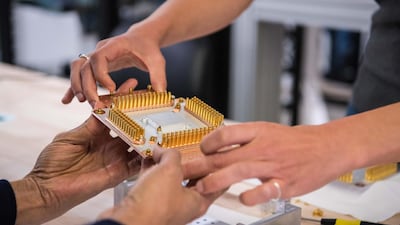
A component of Google's Quantum Computer in the Santa Barbara lab. Today’s computers function using something called bits, which are arranged in a combination of ones and zeroes. Quantum computers use quantum bits, or "qubits", which mean they are capable of solving calculations a traditional computer could never answer. Reuters -

Quantum computers are as fragile as they are complex. They require an ultra-cold temperature to operate, keeping the environment stable with less chance of the qubits flipping between states. -
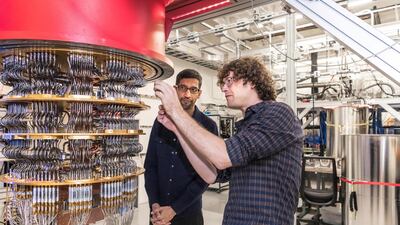
Sundar Pichai and Daniel Sank with one of Google's quantum computers in Santa Barbara. In late 2019, Google announced it had achieved "quantum supremacy", when its quantum computer became the first to solve a calculation in less than four minutes that would have taken the world’s most powerful supercomputer 10,000 years to complete. -
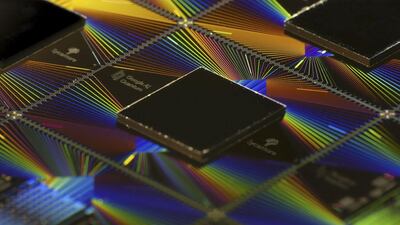
Quantum computing could help solve everything from the mundane, such as finding the most efficient route, to huge breakthroughs in science, including creating new cancer treatments – or possibly even finding a cure for cancer.They may even one day answer questions about the origins of the universe and address mysteries of space and time. AFP -

Quantum computers will also able to sort through reams of data on complicated subjects like climate change to predict how it will progress. AFP



