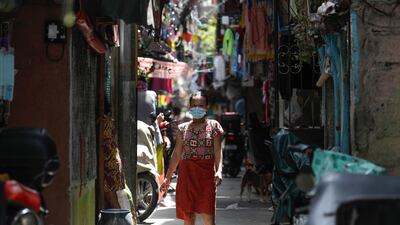
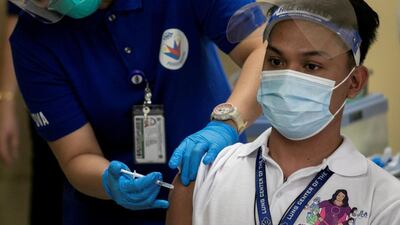
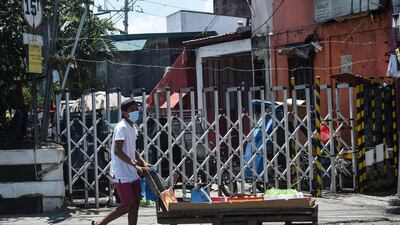
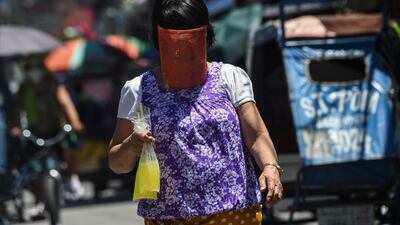
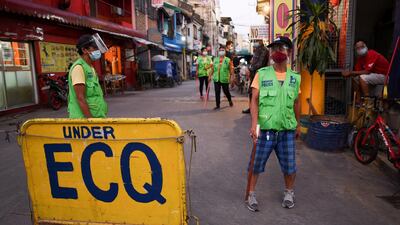
Filipinos in the UAE hope flight restrictions will end next week, to allow them to reunite with loved ones back home.
The Philippines government recently extended its ban on travellers from the UAE to June 15 to help curb the spread of Covid-19.
Airlines - including Cebu Pacific and Air Philippines - cancelled flights between Manila and Dubai, while Emirates and Etihad Airways will only carry transit passengers.
On Monday, Manila approved the Sinopharm vaccine as it mounted a new vaccine push, with 15 million doses set to arrive in the coming weeks.
Seats on June 16 flights have been snapped up in recent days ahead of the June 15 review.
Two years for a mother feels like a really long time
Ellanie Villena, owner of Angel Wings International Tourism travel agency in Dubai, said limited flights were scheduled for later this month, subject to change.
“We had about 30 slots available for a special flight on Cebu Pacific from Dubai to Manila scheduled for June 16, but I think all the seats are taken now as there is a cap on the number of passengers allowed into the Philippines,” she said.
“We have two additional flights, one on June 28 and one on June 30 to Manila, but things are always subject to change with government announcements.
"Filipino residents in the UAE can avail the chartered [repatriation] flights but need to be sure they carry a negative PCR test and follow the quarantine protocols in the Philippines. Non-Filipinos will not be allowed to enter the country.
“For the past month or so the majority of our work has been to rebook and refund flights."
Those travelling from Dubai to the Philippines have to undergo 14 days mandatory quarantine, 10 days of which is spent in a government-appointed centre.
The changing travel updates have scuppered the plans of many Filipinos hoping to go home for a summer break. But many remain optimistic things will change later in the summer.
Loricelle Bernardo, 44, said she is desperate to see her daughter who lives in the Philippines with her mother.
"I'm planning to go back by July 1. I really want to go to see my daughter because I haven't seen her for two years,” said the mother of two, whose eldest son works in Dubai.
“She's turning 17 this August and I really want to see her celebrate her birthday."
Two years for a mother feels like a really long time, Ms Bernado said.
"It's good we have social media and Zoom so we can see them but, it's different, it's not personal.
"You can see them but you cannot hug, kiss or snuggle them.”
Despite the lengthy quarantine period, Ms Bernardo said she was willing to sacrifice a large chunk of her 30-day leave just to see her daughter.
“If you are working legally in Dubai and you register with the Philippine Embassy, the government will accommodate you,” she said.
“They will pay for the quarantine and the swab test. I think it is different if you live on another island [in the Philippines] and you have to take another flight, then you need to do another quarantine."
Ivy Padilla Espanueva, 30, from Zaragoza Bolinao, which is an eight-hour bus ride from Manila, said she was desperate to see her 2-year-old daughter.
"I booked my flight for July 13. At the moment, there are only repatriation flights, which is really sad, and I don't know what to do, but all Filipinos are hoping that the rules will change this July," she said.
Her daughter is about to turn 3, Ms Espanueva said.
"I really want to be with my family because it has been more than two years since I saw my daughter."
"If I manage to get there, I'll have to do 10 days in quarantine, but I still really want to go home to be with her."
Mother of two Toni Anne Gelle, 30, who is from Metro Manila, was sceptical about booking a trip home this summer.
“I want to go home but, because of the travel ban, I think I should just stay put for now, for my job, for my safety, and I don't want to be stuck there,” she said.
“I saw my children last year, in January. Normally I go at least twice a year, and I would have gone this summer, but last time I got stuck for one month because of the travel suspensions.
“It is really sad not to be able to see my children but I need to be practical. I need this job, and I need to be healthy and safe, so you just accept it.”
Ms Gelle said many of her friends and colleagues had booked flights but they kept getting cancelled so, to her, it was not worth the hassle.
Mary Joy Reyes, 45, from Panay Island, would love to go home for the summer but believes the travel restrictions will prevent that this year.
"I miss my family so much – my father and mother, and my four children – but the situation is so hard now, and it is important I keep my job so I can earn money for my children's future.
"I feel sad because I'm away from my family, but I'm happy because I have great employers here in Dubai."
Esperanza Albay, 48, from Mindanao said she misses her three daughters terribly.
"I'm not going on vacation this year because I'm worried about quarantine, or getting stuck in the airport and not being able to come back," she said.
"I live on Mindanao, and you have to do quarantine in Manila and then again on my island in Davao.
"It has been two years now since I went home, but my kids are older, so they understand the situation. I promised them I am coming next year for vacation."

Kamindu Mendis bio
Full name: Pasqual Handi Kamindu Dilanka Mendis
Born: September 30, 1998
Age: 20 years and 26 days
Nationality: Sri Lankan
Major teams Sri Lanka's Under 19 team
Batting style: Left-hander
Bowling style: Right-arm off-spin and slow left-arm orthodox (that's right!)
KILLING OF QASSEM SULEIMANI
UAE currency: the story behind the money in your pockets
'Cheb%20Khaled'
%3Cp%3E%3Cstrong%3EArtist%3A%20%3C%2Fstrong%3EKhaled%3Cbr%3E%3Cstrong%3ELabel%3A%20%3C%2Fstrong%3EBelieve%3Cbr%3E%3Cstrong%3ERating%3A%3C%2Fstrong%3E%204%2F5%3C%2Fp%3E%0A
UAE currency: the story behind the money in your pockets
More from Rashmee Roshan Lall
Results
2-15pm: Commercial Bank Of Dubai – Conditions (TB) Dh100,000 (Dirt) 1,400m; Winner: Al Habash, Patrick Cosgrave (jockey), Bhupat Seemar (trainer)
2.45pm: Al Shafar Investment – Handicap (TB) Dh80,000 (D) 1,200m; Winner: Day Approach, Ray Dawson, Ahmad bin Harmash
3.15pm: Dubai Real estate Centre – Handicap (TB) Dh80,000 (D) 1,600m; Winner: Celtic Prince, Richard Mullen, Rashed Bouresly
3.45pm: Jebel Ali Sprint by ARM Holding – Listed (TB) Dh500,000 (D) 1,000m; Winner: Khuzaam, Pat Dobbs, Doug Watson
4.15pm: Shadwell – Conditions (TB) Dh100,000 (D) 1,600m; Winner: Tenbury Wells, Royston Ffrench, Salem bin Ghadayer
4.45pm: Jebel Ali Stakes by ARM Holding – Listed (TB) Dh500,000 (D) 1,950m; Winner: Lost Eden, Andrea Atzeni, Doug Watson
5.15pm: Jebel Ali Racecourse – Handicap (TB) Dh76,000 (D) 1,950m; Winner: Rougher, Pat Dobbs, Doug Watson
Timeline
2012-2015
The company offers payments/bribes to win key contracts in the Middle East
May 2017
The UK SFO officially opens investigation into Petrofac’s use of agents, corruption, and potential bribery to secure contracts
September 2021
Petrofac pleads guilty to seven counts of failing to prevent bribery under the UK Bribery Act
October 2021
Court fines Petrofac £77 million for bribery. Former executive receives a two-year suspended sentence
December 2024
Petrofac enters into comprehensive restructuring to strengthen the financial position of the group
May 2025
The High Court of England and Wales approves the company’s restructuring plan
July 2025
The Court of Appeal issues a judgment challenging parts of the restructuring plan
August 2025
Petrofac issues a business update to execute the restructuring and confirms it will appeal the Court of Appeal decision
October 2025
Petrofac loses a major TenneT offshore wind contract worth €13 billion. Holding company files for administration in the UK. Petrofac delisted from the London Stock Exchange
November 2025
180 Petrofac employees laid off in the UAE
THE SPECS
Engine: 1.5-litre turbocharged four-cylinder
Transmission: Constant Variable (CVT)
Power: 141bhp
Torque: 250Nm
Price: Dh64,500
On sale: Now
Company%20profile
%3Cp%3E%3Cbr%3E%3Cstrong%3EName%3A%3C%2Fstrong%3E%20Khodar%3Cbr%3E%3Cstrong%3EBased%3A%3C%2Fstrong%3E%20Cairo%20and%20Alexandria%2C%20in%20Egypt%3Cbr%3E%3Cstrong%3EFounders%3A%3C%2Fstrong%3E%20Ayman%20Hamza%2C%20Yasser%20Eidrous%20and%20Amr%20El%20Sheikh%3Cbr%3E%3Cstrong%3ESector%3A%3C%2Fstrong%3E%20agriculture%20technology%3Cbr%3E%3Cstrong%3EFunding%3A%3C%2Fstrong%3E%20%24500%2C000%3Cbr%3E%3Cstrong%3EInvestors%3A%3C%2Fstrong%3E%20Saudi%20Arabia%E2%80%99s%20Revival%20Lab%20and%20others%3Cbr%3E%3Cstrong%3EEmployees%3A%3C%2Fstrong%3E%2035%3C%2Fp%3E%0A
From Zero
Artist: Linkin Park
Label: Warner Records
Number of tracks: 11
Rating: 4/5
How the UAE gratuity payment is calculated now
Employees leaving an organisation are entitled to an end-of-service gratuity after completing at least one year of service.
The tenure is calculated on the number of days worked and does not include lengthy leave periods, such as a sabbatical. If you have worked for a company between one and five years, you are paid 21 days of pay based on your final basic salary. After five years, however, you are entitled to 30 days of pay. The total lump sum you receive is based on the duration of your employment.
1. For those who have worked between one and five years, on a basic salary of Dh10,000 (calculation based on 30 days):
a. Dh10,000 ÷ 30 = Dh333.33. Your daily wage is Dh333.33
b. Dh333.33 x 21 = Dh7,000. So 21 days salary equates to Dh7,000 in gratuity entitlement for each year of service. Multiply this figure for every year of service up to five years.
2. For those who have worked more than five years
c. 333.33 x 30 = Dh10,000. So 30 days’ salary is Dh10,000 in gratuity entitlement for each year of service.
Note: The maximum figure cannot exceed two years total salary figure.
Real estate tokenisation project
Dubai launched the pilot phase of its real estate tokenisation project last month.
The initiative focuses on converting real estate assets into digital tokens recorded on blockchain technology and helps in streamlining the process of buying, selling and investing, the Dubai Land Department said.
Dubai’s real estate tokenisation market is projected to reach Dh60 billion ($16.33 billion) by 2033, representing 7 per cent of the emirate’s total property transactions, according to the DLD.
'Gold'
Director:Anthony Hayes
Stars:Zaf Efron, Anthony Hayes
Rating:3/5
The bio
Job: Coder, website designer and chief executive, Trinet solutions
School: Year 8 pupil at Elite English School in Abu Hail, Deira
Role Models: Mark Zuckerberg and Elon Musk
Dream City: San Francisco
Hometown: Dubai
City of birth: Thiruvilla, Kerala
Tearful appearance
Chancellor Rachel Reeves set markets on edge as she appeared visibly distraught in parliament on Wednesday.
Legislative setbacks for the government have blown a new hole in the budgetary calculations at a time when the deficit is stubbornly large and the economy is struggling to grow.
She appeared with Keir Starmer on Thursday and the pair embraced, but he had failed to give her his backing as she cried a day earlier.
A spokesman said her upset demeanour was due to a personal matter.
Mercer, the investment consulting arm of US services company Marsh & McLennan, expects its wealth division to at least double its assets under management (AUM) in the Middle East as wealth in the region continues to grow despite economic headwinds, a company official said.
Mercer Wealth, which globally has $160 billion in AUM, plans to boost its AUM in the region to $2-$3bn in the next 2-3 years from the present $1bn, said Yasir AbuShaban, a Dubai-based principal with Mercer Wealth.
“Within the next two to three years, we are looking at reaching $2 to $3 billion as a conservative estimate and we do see an opportunity to do so,” said Mr AbuShaban.
Mercer does not directly make investments, but allocates clients’ money they have discretion to, to professional asset managers. They also provide advice to clients.
“We have buying power. We can negotiate on their (client’s) behalf with asset managers to provide them lower fees than they otherwise would have to get on their own,” he added.
Mercer Wealth’s clients include sovereign wealth funds, family offices, and insurance companies among others.
From its office in Dubai, Mercer also looks after Africa, India and Turkey, where they also see opportunity for growth.
Wealth creation in Middle East and Africa (MEA) grew 8.5 per cent to $8.1 trillion last year from $7.5tn in 2015, higher than last year’s global average of 6 per cent and the second-highest growth in a region after Asia-Pacific which grew 9.9 per cent, according to consultancy Boston Consulting Group (BCG). In the region, where wealth grew just 1.9 per cent in 2015 compared with 2014, a pickup in oil prices has helped in wealth generation.
BCG is forecasting MEA wealth will rise to $12tn by 2021, growing at an annual average of 8 per cent.
Drivers of wealth generation in the region will be split evenly between new wealth creation and growth of performance of existing assets, according to BCG.
Another general trend in the region is clients’ looking for a comprehensive approach to investing, according to Mr AbuShaban.
“Institutional investors or some of the families are seeing a slowdown in the available capital they have to invest and in that sense they are looking at optimizing the way they manage their portfolios and making sure they are not investing haphazardly and different parts of their investment are working together,” said Mr AbuShaban.
Some clients also have a higher appetite for risk, given the low interest-rate environment that does not provide enough yield for some institutional investors. These clients are keen to invest in illiquid assets, such as private equity and infrastructure.
“What we have seen is a desire for higher returns in what has been a low-return environment specifically in various fixed income or bonds,” he said.
“In this environment, we have seen a de facto increase in the risk that clients are taking in things like illiquid investments, private equity investments, infrastructure and private debt, those kind of investments were higher illiquidity results in incrementally higher returns.”
The Abu Dhabi Investment Authority, one of the largest sovereign wealth funds, said in its 2016 report that has gradually increased its exposure in direct private equity and private credit transactions, mainly in Asian markets and especially in China and India. The authority’s private equity department focused on structured equities owing to “their defensive characteristics.”