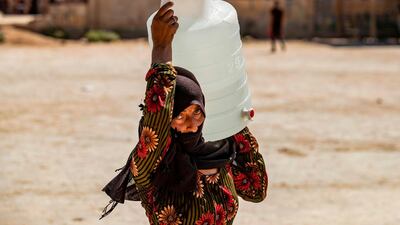
A displaced Syrian brings water back to their camp in Syria's northeastern city of Hasakah last month. AFP

Middle East among 'world's most vulnerable' for ecological threats


Patrick Ryan
  • English
  • Arabic

The Middle East is one of the world’s most vulnerable regions when it comes to ecological threats over the next 30 years, according to a global report.

The first Ecological Threat Register, produced by Australia-based Institute of Economics and Peace (IEP), also warned of the mass displacement of 1.2 billion people across the world by 2050.

The Middle East was named alongside Sub-Saharan Africa, South Asia and North Africa as the regions facing the largest number of ecological risks.

The report stated more than one billion people are living in countries which were unlikely to adapt to new challenges over the next 30 years.

“There are a number of countries in the Middle East that are going to be vulnerable to severe water shortages in the future,” said Steve Killelea, founder and executive chairman of the IEP.

Countries like Iraq, Syria and Yemen will have low resilience to ecological stresses

“Countries like Iraq, Syria and Yemen will have low resilience to ecological stresses.

“We saw the impact wars had in those countries in terms of the numbers who were forced to migrate. Now they are also going to be facing increased stress on their water and food supplies.”

The Ecological Threat Register measures the risk to countries arising from population growth, water stress, food insecurity, droughts, floods, cyclones, rising temperatures and sea levels.

The report found that 141 countries were likely to be exposed to at least one ecological threat by 2050.

The 19 countries with the highest number of threats have a combined population of 2.1 billion people, representing close to 25 per cent of people in the world.

Water stress represents the most significant concern to life in the Middle East over the coming decades, according to Mr Killelea.

The number of recorded water-related conflict and violent incidents increased by 270 per cent globally in the past decade.

Since 2000, most of those incidents took place in Yemen and Iraq, according to the report.

The report states there are 2.6 billion people in the world who are experiencing water stress today, a figure which is predicted to grow to 5.4 billion people by 2040.

The worst affected countries are predicted to be Lebanon, Singapore, Israel and Iraq.

“Ecological threats and climate change pose serious challenges to global peacefulness,” said Mr Killelea.

Over the next 30 years, lack of access to food and water will only increase without urgent global cooperation, he warned.

“In the absence of action civil unrest, riots and conflict will most likely increase. Covid-19 is already exposing gaps in the global food chain.”

Palestine was also named in the new report as being among the countries where water scarcity represented the biggest ecological threat over the next 30 years.

The report also stated the global demand for food is expected to increase by 50 per cent, meaning that many more people will be at risk of hunger unless there is a significant increase in supply.

More than two billion people across the world already face uncertain access to food, that figure is predicted to increase to 3.5 billion by 2050.

With the world’s population expected to rise to 10 billion over the next three decades, the IEP predicts access to food is going to be a major issue for large sectors of the global population.

Sheikh Mohammed bin Rashid, Vice President and Ruler of Dubai, said last month that bolstering food and water security was a top priority for the UAE.

He stressed that the Covid-19 outbreak had only served to highlight the need to be self-sufficient.

A global report, published by the Water Resources Institute (WRI) in August, 2019, ranked the country 10th out of 164 in a global league table of nations where water supplies are most stretched.

The UAE was among 17 countries facing “extremely high water stress”, researchers said, meaning 80 per cent of available surface and groundwater in an average year is being consumed.

Mariam Al Mheiri, Minister of State for Food Security, called for water resources to be managed more effectively through the use of advanced recycling technologies during a meeting with Sheikh Mohammed.

“The food and water security file shows an urgent need for sustainable development and enhancing the work of the management of resources to provide water and food for future generations," she said.

Mr Killelea added that the growing economy in China will also put extreme pressure on global food demand.

“The rising incomes in north Asia, particularly in China, will mean more people will move into the middle class, a demographic that traditionally consumes more food,” he said.

“That puts additional stresses on what food is out there which is likely to increase the cost as well.”

The countries predicted to struggle the most with food supply issues are Sierra Leone, Liberia, Niger, Malawi and Lesotho, where more than half of the population already experience uncertainty with access to sufficient food to be healthy.

It is not just countries in the developing world that are at risk from ecological threats over the coming decades.

Mr Killelea said regions such as Europe and North America will be impacted by the number of refugees created by ecological crises.

“We saw how the refugee crisis of 2015 and 2016, which saw two million people flee to Europe, created political turbulence and social unrest,” he said.

“Mass displacement will lead to larger refugee flows to the most developed countries.

“Ecological change is the next big global threat to our planet and people’s lives, and we must unlock the power of business and government action to build resilience for the places most at risk.”


MATCH INFO

Sheffield United 2 Bournemouth 1
United: Sharp (45 2'), Lundstram (84')
Bournemouth: C Wilson (13')

Man of the Match: Jack O’Connell (Sheffield United)

How to become a Boglehead

Bogleheads follow simple investing philosophies to build their wealth and live better lives. Just follow these steps.

•   Spend less than you earn and save the rest. You can do this by earning more, or being frugal. Better still, do both.

•   Invest early, invest often. It takes time to grow your wealth on the stock market. The sooner you begin, the better.

•   Choose the right level of risk. Don't gamble by investing in get-rich-quick schemes or high-risk plays. Don't play it too safe, either, by leaving long-term savings in cash.

•   Diversify. Do not keep all your eggs in one basket. Spread your money between different companies, sectors, markets and asset classes such as bonds and property.

•   Keep charges low. The biggest drag on investment performance is all the charges you pay to advisers and active fund managers.

•   Keep it simple. Complexity is your enemy. You can build a balanced, diversified portfolio with just a handful of ETFs.

•   Forget timing the market. Nobody knows where share prices will go next, so don't try to second-guess them.

•   Stick with it. Do not sell up in a market crash. Use the opportunity to invest more at the lower price.

The specs

Engine: Direct injection 4-cylinder 1.4-litre
Power: 150hp
Torque: 250Nm
Price: From Dh139,000
On sale: Now

F1 2020 calendar

March 15 - Australia, Melbourne; March 22 - Bahrain, Sakhir; April 5 - Vietnam, Hanoi; April 19 - China, Shanghai; May 3 - Netherlands, Zandvoort; May 20 - Spain, Barcelona; May 24 - Monaco, Monaco; June 7 - Azerbaijan, Baku; June 14 - Canada, Montreal; June 28 - France, Le Castellet; July 5 - Austria, Spielberg; July 19 - Great Britain, Silverstone; August 2 - Hungary, Budapest; August 30 - Belgium, Spa; September 6 - Italy, Monza; September 20 - Singapore, Singapore; September 27 - Russia, Sochi; October 11 - Japan, Suzuka; October 25 - United States, Austin; November 1 - Mexico City, Mexico City; November 15 - Brazil, Sao Paulo; November 29 - Abu Dhabi, Abu Dhabi.

'The worst thing you can eat'

Trans fat is typically found in fried and baked goods, but you may be consuming more than you think.

Powdered coffee creamer, microwave popcorn and virtually anything processed with a crust is likely to contain it, as this guide from Mayo Clinic outlines: 

Baked goods - Most cakes, cookies, pie crusts and crackers contain shortening, which is usually made from partially hydrogenated vegetable oil. Ready-made frosting is another source of trans fat.

Snacks - Potato, corn and tortilla chips often contain trans fat. And while popcorn can be a healthy snack, many types of packaged or microwave popcorn use trans fat to help cook or flavour the popcorn.

Fried food - Foods that require deep frying — french fries, doughnuts and fried chicken — can contain trans fat from the oil used in the cooking process.

Refrigerator dough - Products such as canned biscuits and cinnamon rolls often contain trans fat, as do frozen pizza crusts.

Creamer and margarine - Nondairy coffee creamer and stick margarines also may contain partially hydrogenated vegetable oils.

Company name: Play:Date

Launched: March 2017 on UAE Mother’s Day

Founder: Shamim Kassibawi

Based: Dubai with operations in the UAE and US

Sector: Tech 

Size: 20 employees

Stage of funding: Seed

Investors: Three founders (two silent co-founders) and one venture capital fund

Why it pays to compare

A comparison of sending Dh20,000 from the UAE using two different routes at the same time - the first direct from a UAE bank to a bank in Germany, and the second from the same UAE bank via an online platform to Germany - found key differences in cost and speed. The transfers were both initiated on January 30.

Route 1: bank transfer

The UAE bank charged Dh152.25 for the Dh20,000 transfer. On top of that, their exchange rate margin added a difference of around Dh415, compared with the mid-market rate.

Total cost: Dh567.25 - around 2.9 per cent of the total amount

Total received: €4,670.30 

Route 2: online platform

The UAE bank’s charge for sending Dh20,000 to a UK dirham-denominated account was Dh2.10. The exchange rate margin cost was Dh60, plus a Dh12 fee.

Total cost: Dh74.10, around 0.4 per cent of the transaction

Total received: €4,756

The UAE bank transfer was far quicker – around two to three working days, while the online platform took around four to five days, but was considerably cheaper. In the online platform transfer, the funds were also exposed to currency risk during the period it took for them to arrive.

THE POPE'S ITINERARY

Sunday, February 3, 2019 - Rome to Abu Dhabi
1pm: departure by plane from Rome / Fiumicino to Abu Dhabi
10pm: arrival at Abu Dhabi Presidential Airport


Monday, February 4
12pm: welcome ceremony at the main entrance of the Presidential Palace
12.20pm: visit Abu Dhabi Crown Prince at Presidential Palace
5pm: private meeting with Muslim Council of Elders at Sheikh Zayed Grand Mosque
6.10pm: Inter-religious in the Founder's Memorial


Tuesday, February 5 - Abu Dhabi to Rome
9.15am: private visit to undisclosed cathedral
10.30am: public mass at Zayed Sports City – with a homily by Pope Francis
12.40pm: farewell at Abu Dhabi Presidential Airport
1pm: departure by plane to Rome
5pm: arrival at the Rome / Ciampino International Airport

Tax authority targets shisha levy evasion

The Federal Tax Authority will track shisha imports with electronic markers to protect customers and ensure levies have been paid.

Khalid Ali Al Bustani, director of the tax authority, on Sunday said the move is to "prevent tax evasion and support the authority’s tax collection efforts".

The scheme’s first phase, which came into effect on 1st January, 2019, covers all types of imported and domestically produced and distributed cigarettes. As of May 1, importing any type of cigarettes without the digital marks will be prohibited.

He said the latest phase will see imported and locally produced shisha tobacco tracked by the final quarter of this year.

"The FTA also maintains ongoing communication with concerned companies, to help them adapt their systems to meet our requirements and coordinate between all parties involved," he said.

As with cigarettes, shisha was hit with a 100 per cent tax in October 2017, though manufacturers and cafes absorbed some of the costs to prevent prices doubling.

Match info

Costa Rica 0

Serbia 1
Kolarov (56')

Our legal consultant

Name: Dr Hassan Mohsen Elhais

Position: legal consultant with Al Rowaad Advocates and Legal Consultants.

RESULTS
%3Cp%3E%0D5pm%3A%20Deerfields%20%E2%80%93%20Handicap%20(PA)%20Dh80%2C000%20(Turf)%202%2C200m%0D%3Cbr%3EWinner%3A%20Taajer%2C%20Richard%20Mullen%20(jockey)%2C%20Salem%20Al%20Ketbi%20(trainer)%0D%3Cbr%3E5.30pm%3A%20The%20Galleria%20%E2%80%93%20Handicap%20(PA)%20Dh80%2C000%20(T)%201%2C600m%0D%3Cbr%3EWinner%3A%20Zafaranah%2C%20Antonio%20Fresu%2C%20Musabah%20Al%20Muhairi%0D%3Cbr%3E6pm%3A%20Wathba%20Stallions%20Cup%20%E2%80%93%20Maiden%20(PA)%20Dh70%2C000%20(T)%201%2C200m%0D%3Cbr%3EWinner%3A%20Ifahat%20Du%20Loup%2C%20Abdul%20Aziz%20Al%20Balushi%2C%20Sulaiman%20Al%20Ghunaimi%0D%3Cbr%3E6.30pm%3A%20Mazyad%20%E2%80%93%20Handicap%20(PA)%20Dh80%2C000%20(T)%201%2C200m%0D%3Cbr%3EWinner%3A%20AF%20Majalis%2C%20Tadhg%20O%E2%80%99Shea%2C%20Ernst%20Oertel%0D%3Cbr%3E7pm%3A%20Dalma%20%E2%80%93%20Maiden%20(PA)%20Dh80%2C000%20(T)%201%2C400m%0D%3Cbr%3EWinner%3A%20Bassam%20Al%20Wathba%2C%20Bernardi%20Pinheiro%2C%20Majed%20Al%20Jahouri%0D%3Cbr%3E7.30pm%3A%20World%20Trade%20Centre%20%E2%80%93%20Handicap%20(TB)%20Dh80%2C000%20(T)%201%2C400m%0D%3Cbr%3EWinner%3A%20Fawaareq%2C%20Dane%20O%E2%80%99Neill%2C%20Doug%20Watson%3C%2Fp%3E%0A
The burning issue

The internal combustion engine is facing a watershed moment – major manufacturer Volvo is to stop producing petroleum-powered vehicles by 2021 and countries in Europe, including the UK, have vowed to ban their sale before 2040. The National takes a look at the story of one of the most successful technologies of the last 100 years and how it has impacted life in the UAE.

Part three: an affection for classic cars lives on

Read part two: how climate change drove the race for an alternative 

Read part one: how cars came to the UAE