

US Special Presidential Envoy for Climate John Kerry says the world must work at “raising the ambition” to meet the challenge climate change presents.
In an interview with The National, Mr Kerry praised the UAE for its role in combating climate change.
He stressed “the importance of an oil and gas-producing nation bringing together a group of nations that many people might think were improbably committed to dealing with climate crisis ... you can’t overstate the importance”.
He added that “the UAE is investing significantly in alternative and renewable energy. They have deployed it in this country; they have one of the largest solar fields in the world producing 1,170 or so megawatts, with three million plus solar panels deployed”.
Mr Kerry visited Noor solar park in Abu Dhabi, the largest single-site facility in the world.
He also toured a number of entities leading the sustainability drive, including the International Renewable Energy Agency, or Irena, and renewable energy company Masdar.
Mr Kerry reflected on his visit saying: “They are involved in hydrogen innovation and technology, research and development, and recognise that we have a lot of work to do. But they want to be part of trying to move in the right direction."
He spoke to The National in Abu Dhabi after the conclusion of the Regional Dialogue for Climate Action that was hosted by the UAE and attended by Mr Kerry and Alok Sharma, the Cop26 President.
“By convening this group, they helped to produce a unified statement today of commitment to making the Glasgow negotiations in November successful, and to increasing the reduction of emissions, and continuing to contribute significantly to the global response to the climate crisis," Mr Kerry said.
"It was very important and extremely welcome.”
Collective action on climate change was possible, he said, as was witnessed when 196 countries signed to the Paris Agreement in 2015, creating a framework for climate action.
Six years on, the international community is expected to convene in November, for Cop26 in Scotland.
“Now we have to come back together and raise the ambition to make that framework work," Mr Kerry said.
However, before Glasgow, there will be an online summit led by US President Joe Biden at the end of this month, bringing together 40 leaders, including those of Saudi Arabia and the UAE.
Mr Kerry said that the priority for that meeting “very clearly is raising ambition. We have to raise global ambition”.
The US administration thinks that ambitions are not high enough heading to Glasgow and wants to agree on tangible targets to limit the rise in global temperatures.
“The United States, as President Biden has said many times, will not lead by the example of its power, but by the power of its example," Mr Kerry said.
"And it's going to do a great deal to help hold the Earth's temperature increase in the range of 1.5°C”.
He acknowledged that would mean the US has a lot of work to do reduce its greenhouse emissions.
“The president has already committed to a power sector that will be carbon-free by 2035. He's committed to build 500,000 charging stations for electric vehicles. He's committed to transition 500,000 school buses to electric,” Mr Kerry said.
The former US secretary of state, who has decades of experience in foreign policy, said that climate action could help bring stability to the Middle East because it "demands unity of purpose and co-operation".
"It demands multilateralism and engagement. No one nation can solve this problem,” he said.
Multilateralism will be instrumental as “nations that are threatened by big nations that are emitting huge amounts of greenhouse gas will band together and demand accountability and response. And they have a right to,” Mr Kerry said. “It will change politics for a lot of people [and] a lot of places”.
Mr Kerry predicted that the issue of climate action will increasingly dominate politics and public policy.
“It will concentrate political effort: on survival, on prevention, on adaptation, on building resilience,” he said.
In the lead up to Cop26, countries will have to consider how they will act to bring about this change.
Fires and disasters show climate crisis is here
Mr Kerry spoke at length about the impact of climate change across the world.
“For some, the effect of climate still feels remote and far in the future, but the vast majority of citizens of the world see this happening now. They feel it happening," he said.
"The fires that have decimated millions upon millions of acres and destroyed species in Australia last year, in California and in Russia.
"The floods that are hitting with greater impact and greater frequency ... the ocean is warming, the threat to species, the melting of the ice in the Arctic and Antarctic and rising sea-levels.
"There are climate refugees in the world today. People have had to move because they can't grow their food or live in a certain place."

With the increase of the frequency of extreme weather "most people now realise that storms have changed in intensity ... the frequency, they're feeling it in their farms, where they've either had a flood, or their crops don't grow the same way.
"So, the evidence is mounting, the science is mounting, the knowledge is mounting ... there's just been a difference. That’s change."
He added that the fact these events are happening should help galvanise action.
“We now know, because the scientists are telling us, that we have a certain amount of time within which to prevent the worst consequences of the climate crisis."
Mr Kerry compared climate action today as insurance for the future.
“Reasonable people would go: 'You know what? We better buy some insurance against this. We insure our cars, we insure our bodies, we insure our homes.'
"But we insure those for percentages that are way below the percentage of guarantee that these things can happen.
"In many cases, some of these net damages are at 100 per cent. So that's why I think things are changing."
Green jobs and opportunity
Mr Kerry said: “That's what makes this meeting in Glasgow so important in November. Because the world will come back together and have an opportunity to move us all together in a direction that is responsible and preserves this planet, and hopefully in better shape for our kids for the future and for their kids.”
Mr Kerry seemed upbeat about the potential climate action could bring to the economy.
-

US climate envoy John Kerry attends the Regional Climate Dialogue in Abu Dhabi on Sunday. This is Mr Kerry's first visit to the Middle East, and Asia, since being appointed to the role. Courtesy: Office of the UAE Special Envoy for Climate Change -

US climate envoy John Kerry attends the Regional Climate Dialogue in Abu Dhabi on Sunday. This is Mr Kerry's first visit to the Middle East, and Asia, since being appointed to the role. Courtesy: Office of the UAE Special Envoy for Climate Change -

Alok Sharma, President of Cop26, attends the Regional Climate Dialogue in Abu Dhabi. -
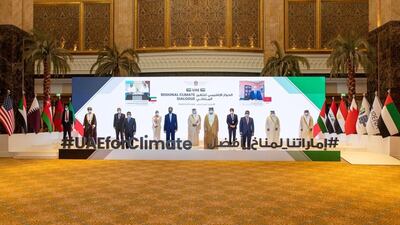
The pledge issued at the end of the Regional Climate Dialogue vowed to help the most vulnerable. -
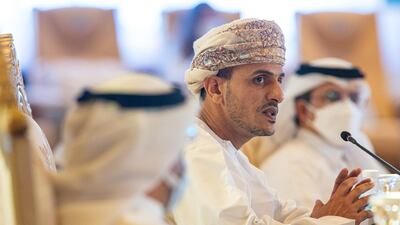
Delegates at the talks in Abu Dhabi. -
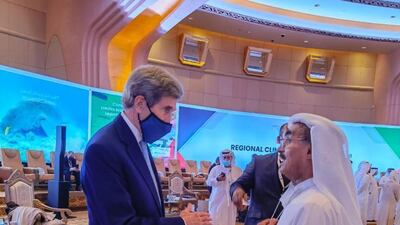
Abdullah Al Nuaimi, UAE Minister of Climate Change and Environment and John Kerry, US climate envoy at the dialogue. -
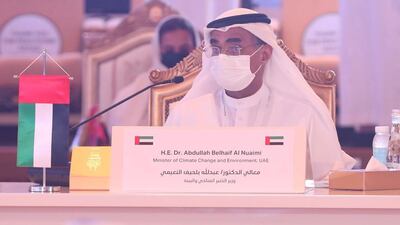
Abdullah Al Nuaimi, UAE Minister of Climate Change and Environment, at the Regional Climate Dialogue. -
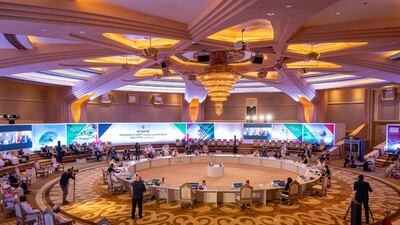
The dialogue comes during a critical year in the global fight to halt rising temperatures. Courtesy: Office of the UAE Special Envoy for Climate Change -
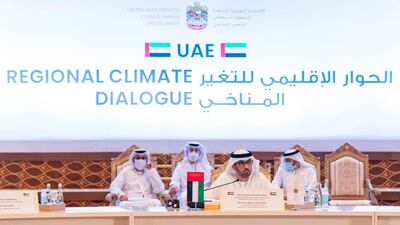
The UAE's Special Envoy for Climate Change, Dr Sultan Al Jaber, at the Regional Climate Dialogue. Courtesy: Office of the UAE Special Envoy for Climate Change -
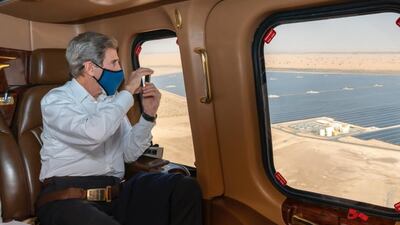
US climate envoy John Kerry is given a helicopter tour of Noor solar park, outside Abu Dhabi on Saturday. Courtesy: Office of the UAE Special Envoy for Climate Change -
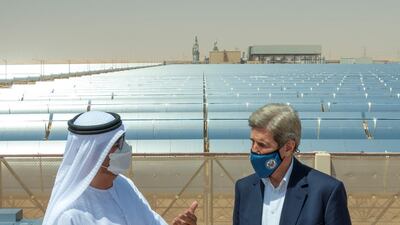
John Kerry speaks with Dr Sultan Al Jaber at Abu Dhabi's Shams 1 solar park on Saturday. The National -
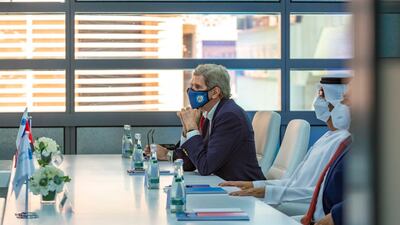
This is John Kerry's first visit to the Middle East since being appointed US climate envoy. The National -
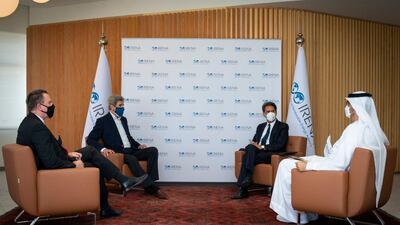
Mr Kerry has vowed to make up for the 'lost years' of the Donald Trump presidency and put the US at the forefront of efforts to protect the environment. The National -
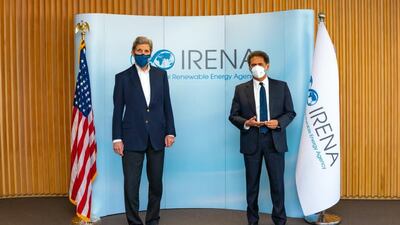
John Kerry meets Francesco La Camera, director general of International Renewable Energy Agency, which has its global headquarters in Abu Dhabi. The National -
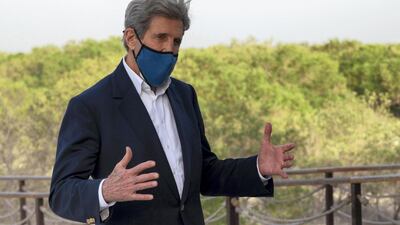
US climate envoy John Kerry visits Jubail Mangrove Park. Courtesy Office of the UAE Special Envoy for Climate Change -
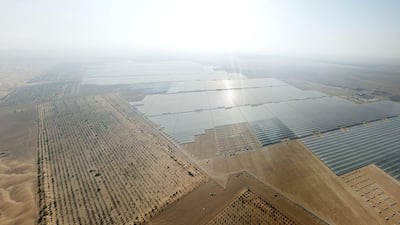
An aerial image of Abu Dhabi's Noor solar park. Its 3.2 million panels make it the largest single-site solar park in the world. Courtesy: Noor Abu Dhabi -
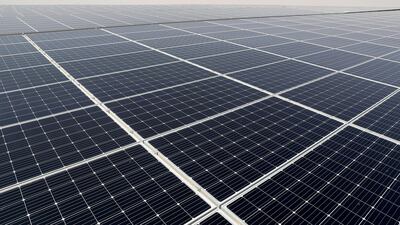
Arrayed panels at Abu Dhabi's Noor solar park. Pawan Singh / The National


“The biggest opportunity is an economic opportunity. An extraordinary amount of jobs will be created," he said.
"I mean, if you have to make electric cars, not the old kind of cars, we've got to change a whole fleet all around the world.
"There are millions of jobs to be created in the making of those cars, in the building of a grid for our country, for instance, or the refurbishment of a grid somewhere else.
"Construction workers, iron workers, pipe fitters, electricians, technicians, all kinds of different people will be involved."
Mr Kerry said that Mr Biden “sees this opportunity as the best jobs programme possible, because there is all kinds of work to be done in the implementation of this transition."
He highlighted the importance of using that transition to create a more equitable world.
“We'll be put to work in this endeavour to make the world fairer, to deal with equity, environmental justice, and to respond appropriately to the adaptation, resilience and the mitigation required."

