
Stray animals taken off the streets of Abu Dhabi are being given the "chance for a better life", as people forced indoors by the Covid-19 pandemic seek creature comforts by adopting pets.
Officials captured 4,000 animals in the first five months of 2020 alone as part of a long-term strategy to contain strays roaming the emirate.
Abu Dhabi started a trap, neuter and release (TNR) programme, operated by waste management authority Tadweer, in 2007 in an effort to limit the growing cat population.
The theory behind TNR, a policy supported by international charities such as the International Fund for Animal Welfare, is to trap feral cats, spay or neuter them and release them back into the environment they came from.
“We take the animal from its habitat to neuter it, and then return it back to where it was found,” said Mohamed Al Naqbi, head of pest control at Tadweer.
“The cages are bar-coded and linked to a GPS system, so when it is time to return the animal we know where exactly it was captured.”
But TNR is not the only policy adopted by authorities, who must also consider animals not suitable for a life on the street, such as lost pets and those that have been sadly dumped by owners.
The National recently joined staff from Tadweer as they looked for stray cats and dogs at the Family Park in Khalidiyah, to gain a greater understanding of the process.
A team of workers and an engineer placed a cage containing cat food between the grass and trees.
It was not long before a cat wandering in the park smelt the bait and walked right into the trap. Once the cat was inside, the cage automatically closed.
The team then looked for signs to show if the cat has been neutered before. If a V-shaped cut is found on its ear, this means the cat has been previously neutered and is released instantly.
-
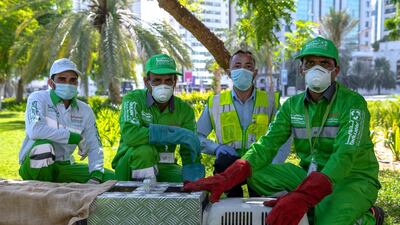
Tadweer workers set about capturing stray cats and dogs at Family Park in central Abu Dhabi. All photos by Victor Besa / The National -
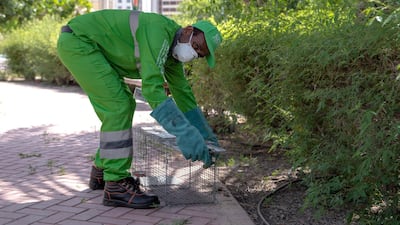
The process is all done by hand and requires patience and skill -
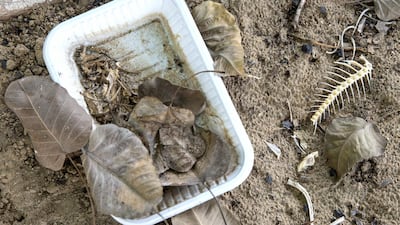
The public are urged not to leave out food for strays as it can quickly spoil in the heat and make animals sick -
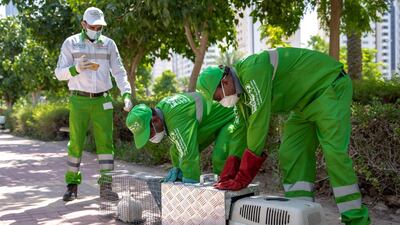
Cats and dogs are caught every day. A trap, neuter and release drive for cats has led to a fall in the number of strays found every day from about 70 to 15 to 30, officials said -
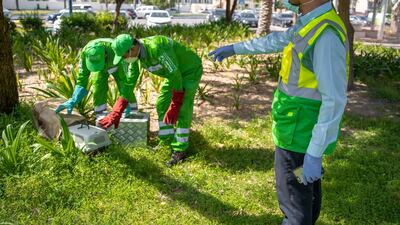
Family Park attracts many strays due to its location in central Abu Dhabi -

Mohamed Al Naqbi, head of pest control projects at Tadweer, said the process was important for public health -

Strays that are caught are taken to Falcon Hospital, where vets and medics have the expertise to treat all kinds of creatures -
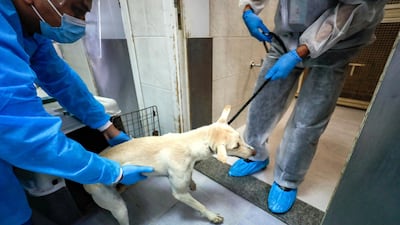
Strays are spayed or neutered to prevent breeding and brought back to good health. -
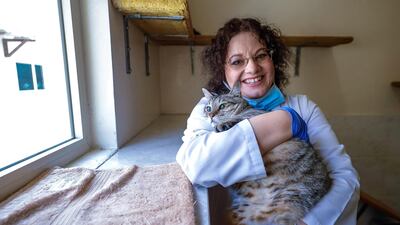
Director Dr Margit Muller said: 'When they come they are so sick, then after a few weeks you get a beautiful animal. Every animal deserves the chance for a happy life' -
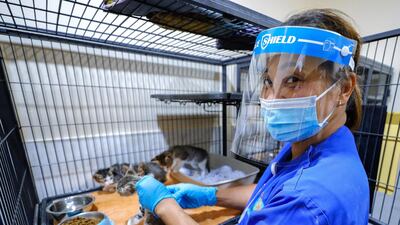
Veterinarian Ronalee Toribio gently injects a deworming solution to kittens at Falcon Hospital -
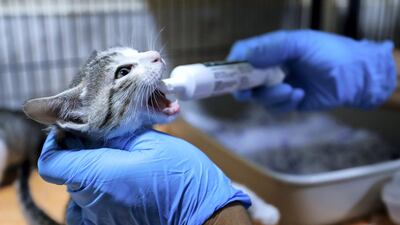
Animals are carefully nursed back to health -
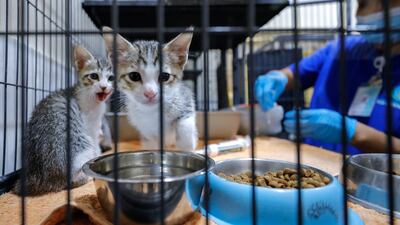
Kittens are given their daily supplements at the Falcon Hospital near Abu Dhabi International Airport -
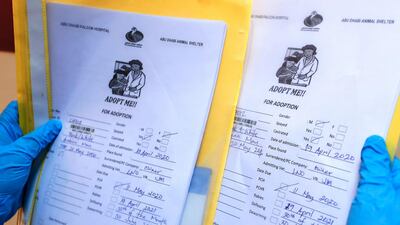
Adoption papers for some of the animals at the clinic -
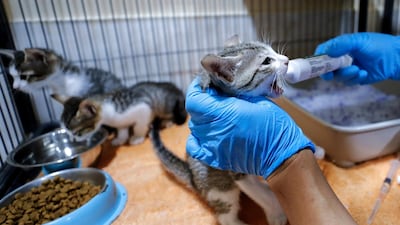
Abu Dhabi, United Arab Emirates, June 22, 2020. Veterinarian Ronalee Toribio, a gently orally injects deworming solution to kittens at the Abu Dhabi Falcon Hospital. Victor Besa / The National Section: NA Reporter: Haneen Dajani -
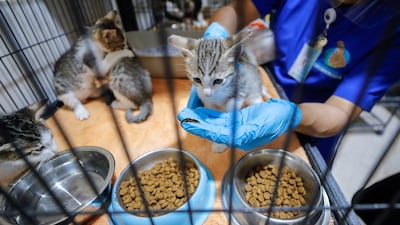
Staff have seen a rise in adoption interest due the virus outbreak, as more residents spend time at home -
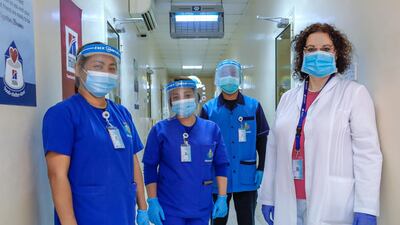
Dr Muller and her team said they love the work they do with animals -
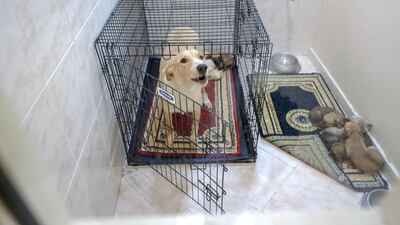
The Dog Maternity unit at the Abu Dhabi Falcon Hospital -

Head veterinarian and supervisor of the Pet Care Centre, Gelah Magtuba (left) with co-veterinarian, Ronalee Toribio -
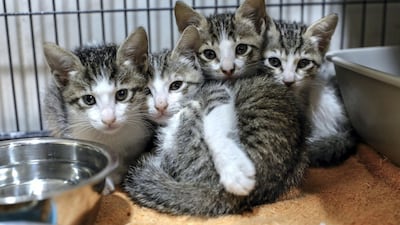
Kittens ready for adoption -

A cat with her week old kittens -
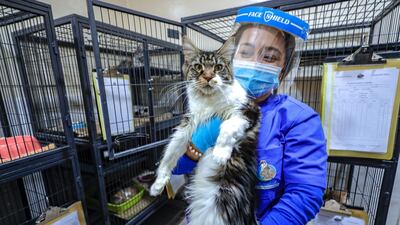
Head vet Gelah Magtuba with her favourite cat, Connie


If no such sign was found, the cat is placed in an air-conditioned van and transferred to the Abu Dhabi Falcon Hospital.
It is important to return the cats to their original locations to avoid creating a population imbalance in certain areas.
If the cats are returned to an area that is considered the territory of a different cat group, for instance, fights could emerge.
Since the TNR programme was launched, the number of stray cats has dropped dramatically, said Mr Al Naqbi.
“Before TNR we used to find 70 stray cats a day.
“Now we receive between 15 to 30 calls a day reporting stray cats.”

Once a cat or dog is taken to Falcon Hospital, medical workers check if they have a chip in their bodies which could lead them to the owner.
If the owners of cats cannot be identified or there are no chips, staff use their judgment to decide whether it is safe to return the animal to the streets or they should be kept at the centre and put up for adoption.
Either way, dogs are never returned back to the street; they are sheltered and offered for adoption by the Falcon Hospital.
Only in rare cases, if the animal is suffering from an infectious incurable disease that it is put to sleep.
“It is rare that we put an animal to sleep, maybe once or twice a month,” said Dr Margit Muller, executive director of the Abu Dhabi Falcon Hospital, which has sheltered and neutered more than 50,000 animals since 2011.
“They would have non-treatable diseases that could affect the other cats, so you have no other option but to put it to sleep."
Dr Muller said hospital staff do all they can to improve the health of the animals they receive.
“When they come they are so sick, then after a few weeks you get a beautiful animal," she said.
“I believe every animal deserves the chance for a happy life.”
She showed pictures of a Pomeranian that was treated at the hospital for a leg injury, but eventually had to undergo amputation.
The dog was treated and trained at the hospital for weeks before he was adopted.
The cats and dogs quarantine in an area of the hospital where animals with treatable diseases or injuries are kept until they are cured.
“These are not cases to be put down, they don’t deserve it; we want to give each dog and cat a chance for a better life.”
After receiving treatment, a microchip is injected in the back of each animal before they leave the hospital.
Pointing to a Persian and another British Blue cat, Dr Muller said they were brought to the hospital from the street, but are in fact domestic cats who either escaped their owners or were abandoned.
“Those are not cats to be taken back to the street," she said. "They are treated, sheltered and offered for adoption.

More than 5,000 cats and dogs have been adopted through the centre so far this year.
“During this pandemic, we have been seeing more people adopt cats and dogs,” said Dr Muller.
“Many people felt lonely [during quarantine], those who adopted pets during this time now have a friend for life."
Other stray animals caught by Tadweer this year include about 2,000 camels, nine sheep, four foxes and a horse – in addition to the 1,824 cats and 418 dogs who were taken to Falcon Hospital.
“Large animals such as camels are taken to special animal impounding centres that are fully equipped with the appropriate food and care,” said Mr Al Naqbi.
“We then place an advert in the newspaper for the owner to recognise it and come back to take it.”
If two weeks pass and the owner fails to show up, the camel is sold at a public auction.

