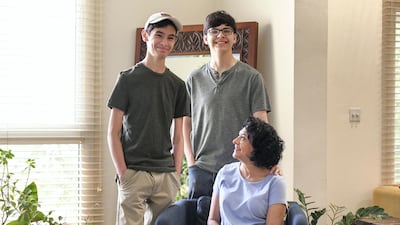

Homeschooling groups that advise parents on how to teach children at home have received continued interest, even after many schools reopened this term.
Two associations in Dubai and Abu Dhabi have received dozens of queries, as some families opt to take their children out of schools in favour of learning from home.
Despite that, this method of education, experts say, remains a fringe choice – and one that can leave children lagging behind or missing social interaction.
Schools across the country began a return to in-class teaching from September, staggered in some emirates, after a long period of e-learning from March. Some schools have faced disruption or temporary closures due to isolated outbreaks and most today offer some form of 'blended' learning model.
Gloria Brown, of the Abu Dhabi Homeschoolers Association, said she had fielded dozens of queries in recent weeks from parents who wanted to know more about how the format worked.
Ms Brown said interest reached a high in September and October but still continued today.
“One of the things we see are people who are accidentally homeschooling and they like it, and they think 'I can do this'," she said.
"My job is to encourage them [to know] that they can.
“We are our child’s best advocate. We know our child like no one else. And if you just listen to your child, you know how to teach them.”
Another group saw a surge in interest in homeschooling as learning was transferred online in March, as cases rapidly grew in the Emirates.
Facing the prospect of paying high fees for limited contact with teachers, more parents, some of whom faced pay cuts, considered the shift.

"Here in the Northern Emirates, we had an upsurge of interested parents between June and September," said Aminah Cooper, an American mother-of-five and co-founder of Dubai Northern Emirates Homeschool Association.
Things have since "mellowed out", she said.
Abu Dhabi resident Gabi Vasile, from Italy, took her 10-year-old son out of Raha International School to begin permanent home learning during the pandemic.
"We said 'let's do it, now is the time to join homeschooling', so we did," she said.
"So far he's enjoying it. He's very independent and he wants to do things his way, which is another reason why homeschooling suits him."
Homeschooling is neither prohibited nor regulated by authorities in the UAE. KHDA, the education regulator in Dubai, does not currently recognise homeschooling programmes. The Abu Dhabi Department of Education and Knowledge (Adek) said it does not recognise homeschooling as an official educational path.
“If a student wants to enrol back in a physical school, they may, but will return back to the year or grade they were in in the last time they were enrolled in a physical school or educational institute,” according to an Adek representative.
As such, no official figures have been compiled on the number of children who follow home learning programmes.
The number is probably in the hundreds, and possibly the low thousands.
Abu Dhabi Homeschoolers Association has about 1,000 members and Dubai Northern Emirates Homeschool Association has 400 members, a number which is growing every week.
Emiratis who choose to teach their children at home must show they are meeting certain educational requirements, while expats do not.
But pupils may face clear problems if they aspire to a university education without showing they had followed a curriculum and passed exams.
Signing up to an accredited programme, many of which are based in the UK and the United States, provides structure and a curriculum.
Critics claim the quality of the education taught by parents may vary considerably, and that a lack of development, or even forms of abuse, that could have been spotted by a teacher could go unnoticed.
Ms Brown has been homeschooling her children, who have a large age gap, for 30 years.
She said her now adult children did very well academically and in their careers, and she continues to teach her teenagers at home.
Costs for a curriculum programme vary from a "a few dirhams to a few thousand", she said.
She spends about $2,000 (Dh7,345) on a set curriculum, and about the same again on online classes.
She said one of the most popular questions the group received was about the social aspect of home learning.
“One of the biggest things that people don’t realise is, Covid-19 has affected us as well," she said.
"We are very social. It’s a community of kids and we get together for field trips.”
It has devoted a number of its recent zoom meetings, which would otherwise have been in person, to a project to help raise money and awareness about The Water Project, which works to provide safe drinking water in sub-Saharan Africa.
During the pandemic, the charity, which has an office in Dubai, also provides handwashing stations, health and hygiene training and homemade mask making.
“This has been great for our homeschool group,” she said.
“We continually seek ways to give our children a well-rounded education."
“Getting involved in community events, meeting other kids of different backgrounds, cultures and ages helps us do that.”

