

With more than 200 nationalities calling this country home, schools in the UAE offer a wide choice of curriculums.
One of the most common concerns among parents, especially when their children are ready to move from primary to secondary school, is choosing a curriculum that will help them get into a good university.
Two common choices, especially for children going to UK curriculum-based schools, is the General Certificate of Education Advanced Level (commonly known as the GCE A Level or, simply, A-Level), and the International Baccalaureate (IB) Diploma Program (IBDP).
Both the courses are popular high-school programmes, which pupils take during the final two years of their schooling. They can be taken by anyone over 16.
However, parents spend countless hours deciding which programme prepares their child better for life with several key questions to consider.
Which course is more widely accepted by the universities? Is one tougher than the other? Can the pupil choose one system and change his or her mind later?
The National compiles a set of frequently asked questions on the two curriculums and clears some misconceptions that surround the programmes.
Differences and similarities between the A-Level and IB Diploma
The IB Diploma and A-Levels have similarities and differences. What matters more than a discussion of which is best is how hard a pupil is prepared to work and the nature of the school they attend.
According to Peter Fremaux, head of secondary at Greenfield International School, an IB school in Dubai, the main similarity is that both offer the same level of education and both are university entry qualifications.
“When A-Level exam boards and the IB write their courses, they work with universities to ensure they are at the correct standard, with the level of content needed to allow pupils to begin university study.
"This means in the individual subjects, pupils follow similar content. Both are taken every year by thousands of pupils across the world and both are recognised and well known by all major universities," he told The National.
For the IB Diploma, pupils take six separate subjects including two languages, mathematics, sciences, humanities and, if they wish, an arts subject.
Pupils also take three core units, writing a 4,500-word extended essay, studying the theory of knowledge and involving themselves in activities involving creativity, activity and service.
A-Levels require pupils to study three to four subjects. Although not part of the A-Level courses, strong British schools will offer extensive extra-curricular activities and study programmes.
Whereas not technically A-Levels, many British curriculum schools offer vocational courses, for example qualifications provided by the Business and Technology Education Council, commonly known as BTECs.

Which is a more credible qualification?
Both programmes are credible qualifications. It is about which is better for the individual pupil, educationists said.
“There are notions of value based on pathways – for example, some may say that pupils looking to study engineering or medicine at university are better served by the more specialised and in-depth offering through A-Levels," said Brendon Fulton, executive principal at the Dubai British School in Jumeirah Park. "However, there is no university entrance data to support this hypothesis.”
A pupil with excellent A-Level results is as likely to gain a spot in a top university as is a pupil with excellent IB Diploma grades, Mr Fulton said.
Mr Fulton said the different approaches suited different pupils. "Some pupils will thrive on the greater breadth offered by the IB whereas others will benefit more from being able to narrow down what they need to study in the A-Levels.
Mr Fremaux said the approach of the pupil was the most important factor. "Hard-working children will thrive in both A-Levels and the IB, but those with weaker approaches to learning will struggle in both," he said. "The ability of the school to prepare pupils for exams and university will affect outcomes regardless of the qualification followed."

Do universities prefer IB?
No university would turn away an excellent pupil regardless of the curriculum but parents may hear that universities prefer the balanced nature of the IB.
There have also been discussions that A-Levels help pupils gain in-depth knowledge and understanding in a specialised range of subjects but there is no data to support these arguments.
“The accepted understanding is that universities are as likely to admit an excellent A-Level pupil as an excellent IB pupil,” Mr Fulton said.
Should you switch curriculums?
Again, this is purely down to the pupil. They can change from one programme to the other at 16 relatively easily and it is a common switch as families move around the world.
What is important is that parents need to consider both routes to university and be aware of the differences between the IB and A-Level and make the decision based on the needs and disposition of their child.
“The IB requires pupils to take a much broader range of subjects with further core units," Mr Fremaux said. "Some pupils need to maintain this breadth and excel on the freedom this offers whereas for others, it is more appropriate to focus on a more structured, focused range of courses that allows them to drop subjects, which is what the A-Level offers.
“If a pupil finds academic study a challenge or lacks motivation in one curriculum, she/he will probably continue to do so in another. Similarly, strong pupils with excellent attitudes to learning will thrive in whatever they do.”
What are the grading systems?
Both the A-Level and IB are highly rigorous and have straightforward scoring systems.
The IB subjects are scored on a 1-7 scale. Pupils gain a maximum of three points for the core units giving a maximum score of 45. A-Levels are marked on an A*-E scale.
“Universities will ask for a certain level in both qualifications, asking for a certain set of grades at A-Level or number of points in the IB," Mr Fremaux said.
“They may also ask for a certain level or grade in a certain subject. I do not believe that either offers an ‘easier’ way to score points or grades as universities aim to ensure they are equivalent to each other.”
Some schools offer GCSE and then IB Diploma – what is the logic behind this?
The main difference is that the General Certificate of Secondary Education (GCSE) is externally examined whereas the IB's Middle Years Programme is internally assessed by schools.
Parents may prefer this and then have the option to choose the IB Diploma or A-Level, both of which are externally examined.
-

Gems Jumeirah Primary School. -
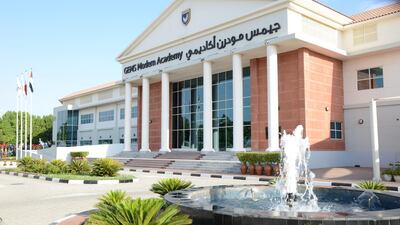
Gems Modern Academy. Courtesy: Gems -

Wellington International School. Pawan Singh / The National -
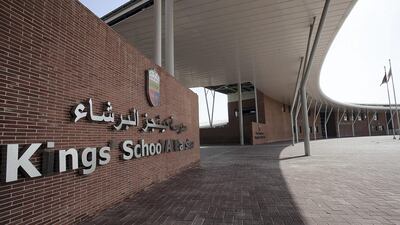
Kings School Al Barsha. Satish Kumar/The National -

Pupils at Jumeirah College. Alex Atack/The National -
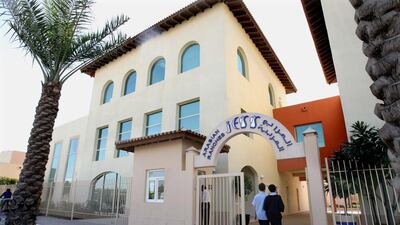
Jumeirah English Speaking School in Arabian Ranches. Courtesy: Stephen Lock -
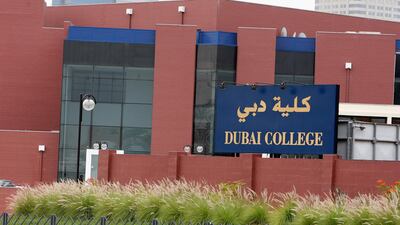
Dubai College building on Al Sufouh Road. Pawan Singh / The National -

Gems Dubai American Academy. Reem Mohammed / The National -
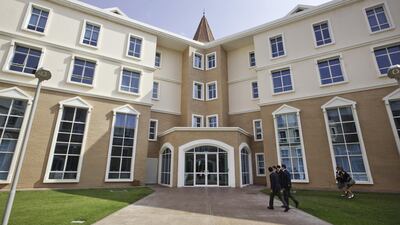
Repton School Dubai. Jaime Puebla / The National -

Lycee Francais International Georges Pompidou Dubai. -
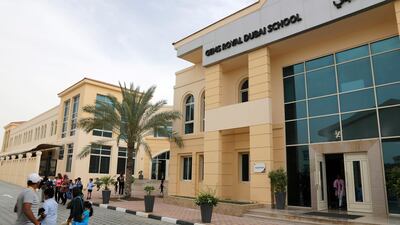
Gems Royal Dubai School. Jeffrey E Biteng / The National -
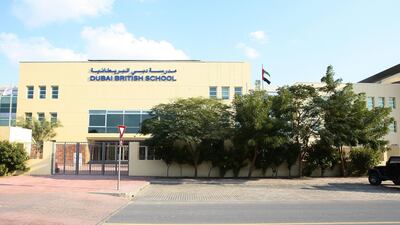
The Dubai British School. Jeffrey Biteng / The National -
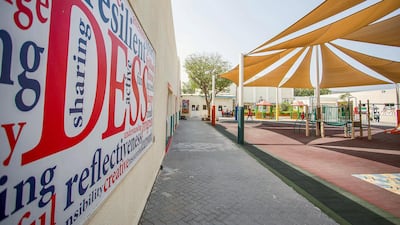
Dubai English Speaking School. -
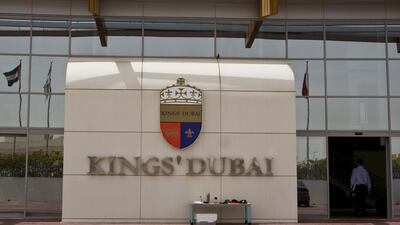
Kings' school Dubai.


The GCSE qualification is also, traditionally, a school-leaving qualification (previously referred to as O-Levels or Ordinary Levels).
Parents need to consider which is more appropriate for their child. For some pupils, the experience gained through taking external qualifications like GCSEs is appropriate in the lead up to the much more important A-Levels or IB Diploma.
Other parents may wish to avoid the pressure of examinations at 16 and would rather wait another two years before their children sit external exams.
Is it possible to study in an IB school and sit A-Levels?
Some schools offer A-Levels as well as the IB but they are two completely separate qualifications.
When a pupil starts one, he or she cannot change midway through and would not mix bits of one with parts of the other.
“Each separate piece of the IB Diploma can stand alone but it is usual for pupils to take all of it and you can only gain the diploma by covering every part of it," Mr Fremaux said. "Similarly, the A-Level is based on the assumption that pupils will have taken three or four A-Levels and not mix different parts of different curriculums.”
The IB is the fastest growing curriculum in Dubai, according to a 2017 research report by UK property consultancy Knight Frank.
The market share of the curriculum increased from two per cent in 2010 to six per cent in 2017 but the British curriculum remains the most popular in Dubai, drawing 93,771 pupils, while Indian-curriculum schools have 79,579 children, Knight Frank said.
Despite the growth, many parents find IB schools expensive.
Experts at the Global International Baccalaureate Conference that was held in October last year in Abu Dhabi called for a reduction in the fees that IB schools charged in the UAE.
"The price for the IB programme is the same all over the world whether the school is charging £60,000 [Dh275,630] or £500 or for free, which is the case with many IB schools in the US," the conference heard.
A 2019 survey by www.whichschooladvisor.com, a website that provides information on different schools in the country, showed UK-curriculum schools offer better value for money when compared with IB schools.

