

A move to online learning imposed by the coronavirus pandemic helped to demonstrate the benefits of extra sleep for school pupils, research found.
A study of 538 pupils from grades 9 to 13 at Dubai College revealed the wellbeing of learners was significantly improved by at least an extra hour of rest afforded by a switch to remote learning.
An education leader at the college said he would welcome a later starting time for lessons to allow pupils to be more refreshed and alert during classes.
While the coronavirus outbreak has led to a year of major upheaval for the education sector, the widespread move to home learning brought an end to early starts and long journeys for pupils who do not live close to their school.
“During the period when pupils were studying online, the impact sleep had on their wellbeing was enormous," said Mark Samways, head of positive education at Dubai College.
“If we could start an hour later, it would be hugely helpful to both staff and pupils. I would certainly support the decision to start later.
“Parents were concerned about the impact of using devices, but we did not find that screen time had a big impact on their wellbeing.”
Mr Samways said pupils were often grumpy and tired when coming to school for classes early in the morning.
Classes start at 7.55am at the school.
Pupils adapt to school life in Covid-19 age
-
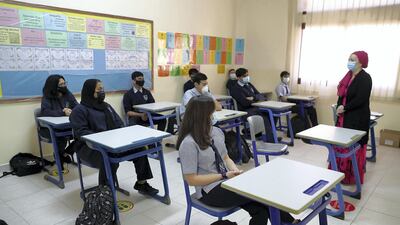
Diana Parva, a French teacher, talks to the class of grade 11 at Victoria English School in Sharjah. Pawan Singh / The National -
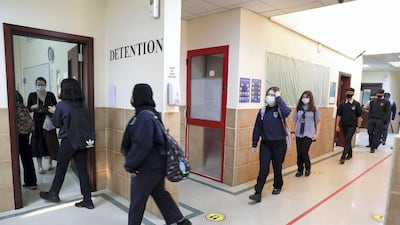
Pupils of grade 11 go to their class on the first day of the school reopening in 2020. Pawan Singh / The National -
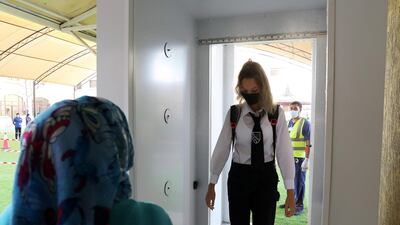
Pupils pass through the disinfection tunnel at the Victoria English School in Sharjah last year. Pawan Singh / The National -
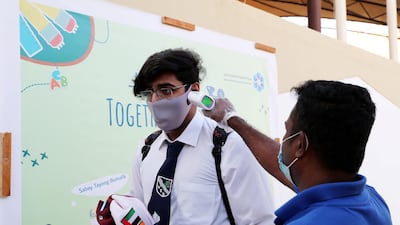
A staff member checks the temperature of a pupil at the entrance gate at the Victoria English School in Sharjah in 2020. Pawan Singh / The National -
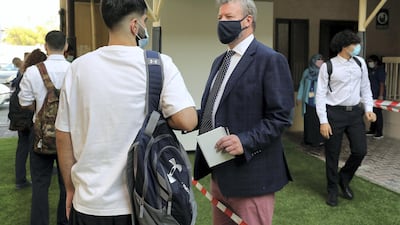
School principal Keith Sykes (R) talks to pupils at Victoria English School in Sharjah on the first day of school in 2020. Pawan Singh / The National -

Pupils stand in a socially distanced queue at the Victoria English School in Sharjah. Pawan Singh / The National


"When we feel tired, we struggle to engage with ideas and concepts," said Mr Samways, who led the research.
“Pupils felt more refreshed and the additional sleep was key to reflective thinking."
The study revealed pupils who slept an extra hour were three times more likely to report a more positive effect and 4.45 times more likely to report greater emotional wellbeing.
The study, titled Boosting Expatriate Student Wellbeing in the UAE: Using Positive Psychology Interventions in a pandemic, found: "During the school closures, pupil engaged in less physical activity, but more sleep, social media use and time playing online games.
“Pupils who increased their hours of sleep were more likely to experience greater wellbeing."
Mr Samways called on schools to prioritise wellbeing ahead of curriculum at this point.
A 2018 student wellbeing census of about 96,000 pupils by the Knowledge and Human Development Authority found 89 per cent were more likely to feel satisfied with life if they slept well.

Michael Lambert, headmaster at Dubai College, which has 1,041 pupils, said the school would use the research to improve its services and consider how to integrate the benefits of positive psychology in the middle and senior school.
“What we know from research into the science of sleep and the adolescent brain is that older pupils can be more productive if their school day starts later," Mr Lambert said.
“In order for a later start to work for our school, however, we would need the schools with whom we collaborate, the schools which staff children attend and the schools which siblings attend, to start later as well. This will take a sector wide approach in Dubai.”
Dubai College’s positive education programme, to which pupils devote 25 minutes every week, preceded the pandemic.
The latest study began in 2019, and pupils were surveyed about their emotional and mental wellbeing three times a year.
Last March, schools had to move online to control the spread of Covid-19, and the positive education programme was also moved online.
Positive psychology includes activities such as pupils writing a letter to someone to express gratitude.
Pupils also engaged in an activity called a worry bin, where they jotted down matters they were nervous or concerned about and put them in a bowl or bin.
The children share these notes and talk about their common worries, which helps them understand that others face similar problems.

