


A digital school that seeks to provide an education to one million refugee and underprivileged children over the next five years launched from Dubai on Wednesday.
The Mohammed bin Rashid Global Initiatives is behind the project that will see the first batch of pupils join the school in September 2021.
Refugee children from countries including Iraq, Syria, Lebanon and Jordan are the focus. MBRGI is seeking accreditation for the school from ministries of education in different parts of the world. An accredited school diploma will help pupils get admission in university.
A pilot launched this month with 20,000 pupils enrolled and will run until August of next year.
They will have access to digital learning materials available in Arabic and international curricula.
Sheikh Mohammed bin Rashid, Vice President and Ruler of Dubai, described the school as filling a "scientific and educational gap in the Arab world".
"We have millions of children who miss years of education due to economic conditions or conflicts. And if no one moves to address these challenges, there will come generations led by ignorance and extremism, instead of leading their homelands with the light of knowledge and knowledge," he said.
Omar Al Olama, Minister of State for Artificial Intelligence, Digital Economy and Remote Work Applications, said education was the key to providing children a brighter future.
“We’ve read in history that if you want to change the future of a country, change the education,” said Omar Al Olama, Minister of State for Artificial Intelligence, Digital Economy and Remote Work Applications.
“With Covid-19 disrupting sectors worldwide, 1.6 billion people around the world were left without a school in 190 countries.
“There are refugee children who do not have access to an education and this is a challenge Sheikh Mohammed wants to overcome. If we want to change the future of the Middle East, we have to provide them with an education,” he said.
A tie-up with leading universities will help provide technological solutions in remote areas where pupils do not have access to digital learning tools.
The universities include Harvard, Stanford, Massachusetts Institute of Technology, New York University and mEducation Alliance.

Dedicated teachers will be recruited in the coming months, but those already in the area will participate in the pilot phase.
There are about 30 to 34 million refugee children worldwide, according to the United Nations Refugee Agency.
Pupils worldwide switched to e-learning because of school closures but most refugees did not have the same opportunity.
The Covid-19 pandemic created a major disruption for these children, who were already facing many challenges, especially in terms of education.
In June, the agency said that many refugee camps did not have the technical infrastructure to support online learning.
“Even before Covid-19 refugee children were twice as likely to be out of school as other children, and despite improvements in refugee enrolment rates, only 63 per cent of refugees are in enrolled in primary school and 24 per cent in secondary education,” it said.
“The pandemic risks creating a backslide in the small gains made and creating a disaster for groups such as adolescent girls.”
The agency estimated that 20 per cent of refugee girls in secondary school are at significant risk of never returning to school because of Covid-19 school closures.
Dr Paul Kim, associate dean and chief technology officer at Stanford University, said pupils at the digital school will be able to create online portfolios of their work that will help with university admissions in future. Teachers and advisors will also help pupils with university applications.
“When we have the machine learning algorithms and modern artificial intelligence systems and tools available, we will be able to track student performance data in a way that never been possible before,” he said.
“With those kind of footprints that we will be tracking, we will be able to better guide our members with highly personalised learning pathways that can help them reach their fullest potential.”
Prof Christopher Dede, a professor in learning technologies at Harvard University, said the digital school was an opportunity to digitally enhance the education sector worldwide.
“This is the time for a mobile engineer to realise these opportunities for learning and overcome the challenges we face in the present and the future,” he said.
“We can design new ways to learn, teach and assess, which can grow from initial projects in the digital school to prove effectiveness to scalable insights that can influence education everywhere, for everyone.
“We can rescue children who have no opportunities now, to help all of us realise a bright future.”
MBRGI is responsible for other educational projects in the region.
Its Madrasa e-learning platform offers high-tech educational content to millions of Arab pupils in kindergarten to grade 12.
It was launched in 2018 and has 5,000 free educational videos in science, maths, biology, chemistry and physics in Arabic.
This year, MBRGI provided about 400 pupils and 11 teachers at two refugee camps in Jordan with offline education solutions, including Madrasa tablets, Wi-Fi hotspots, smart bags and flash memory devices.
These tools have helped refugees in camps and remote areas gain access to an education, especially as the Covid-19 pandemic has left many without an education.
How Covid-19 has heavily affected the lives of refugees:
-

Syrian refugees in a construction site they have been using as a shelter in the southern Lebanese city of Sidon as Lebanon enters lockdown to protect against coronavirus outbreaks, on March 17, 2020. AFP -
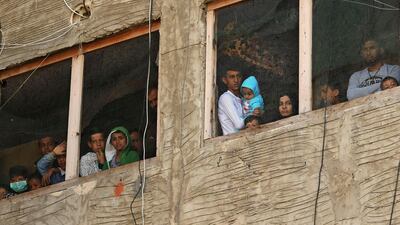
Many child refugees are also living in the construction site. AFP -
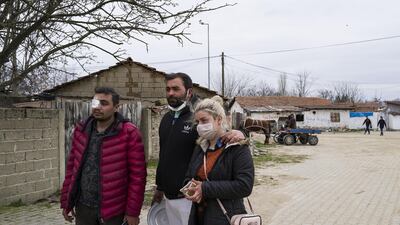
Refugees in Edirne, Turkey, near the border with Greece, wear protective face masks on March 10, 2020. Bloomberg -

Afghan health workers check the temperatures of Afghan refugees returning at the Islam Qala border crossing with Iran on March 18, 2020. Tens of thousands of Afghan refugees are being expelled from Iran over the past few months. AP Photo -
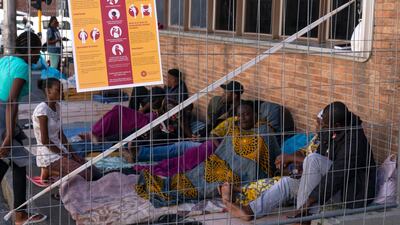
An information poster on the coronavirus is secured to a fence among refugees from various African nations living on a city sidewalk in Cape Town, South Africa, on March 23 2020. EPA -
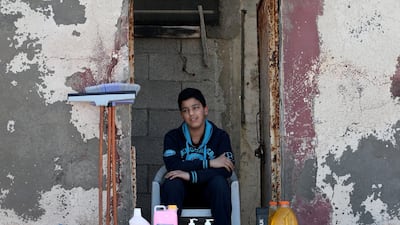
A Palestinian boy sells cleaning tools and sanitisers amid concerns over the spread of coronavirus, at Beach Refugee Camp in Gaza City, Palestine, on March 22, 2020. Reuters -
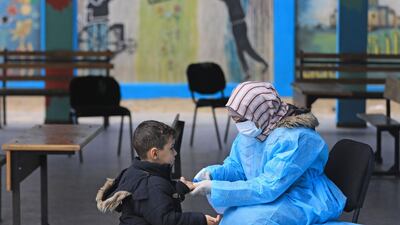
A Palestinian health worker checks the body temperature of a child at a United Nations Relief and Works Agency for Palestinian Refugees (UNRWA) school at Al Shati refugee camp in Gaza City, Palestine on March 18, 2020. AFP -
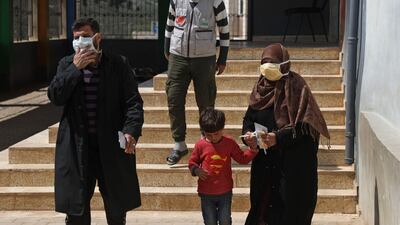
Displaced Syrians wear protective masks as they leave a lecture provided by staff from Turkey's Humanitarian Relief Foundation to raise awareness about the coronavirus pandemic at a refugee camp in Kafr Lusin, Syria, on March 23, 2020. AFP -
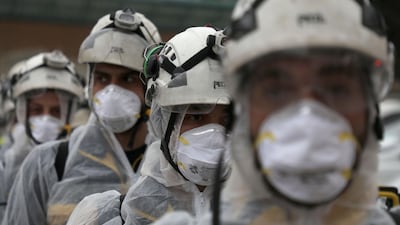
Members of the Syrian Civil Defence, also known as the 'White Helmets', sterilise a school in the area of Ghosn Al Zeitun in Afrin on March 18, 2020 as part of a campaign to disinfect schools against the coronavirus. AFP -
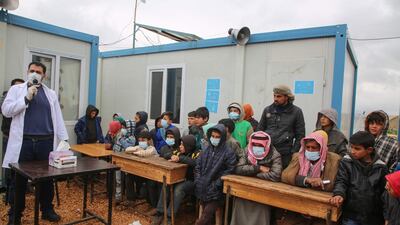
A Syrian medic holds an awareness campaign on how to be protected against the coronavirus, in a camp for displaced people in Kafr Lusin, Syria, on March 18, 2020. AFP



