• Hanna Achilles-Auferoth, founder of homeware brand Achilles Berlin, has already secured a remote work visa and will leave Germany for Dubai soon. Courtesy: Hanna Achilles-Auferoth
    Hanna Achilles-Auferoth, founder of homeware brand Achilles Berlin, has already secured a remote work visa and will leave Germany for Dubai soon. Courtesy: Hanna Achilles-Auferoth
  • Edmundas Balcikonis, founder of a Lithuanian travel software firm, arrived on a break in December and never left. Courtesy: Edmundas Balcikonis
    Edmundas Balcikonis, founder of a Lithuanian travel software firm, arrived on a break in December and never left. Courtesy: Edmundas Balcikonis
  • Edward Batrouni, founder of UK-based software company Zenitech, is making the move to Dubai permanent after working here for several months while the UK was under lockdown. Courtesy: Edward Batrouni
    Edward Batrouni, founder of UK-based software company Zenitech, is making the move to Dubai permanent after working here for several months while the UK was under lockdown. Courtesy: Edward Batrouni
  • The city's lifestyle and several new visa options have made it a strong draw for remote workers. The National
    The city's lifestyle and several new visa options have made it a strong draw for remote workers. The National
  • A recent decline in cases after a spike last winter has allowed many Covid-19 rules to be relaxed. Courtesy: Dubai Media Office
    A recent decline in cases after a spike last winter has allowed many Covid-19 rules to be relaxed. Courtesy: Dubai Media Office
  • Fred Roeder, managing director of London-based Consumer Choice Centre, compiles a global resilience report that places UAE second place in the world for how it has tackled the pandemic. Courtesy: Fred Roeder
    Fred Roeder, managing director of London-based Consumer Choice Centre, compiles a global resilience report that places UAE second place in the world for how it has tackled the pandemic. Courtesy: Fred Roeder

Dubai jobs and visas: meet the remote workers who escaped a world in lockdown


Patrick Ryan
  • English
  • Arabic

More young professionals and start-ups are choosing Dubai as their home – with newly relaxed visa rules and a fast vaccine programme among the key drivers.

The National spoke to the founder of a German homeware brand, a British software company, and a Lithuanian travel agency, along with other digital remote workers who made the move.

Several visited during the height of Europe's winter lockdowns and have now decided to return.

“There were a lot of people who came here last autumn and stayed for several months because of the restrictions in their own countries," said Fred Roeder, managing director of London-based Consumer Choice Centre.

Dubai is experiencing a tectonic shift at the minute, with more highly skilled professionals starting to call it home
Fred Roeder, Consumer Choice Centre

“There was nowhere else to go that offered the same freedoms in Covid times.”

Now many of those visitors are making the move permanent.

"Dubai is experiencing a tectonic shift at the minute, with more and more highly skilled professionals starting to call it home," he said.

Mr Roeder, a respected health economist, produces a regular global resilience ranking of how well countries fared in the pandemic, which last week ranked the UAE second in the world.

It also recognised the Emirates for performing significantly better with its vaccination campaign than European Union countries.

The campaign, which delivers doses to people of all ages at the same time, means new arrivals can get the shots as soon as their visa residency documents are ready, which typically takes three or four weeks.

  • An AI-enabled service allows Dubai residents to book a Covid-19 vaccine appointment quickly and efficiently via WhatsApp, say officials.
    An AI-enabled service allows Dubai residents to book a Covid-19 vaccine appointment quickly and efficiently via WhatsApp, say officials.
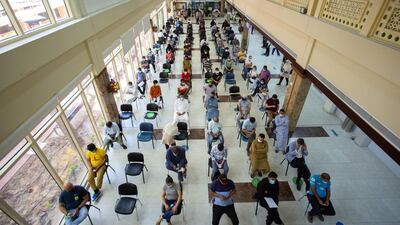
  • Members of the public wait to receive Covid-19 vaccines in Dubai.
    Members of the public wait to receive Covid-19 vaccines in Dubai.
  • A man receives a Covid-19 vaccine at the MBRU community mobile health clinic, near the Al Waha Community, on Nad Al Hamar Road, Dubai.
    A man receives a Covid-19 vaccine at the MBRU community mobile health clinic, near the Al Waha Community, on Nad Al Hamar Road, Dubai.
  • Officials have reported a large turnout for the Covid-19 vaccine drive across Dubai Health Authority's vaccination centres.
    Officials have reported a large turnout for the Covid-19 vaccine drive across Dubai Health Authority's vaccination centres.
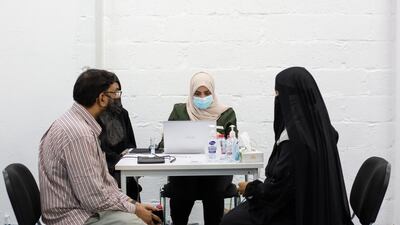
  • Members of the public register to receive their Covid-19 vaccine in Dubai.
    Members of the public register to receive their Covid-19 vaccine in Dubai.
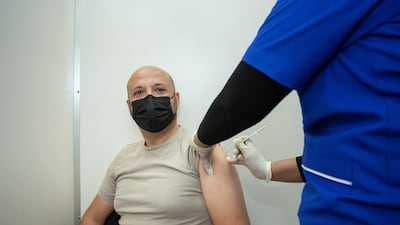
  • A woman is inoculated against Covid-19. A high vaccination rate has helped the UAE keep infection rates down.
    A woman is inoculated against Covid-19. A high vaccination rate has helped the UAE keep infection rates down.
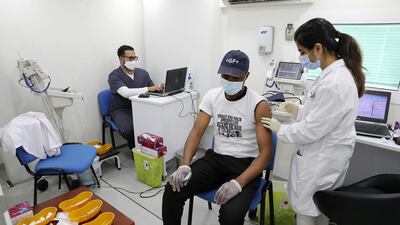
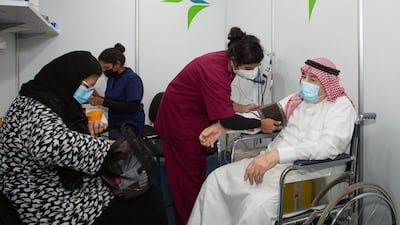
  • A man undergoes tests before receiving his Covid-19 vaccination. Elderly people and those with health issues have been prioritised.
    A man undergoes tests before receiving his Covid-19 vaccination. Elderly people and those with health issues have been prioritised.

“Even though there is a lot of freedom you still see people sticking to the rules, you don't see as many people in other countries keeping their masks on," said Mr Roeder, a German who now too is based in Dubai.

The government's decision to grant resident visas for working remotely make it an even more desirable location, especially for younger people.

The most recent figures available, from Dubai Tourism in late March, show 1,700 people had applied for its remote working visa - the application link is here - with most accepted. For the first time, it allows people to live in the Emirates and work for a company abroad that has no base here.

In addition, 16,000 foreign travellers opted to take advantage of the city's free visa extension in January, Dubai Tourism's chief executive Issam Kazim told CNN Travel. Traditional visa routes working for domestic companies, self-employment and founding a start-up business are still popular.

Fred Roeder said more remote workers are moving to Dubai. Courtesy: Fred Roeder

German homeware founder finds a new home

Berlin resident Hanna Achilles-Auferoth, 34, plans to make the move to Dubai soon.

“I was there from February to April and now plan to move there permanently soon,” said the founder and chief executive of Achilles Berlin, a luxury lifestyle and homeware company.

“Dubai is an extremely attractive proposition for an e-commerce entrepreneur.

“When I was there I saw how easy it was to work remotely. I was impressed by how it was open for business meetings in restaurants, which was not something I could do in Germany.”

Ms Achilles-Auferoth already has one of the new remote work visas. The nature of her business means her employees do not need to be based in one location.

“We have a team of 10 but we all work remotely around the globe,” she said.

“It’s a very attractive prospect to be based in Dubai.”

Dubai's sunshine beats a Lithuanian winter

Edmundas Balcikonis relocated to Dubai in December to work temporarily while his home country, Lithuania, was under lockdown.

Mr Balcikonis, 34, runs a travel software firm called Eddy Travels, and despite the disruption caused by the pandemic, found his stint in Dubai was successful.

He plans to return to Lithuania soon to tie up loose ends before making the switch to Dubai permanent.

“Nothing was happening anywhere except in Dubai, so I decided to work from there instead of being in lockdown by myself at home,” he said.

“Being able to go to business meetings in person gave me great confidence in the market here.

“It made me decide to make the move to Dubai full-time.”

Edmundas Balcikonis is in the process of relocating his travel software firm to Dubai. Courtesy: Edmundas Balcikonis

UK resident Edward Batrouni, 41, stayed in Dubai – working remotely – with his wife and two children, from December to April.

“We ended up staying longer than we first expected,” he said.

“My company has offices globally and Dubai is a perfect hub for me to operate from.”

He now plans to return and make it his family’s permanent home.

"I knew the UAE was at the forefront of innovation and were digitising as many processes as they could," said the founder of software company Zenitech.

“That made me want to be part of that growth and help shine a light on it.”

UAE currency: the story behind the money in your pockets
The%20specs
%3Cp%3E%3Cstrong%3EEngine%3A%20%3C%2Fstrong%3E2.0-litre%204-cyl%20turbo%3Cbr%3E%3Cstrong%3EPower%3A%20%3C%2Fstrong%3E190hp%20at%205%2C600rpm%3Cbr%3E%3Cstrong%3ETorque%3A%20%3C%2Fstrong%3E320Nm%20at%201%2C500-4%2C000rpm%3Cbr%3E%3Cstrong%3ETransmission%3A%20%3C%2Fstrong%3E7-speed%20dual-clutch%20auto%3Cbr%3E%3Cstrong%3EFuel%20consumption%3A%20%3C%2Fstrong%3E10.9L%2F100km%3Cbr%3E%3Cstrong%3EPrice%3A%20%3C%2Fstrong%3EFrom%20Dh119%2C900%3Cbr%3E%3Cstrong%3EOn%20sale%3A%20%3C%2Fstrong%3ENow%3C%2Fp%3E%0A
Tips for taking the metro

- set out well ahead of time

- make sure you have at least Dh15 on you Nol card, as there could be big queues for top-up machines

- enter the right cabin. The train may be too busy to move between carriages once you're on

- don't carry too much luggage and tuck it under a seat to make room for fellow passengers

Emergency

Director: Kangana Ranaut

Stars: Kangana Ranaut, Anupam Kher, Shreyas Talpade, Milind Soman, Mahima Chaudhry 

Rating: 2/5

Gulf Under 19s final

Dubai College A 50-12 Dubai College B

Dubai Bling season three

Cast: Loujain Adada, Zeina Khoury, Farhana Bodi, Ebraheem Al Samadi, Mona Kattan, and couples Safa & Fahad Siddiqui and DJ Bliss & Danya Mohammed 

Rating: 1/5

How to turn your property into a holiday home
  1. Ensure decoration and styling – and portal photography – quality is high to achieve maximum rates.
  2. Research equivalent Airbnb homes in your location to ensure competitiveness.
  3. Post on all relevant platforms to reach the widest audience; whether you let personally or via an agency know your potential guest profile – aiming for the wrong demographic may leave your property empty.
  4. Factor in costs when working out if holiday letting is beneficial. The annual DCTM fee runs from Dh370 for a one-bedroom flat to Dh1,200. Tourism tax is Dh10-15 per bedroom, per night.
  5. Check your management company has a physical office, a valid DTCM licence and is licencing your property and paying tourism taxes. For transparency, regularly view your booking calendar.
Ten tax points to be aware of in 2026

1. Domestic VAT refund amendments: request your refund within five years

If a business does not apply for the refund on time, they lose their credit.

2. E-invoicing in the UAE

Businesses should continue preparing for the implementation of e-invoicing in the UAE, with 2026 a preparation and transition period ahead of phased mandatory adoption. 

3. More tax audits

Tax authorities are increasingly using data already available across multiple filings to identify audit risks. 

4. More beneficial VAT and excise tax penalty regime

Tax disputes are expected to become more frequent and more structured, with clearer administrative objection and appeal processes. The UAE has adopted a new penalty regime for VAT and excise disputes, which now mirrors the penalty regime for corporate tax.

5. Greater emphasis on statutory audit

There is a greater need for the accuracy of financial statements. The International Financial Reporting Standards standards need to be strictly adhered to and, as a result, the quality of the audits will need to increase.

6. Further transfer pricing enforcement

Transfer pricing enforcement, which refers to the practice of establishing prices for internal transactions between related entities, is expected to broaden in scope. The UAE will shortly open the possibility to negotiate advance pricing agreements, or essentially rulings for transfer pricing purposes. 

7. Limited time periods for audits

Recent amendments also introduce a default five-year limitation period for tax audits and assessments, subject to specific statutory exceptions. While the standard audit and assessment period is five years, this may be extended to up to 15 years in cases involving fraud or tax evasion. 

8. Pillar 2 implementation 

Many multinational groups will begin to feel the practical effect of the Domestic Minimum Top-Up Tax (DMTT), the UAE's implementation of the OECD’s global minimum tax under Pillar 2. While the rules apply for financial years starting on or after January 1, 2025, it is 2026 that marks the transition to an operational phase.

9. Reduced compliance obligations for imported goods and services

Businesses that apply the reverse-charge mechanism for VAT purposes in the UAE may benefit from reduced compliance obligations. 

10. Substance and CbC reporting focus

Tax authorities are expected to continue strengthening the enforcement of economic substance and Country-by-Country (CbC) reporting frameworks. In the UAE, these regimes are increasingly being used as risk-assessment tools, providing tax authorities with a comprehensive view of multinational groups’ global footprints and enabling them to assess whether profits are aligned with real economic activity. 

Contributed by Thomas Vanhee and Hend Rashwan, Aurifer