Novak Djokovic checks his broken racket at the Italian Open. AP

Novak Djokovic may set a bad example but outbursts are not unique in tennis' gladiatorial world


Reem Abulleil
  • English
  • Arabic

It’s not easy to come out of the worst week of your professional tennis career, step back on court just a few days later, and win an historic Masters 1000 event.

But that's exactly what Novak Djokovic has managed to pull off this past week in Rome, shortly after getting defaulted at the US Open for accidentally hitting a line judge with a ball.

A serious mistake and a great deal of bad luck abruptly ended Djokovic’s shot at an 18th Grand Slam title in New York.

The world No 1 has been open about the whole experience while talking in Rome, admitting it was an incident he will never forget but he’s also adamant about moving on.

“I understand that I have outbursts, and this is kind of the personality and the player that I have always been,” he said.

“Obviously went through ups and downs in my career, managing to control my emotions. But you're alone out there. It's a lot of intensity and a lot of pressure. You have to deal with all of that; so sometimes situations like this happen.”

What Djokovic is describing is nothing new in tennis. The sport has a unique gladiatorial element to it, pitting two players against each other with zero help from anyone around you. You cannot even speak to your coach during a match.

Players handle that pressure in various ways. Some spend the entire match shouting self-loathing monologues at themselves or towards their box, à la Andy Murray; others abandon any sense of restraint like Nick Kyrgios or Benoit Paire, while some internalise it all and still manage to win. But the majority of players have, at one point or another, tossed a racquet or a ball in anger, with little consideration to the consequences.

Should the players pay more attention to the possible consequences? Absolutely. Is it a terrible example for kids watching? It certainly is, and Djokovic, and his peers, are well aware of that. But is this exclusively a “Djokovic problem” and should he suddenly be painted as this volatile player with “anger issues”? Of course not.

The narrative being spun over the last week in Rome surrounding the Serb and his behaviour on court has been wild. After he smashed his racquet and got a code violation during his three-set quarter-final win over Dominik Koepfer in Rome, the headline was, “Djokovic has another outburst on court”.

When he had a heated argument with the chair umpire and received a code for audible obscenity during his semi-final victory over Casper Ruud, the headline was similarly, “Djokovic gets angry again”.

______________

When Djokovic defaulted

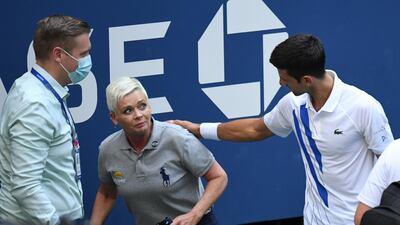
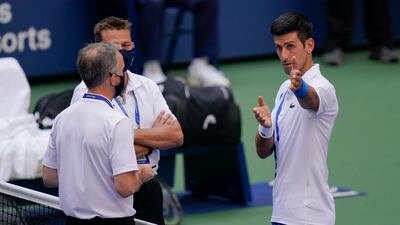
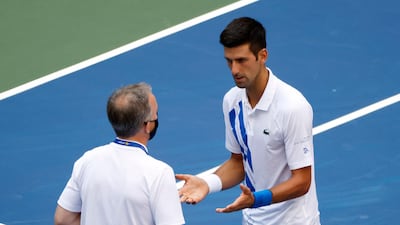
  • Novak Djokovic checks on the wellbeing of the line judge he struck with a ball during his US Open fourth round match against Pablo Carreno Busta. Reuters
    Novak Djokovic checks on the wellbeing of the line judge he struck with a ball during his US Open fourth round match against Pablo Carreno Busta. Reuters
  • Novak Djokovic checks on the line judge. Reuters
    Novak Djokovic checks on the line judge. Reuters
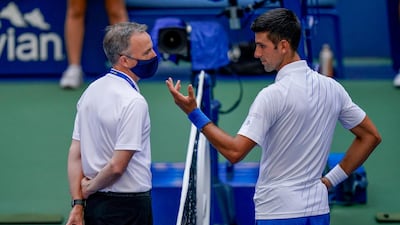
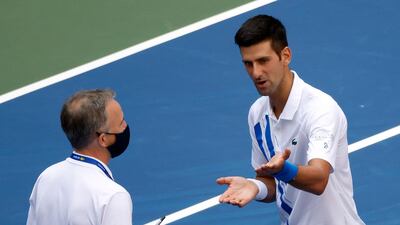
  • Novak Djokovic talks with the match umpire. PA
    Novak Djokovic talks with the match umpire. PA
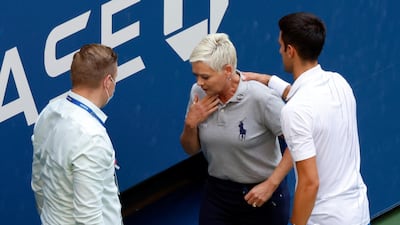
  • Novak Djokovic tries to help the line judge. EPA
    Novak Djokovic tries to help the line judge. EPA
  • Novak Djokovic tries to help the line judge. EPA
    Novak Djokovic tries to help the line judge. EPA
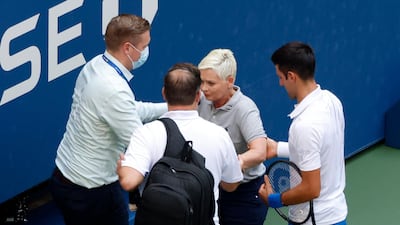
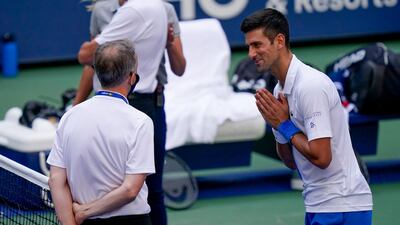
  • Novak Djokovic, of Serbia, talks with tournament officials after the incident. PA
    Novak Djokovic, of Serbia, talks with tournament officials after the incident. PA
  • Novak Djokovic talks with a match official. PA
    Novak Djokovic talks with a match official. PA
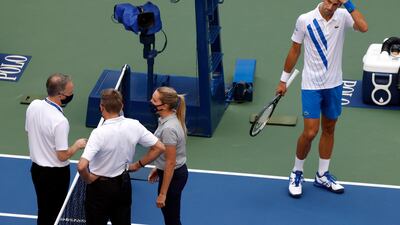
  • Novak Djokovic waits for a decision by US Open officials. EPA
    Novak Djokovic waits for a decision by US Open officials. EPA
  • Novak Djokovic talks to the head of officiating at the International Tennis Federation Soeren Friemel. EPA
    Novak Djokovic talks to the head of officiating at the International Tennis Federation Soeren Friemel. EPA
  • Novak Djokovic talks to the head of officiating at the International Tennis Federation Soeren Friemel. EPA
    Novak Djokovic talks to the head of officiating at the International Tennis Federation Soeren Friemel. EPA
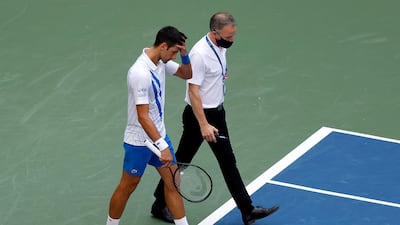
  • Novak Djokovic walks off the court with Soeren Friemel. EPA
    Novak Djokovic walks off the court with Soeren Friemel. EPA
  • Novak Djokovic shakes hands with Pablo Carreno Busta after the Serb's disqualification. PA
    Novak Djokovic shakes hands with Pablo Carreno Busta after the Serb's disqualification. PA
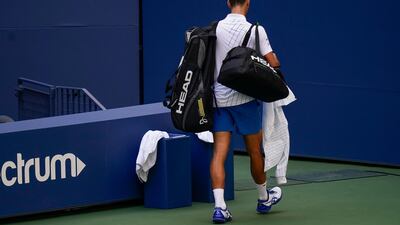
  • Novak Djokovic leaves the court after his disqualification. AP
    Novak Djokovic leaves the court after his disqualification. AP

It is understandable that the public is paying extra attention to Djokovic’s demeanour on court since he got defaulted at the US Open, but tracking every code violation and focusing every storyline on it is ignoring the fact that this is a common occurrence in tennis.

Even someone as reserved as Karolina Pliskova lost her cool in Rome before and smashed her racquet against the umpire’s chair, leaving a hole in the side of it.

In a match against Roger Federer in Dubai in 2017, Paire angrily threw his racquet against the backboard of the court. It bounced off the wall but thankfully did not hit anyone.

“Yeah, it was funny, actually. He got lucky,” Federer said afterwards. The Swiss laughed it off because he sees it so often, and isn’t immune to it either.

“Players know what the consequences are,” Federer added. “He knew that if he smashed one more racquet it would be a point penalty and then it goes into game quickly, and things get really serious and expensive and all that.

“Sure, you have to be careful. When you whack a ball out of the stadiums, you want to be 100 per cent sure you clear everything in the path, even birds and stuff. If you throw the racquet, you want to know how it bounces. And if it's the unknown, you shouldn't do it.”

Simona Halep had to work on her attitude. EPA

That “shouldn’t do it” part is easier said than done. Djokovic says he is constantly working on controlling his emotions better during matches. Murray says he has spent years trying to figure out why he gets this angry with himself on court.

Attitude on court is often a career-long work-in-progress. Simona Halep had to lose her coach Darren Cahill for a while to work on her attitude before he agreed to reunite with her. That particular case was more about bringing her best fighting spirit to the court, and it wasn’t about anger, but it is all connected. When you’re in a high-pressure situation, it is not always easy to summon your best behaviour or your inner warrior on demand.

Halep saw what happened to Djokovic at the US Open and says it was a helpful warning for her.

“Definitely. I was, like, ‘whoa’. We have to really be careful because people are around us. We don't have to react that bad during the matches, because it's just a tennis match,” said the Romanian two-time major champion.

Players should be more careful, and should do everything possible to stop themselves from tossing racquets and balls in anger during a match. That’s an undeniable fact. But singling out Djokovic and pretending he is the sole repeat offender is ridiculous.

“It's definitely not the best message out there, especially for the young tennis players looking at me. I don't encourage that, definitely,” Djokovic said.

“But, look, we're all people. We all do our best. There were times and periods when I don't do that, and there are sometimes periods when I do. It's unpredictable really in life what can happen.”


Dust and sand storms compared

Sand storm

  • Particle size: Larger, heavier sand grains
  • Visibility: Often dramatic with thick "walls" of sand
  • Duration: Short-lived, typically localised
  • Travel distance: Limited 
  • Source: Open desert areas with strong winds

Dust storm

  • Particle size: Much finer, lightweight particles
  • Visibility: Hazy skies but less intense
  • Duration: Can linger for days
  • Travel distance: Long-range, up to thousands of kilometres
  • Source: Can be carried from distant regions

Qosty Byogaani

Starring: Hani Razmzi, Maya Nasir and Hassan Hosny

Four stars

Specs

Engine: Dual-motor all-wheel-drive electric

Range: Up to 610km

Power: 905hp

Torque: 985Nm

Price: From Dh439,000

Available: Now

Fixtures
%3Cp%3E%3Cstrong%3EWednesday%2C%20April%203%3C%2Fstrong%3E%3C%2Fp%3E%0A%3Cp%3EArsenal%20v%20Luton%20Town%2C%2010.30pm%20(UAE)%3C%2Fp%3E%0A%3Cp%3EManchester%20City%20v%20Aston%20Villa%2C%2011.15pm%20(UAE)%3C%2Fp%3E%0A%3Cp%3E%3Cstrong%3EThursday%2C%20April%204%3C%2Fstrong%3E%3C%2Fp%3E%0A%3Cp%3ELiverpool%20v%20Sheffield%20United%2C%2010.30pm%20(UAE)%3C%2Fp%3E%0A
Ten tax points to be aware of in 2026

1. Domestic VAT refund amendments: request your refund within five years

If a business does not apply for the refund on time, they lose their credit.

2. E-invoicing in the UAE

Businesses should continue preparing for the implementation of e-invoicing in the UAE, with 2026 a preparation and transition period ahead of phased mandatory adoption. 

3. More tax audits

Tax authorities are increasingly using data already available across multiple filings to identify audit risks. 

4. More beneficial VAT and excise tax penalty regime

Tax disputes are expected to become more frequent and more structured, with clearer administrative objection and appeal processes. The UAE has adopted a new penalty regime for VAT and excise disputes, which now mirrors the penalty regime for corporate tax.

5. Greater emphasis on statutory audit

There is a greater need for the accuracy of financial statements. The International Financial Reporting Standards standards need to be strictly adhered to and, as a result, the quality of the audits will need to increase.

6. Further transfer pricing enforcement

Transfer pricing enforcement, which refers to the practice of establishing prices for internal transactions between related entities, is expected to broaden in scope. The UAE will shortly open the possibility to negotiate advance pricing agreements, or essentially rulings for transfer pricing purposes. 

7. Limited time periods for audits

Recent amendments also introduce a default five-year limitation period for tax audits and assessments, subject to specific statutory exceptions. While the standard audit and assessment period is five years, this may be extended to up to 15 years in cases involving fraud or tax evasion. 

8. Pillar 2 implementation 

Many multinational groups will begin to feel the practical effect of the Domestic Minimum Top-Up Tax (DMTT), the UAE's implementation of the OECD’s global minimum tax under Pillar 2. While the rules apply for financial years starting on or after January 1, 2025, it is 2026 that marks the transition to an operational phase.

9. Reduced compliance obligations for imported goods and services

Businesses that apply the reverse-charge mechanism for VAT purposes in the UAE may benefit from reduced compliance obligations. 

10. Substance and CbC reporting focus

Tax authorities are expected to continue strengthening the enforcement of economic substance and Country-by-Country (CbC) reporting frameworks. In the UAE, these regimes are increasingly being used as risk-assessment tools, providing tax authorities with a comprehensive view of multinational groups’ global footprints and enabling them to assess whether profits are aligned with real economic activity. 

Contributed by Thomas Vanhee and Hend Rashwan, Aurifer

Kathryn Hawkes of House of Hawkes on being a good guest (because we’ve all had bad ones)

  • Arrive with a thank you gift, or make sure you have one for your host by the time you leave. 
  • Offer to buy groceries, cook them a meal or take your hosts out for dinner.
  • Help out around the house.
  • Entertain yourself so that your hosts don’t feel that they constantly need to.
  • Leave no trace of your stay – if you’ve borrowed a book, return it to where you found it.
  • Offer to strip the bed before you go.
DRIVERS' CHAMPIONSHIP STANDINGS

1. Sebastian Vettel (Ferrari) 171 points
2. Lewis Hamilton (Mercedes-GP) 151
3. Valtteri Bottas (Mercedes-GP) 136
4. Daniel Ricciardo (Red Bull Racing) 107
5. Kimi Raikkonen (Ferrari) 83
6. Sergio Perez (Force India) 50
7. Max Verstappen (Red Bull Racing) 45
8. Esteban Ocon (Force India) 39
9. Carlos Sainz (Torro Rosso) 29
10. Felipe Massa (Williams) 22

Dubai Bling season three

Cast: Loujain Adada, Zeina Khoury, Farhana Bodi, Ebraheem Al Samadi, Mona Kattan, and couples Safa & Fahad Siddiqui and DJ Bliss & Danya Mohammed 

Rating: 1/5

Teri%20Baaton%20Mein%20Aisa%20Uljha%20Jiya
%3Cp%3E%3Cstrong%3EDirectors%3A%3C%2Fstrong%3E%20Amit%20Joshi%20and%20Aradhana%20Sah%3C%2Fp%3E%0A%3Cp%3E%3Cstrong%3ECast%3A%3C%2Fstrong%3E%20Shahid%20Kapoor%2C%20Kriti%20Sanon%2C%20Dharmendra%2C%20Dimple%20Kapadia%2C%20Rakesh%20Bedi%3C%2Fp%3E%0A%3Cp%3E%3Cstrong%3ERating%3A%3C%2Fstrong%3E%204%2F5%3C%2Fp%3E%0A
Key findings of Jenkins report
  • Founder of the Muslim Brotherhood, Hassan al Banna, "accepted the political utility of violence"
  • Views of key Muslim Brotherhood ideologue, Sayyid Qutb, have “consistently been understood” as permitting “the use of extreme violence in the pursuit of the perfect Islamic society” and “never been institutionally disowned” by the movement.
  • Muslim Brotherhood at all levels has repeatedly defended Hamas attacks against Israel, including the use of suicide bombers and the killing of civilians.
  • Laying out the report in the House of Commons, David Cameron told MPs: "The main findings of the review support the conclusion that membership of, association with, or influence by the Muslim Brotherhood should be considered as a possible indicator of extremism."
Destroyer

Director: Karyn Kusama

Cast: Nicole Kidman, Toby Kebbell, Sebastian Stan

Rating: 3/5 

UAE release: January 31 

Dr Amal Khalid Alias revealed a recent case of a woman with daughters, who specifically wanted a boy.

A semen analysis of the father showed abnormal sperm so the couple required IVF.

Out of 21 eggs collected, six were unused leaving 15 suitable for IVF.

A specific procedure was used, called intracytoplasmic sperm injection where a single sperm cell is inserted into the egg.

On day three of the process, 14 embryos were biopsied for gender selection.

The next day, a pre-implantation genetic report revealed four normal male embryos, three female and seven abnormal samples.

Day five of the treatment saw two male embryos transferred to the patient.

The woman recorded a positive pregnancy test two weeks later.