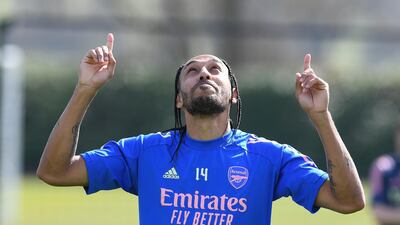
• Pierre-Emerick Aubameyang during Arsenal's training session in St Albans on Wednesday. Getty
    Pierre-Emerick Aubameyang during Arsenal's training session in St Albans on Wednesday. Getty
  • Martin Odegaard, Alexandre Lacazette, Gabriel Magalhaes and Pierre-Emerick Aubameyang train for their Europa League clash against Villarreal. Getty
    Martin Odegaard, Alexandre Lacazette, Gabriel Magalhaes and Pierre-Emerick Aubameyang train for their Europa League clash against Villarreal. Getty
  • David Luiz during Arsenal's training session at London Colney. Getty
    David Luiz during Arsenal's training session at London Colney. Getty
  • Kieran Tierney, Hector Bellerin and Flo Balogun of Arsenal during training. Getty
    Kieran Tierney, Hector Bellerin and Flo Balogun of Arsenal during training. Getty
  • Mat Ryan during Arsenal's training session at London Colney. Getty
    Mat Ryan during Arsenal's training session at London Colney. Getty
  • Gabriel Martinelli and Thomas Partey of Arsenal during training on Wednesday. Getty
    Gabriel Martinelli and Thomas Partey of Arsenal during training on Wednesday. Getty
  • Granit Xhaka and Bukayo Saka during training on the eve of their Europa League clash. Getty
    Granit Xhaka and Bukayo Saka during training on the eve of their Europa League clash. Getty
  • Mikel Arteta oversees Arsenal's training. Getty
    Mikel Arteta oversees Arsenal's training. Getty

Arsenal Premier League squad: Aubameyang and Lacazette retained, David Luiz released


  • English
  • Arabic

The 20 Premier League clubs that took part in the 2020/21 season have submitted lists of players they will be retaining in their squads, and ones they will be releasing.

All clubs must submit their respective lists by June 23.

It is worth noting that player contracts typically will run until June 30, and therefore players who are soon to be out of contract are still on the 'retained' list at the time of publishing.

First up are Arsenal, who endured a difficult season under Spanish manager Mikel Arteta.

An eighth-placed finish meant that the Gunners missed out on qualifying for any European competition in 2021/22, while they also fell to eventual winners Villarreal in the Europa League semi-finals.

Arsenal squad

2020/21 Premier League finish: 8th

Retained

Timothy Akinola
Ryan Alebiosu
Cedric Soares
Pierre-Emerick Aubameyang
Zach Awe
Miguel Azeez
Daniel Ballard
Folarin Balogun
Hector Bellerin
Tolaji Bola
Willian
Calum Chambers
Catalin-Ionut Cirjan
Harrison Clarke
Ben Cottrell
Trae Coyle
Jonathan Dinzeyi
Gabriel
Mohamed Elneny
Marcelo Flores
Omari Giraud-Hutchinson
Hubert Graczyk
Matteo Guendouzi
Karl Hein
James Hillson
Rob Holding
Joel Ideho

  • Pierre-Emerick Aubameyang celebrates during Arsenal training. Getty
    Pierre-Emerick Aubameyang celebrates during Arsenal training. Getty
  • Arsenal striker Alex Lacazette takes some water on board. Getty
    Arsenal striker Alex Lacazette takes some water on board. Getty
  • Pierre-Emerick Aubameyang and Alex Lacazette prepare for the Arsenal training session. Getty
    Pierre-Emerick Aubameyang and Alex Lacazette prepare for the Arsenal training session. Getty
  • Arsenal's Dani Ceballos tries to cool down during the training session at London Colney in St Albans. Getty
    Arsenal's Dani Ceballos tries to cool down during the training session at London Colney in St Albans. Getty
  • Hector Bellerin at training. Getty
    Hector Bellerin at training. Getty
  • Arsenal manager Mikel Arteta during a training session at London Colney. Getty
    Arsenal manager Mikel Arteta during a training session at London Colney. Getty
  • Willian and Dani Ceballos of Arsenal. Getty
    Willian and Dani Ceballos of Arsenal. Getty
  • Pierre-Emerick Aubameyang at training. Getty
    Pierre-Emerick Aubameyang at training. Getty


George Igaba-Ishimwe
Deyan Iliev
Tyreece John-Jules
Alex Kirk
Sead Kolasinac
Alexandre Lacazette
Bernd Leno
Joel Lopez
Ainsley Maitland-Niles
Pablo Mari Villar
Konstantinos Mavropanos
Jordan McEneff
Mark McGuinness
Zech Medley
Nikolaj Duus Moller
Zane Monlouis
Reiss Nelson
Eddie Nketiah
Brooke Norton-Cuffy
Arthur Okonkwo (Offer)
James Olayinka
Jordi Osei-Tutu
Zine-Eddine Oulad M'Hand
Thomas Partey
Charlie Patino
Nicolas Pepe
Omar Rekik
Runar Alex Runarsson
Bukayo Saka
William Saliba
Ben Sheaf
Matt Smith
Tom Smith
Emile Smith Rowe
Zak Swanson
Gabriel Martinelli 
Kieran Tierney
Lucas Torreira
Joe Willock
Granit Xhaka

Released

David Luiz
Joseph Olowu

Ten tax points to be aware of in 2026

1. Domestic VAT refund amendments: request your refund within five years

If a business does not apply for the refund on time, they lose their credit.

2. E-invoicing in the UAE

Businesses should continue preparing for the implementation of e-invoicing in the UAE, with 2026 a preparation and transition period ahead of phased mandatory adoption. 

3. More tax audits

Tax authorities are increasingly using data already available across multiple filings to identify audit risks. 

4. More beneficial VAT and excise tax penalty regime

Tax disputes are expected to become more frequent and more structured, with clearer administrative objection and appeal processes. The UAE has adopted a new penalty regime for VAT and excise disputes, which now mirrors the penalty regime for corporate tax.

5. Greater emphasis on statutory audit

There is a greater need for the accuracy of financial statements. The International Financial Reporting Standards standards need to be strictly adhered to and, as a result, the quality of the audits will need to increase.

6. Further transfer pricing enforcement

Transfer pricing enforcement, which refers to the practice of establishing prices for internal transactions between related entities, is expected to broaden in scope. The UAE will shortly open the possibility to negotiate advance pricing agreements, or essentially rulings for transfer pricing purposes. 

7. Limited time periods for audits

Recent amendments also introduce a default five-year limitation period for tax audits and assessments, subject to specific statutory exceptions. While the standard audit and assessment period is five years, this may be extended to up to 15 years in cases involving fraud or tax evasion. 

8. Pillar 2 implementation 

Many multinational groups will begin to feel the practical effect of the Domestic Minimum Top-Up Tax (DMTT), the UAE's implementation of the OECD’s global minimum tax under Pillar 2. While the rules apply for financial years starting on or after January 1, 2025, it is 2026 that marks the transition to an operational phase.

9. Reduced compliance obligations for imported goods and services

Businesses that apply the reverse-charge mechanism for VAT purposes in the UAE may benefit from reduced compliance obligations. 

10. Substance and CbC reporting focus

Tax authorities are expected to continue strengthening the enforcement of economic substance and Country-by-Country (CbC) reporting frameworks. In the UAE, these regimes are increasingly being used as risk-assessment tools, providing tax authorities with a comprehensive view of multinational groups’ global footprints and enabling them to assess whether profits are aligned with real economic activity. 

Contributed by Thomas Vanhee and Hend Rashwan, Aurifer