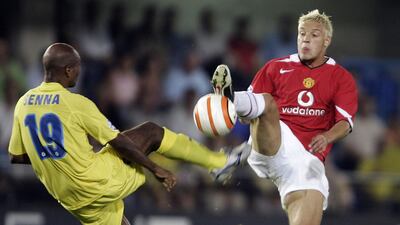
Alan Smith, right, in action for Manchester United against Villarreal in a Champions League match in September 2005. AFP

Alan Smith on joining Manchester United from Leeds and why Roy Keane was impossible to replace


Andy Mitten
  • English
  • Arabic

Alan Smith enjoyed a rich career with the Uniteds of Leeds, Manchester and Newcastle, before dropping down the leagues to play for MK Dons and Notts County. The Yorkshire-born player also played 19 times for England and admitted it could have been more had his younger self been more reliable about staying on the pitch.

While at Leeds, Smith wasn’t popular with Manchester United fans because he was a hero in Yorkshire, a talented local boy playing for an exceptional Leeds side who’d reached the semi finals of the Champions League, even more so when he said that he’d never play for Manchester United. But he did cross the Pennines and later admitted: “I did say that. I’ve also learned to never say never in football. I was young and naive and never thought that a) Man United would ever want me and b) Leeds would ever sell me. Look how silly I was.”

Smith only started 61 times for United but came on in a further 32 games between 2004-07. He picked up some severe injuries but his strengths and values were appreciated.

“My biggest strength was being full on, 100 per cent committed, doing your best, running through a brick wall for someone,” he tells the new official UTD podcast which is released on Monday. “I feel like I was so grounded with my upbringing at Leeds that even when I went to Manchester United, at a bigger level, the characteristics of the clubs are very, very similar. The people who were involved in the club [Leeds], we had a lot of British influence, a Scottish influence with people like Eddie Gray who historically at the club demanded first and foremost 100 per cent work rate and effort. And the fans demand, the working-class fans – Blackburn fans, Leeds fans, Manchester United fans - they all demand the least that you do is give everything you have got to give them. That’s what people want to see. Even at Manchester United, who are on the next level, the fans still want to see working-class players who want to work hard for the club. That is a basic fundamental, and anything more that you can give them is great. But that was my main thing – I wanted to win every game, sometimes to my own detriment.”

Smith had a reputation as a winner at Leeds. As his club faded towards relegation, he joined then serial winners Manchester United.

“I look back and think, ‘What drives those lads to make sure that they get over the line every time?’” he said. “For me, that was the biggest difference, the experienced players just asked that much more of each other. And all different personalities. Keane, Giggs, Scholes, the Nevilles – all totally different personalities but all with an inner desire to be the best. Getting a group together like that, there have only been a few teams over the years, even over the history of football as I know it, a few teams who have managed to get to that level. Everyone is still searching to find that again.

“People go into a dressing room and everyone there is a normal lad who has had a normal upbringing so we have all been in similar situations and that’s something that I always speak to the kids about – the best players who I have ever played with have always been the nicest people. [They were] great lads as well as great players. Going from Leeds to Man United, you think about, ‘What’s he going to be like, what’s so and so going to be like?’ Driving across in the car thinking, ‘Oh, my god, I’m going to sign for Manchester United tomorrow’. You get there and you go, ‘Well, they are just normal people.’ That’s why they did so well because they were actually just normal lads who pushed each other to levels that no one else could get to.”

Leeds fans were not forgiving. They’d been stung when previous heroes Eric Cantona, Rio Ferdinand, Gordon McQueen and Joe Jordan has headed west to join their great rivals, but Smith believes there are similarities between both clubs.

“You know the passion that both clubs have got and that’s why I loved playing for both. Just because they are very, very similar. Leeds fans don’t like me for saying it, but they are. The characteristics of both clubs are very, very similar in terms of the beliefs, the history of the clubs, the people who are involved in it, the styles. The passion of the fans is very, very similar. I think that’s why it made my transition quite easy in that first year. And you’re surrounded by world-class players, which makes it a little bit easier as well.”

Asked whether the reaction to his move to United bothered him, Smith said: “Not really, because I’d been through it myself. I was a kid when Eric [Cantona] went to United and I was probably one of those throwing stones at the team bus when he came. No, I don’t think I did, but you understand what I mean. I was there as a player when Rio [Ferdinand] left and I think it was a bit different for me, because I was one of their own players, if you put it in that way. I’d been there from 10 years old, so it was big for them that I chose the destination that I did. But as I look at it, they should be proud of one of their own young players going on to whatever destination it was, in terms of the calibre you go to. That should not be forgotten because it’s a Leeds-Man United rivalry. It didn’t really bother me because it was a decision I made purely based on the good of Leeds financially and myself footballing wise.”

Roy Keane made 326 league appearances for Manchester United between 1993-2005. Darren Staples / Reuters

In Manchester, his captain was Roy Keane.

“Roy Keane is probably impossible to replace as a player and as a character, especially at Manchester United,” said Smith. “I still don’t think it’s been done now and it’s been crying out for someone like Roy Keane to be in the dressing room and on the field as Roy was. No-one could ever replicate it, so it was [about me] trying to do as good a job in a similar position. It wasn’t like, ‘you’re going to be a Roy Keane’. I could never do that job. It was a case of trying to learn and trying to understand the position that you’re playing in and do it to the best of your ability as a replacement for one of the best midfield players there has ever been.

"It was a difficult task, it was one I would never be able to do it to that same level. I wouldn’t have had to do it as much as I did if Roy would have been as fit as normal. It would probably have been a longer process, rather than being thrown in through necessity. Ability-wise, I was probably put in there because I could tackle and I was brave enough to do it and physical enough to try and do it, not because my actual ability warranted going into that position. I had a great relationship with Roy and it was sad how he ended because he went to Celtic and I couldn’t learn anymore.”

Manchester United's Alan Smith, left, in action against Tottenham at Old Trafford on 4 January 2005. AFP

Smith was an admirer of Keane and plays down suggestions by critics that the Irishman was overrated as a player.

“I’d say watch Roy Keane at Nottingham Forest and when he first came to Manchester United and make your decision based on that,” he says. “Because a lot of people forget and they don’t have a broad spectrum on actually the development of Roy as a player and how he evolved as a player through necessity, through injuries et cetera. For me, I don’t even have to answer that question because like you said, you only have to look at how good Roy Keane was as a box-to-box midfielder when he was a younger player and how good he was as a defensive midfielder towards the end of his career.

“You could ask any player that’s played with him or against him and I’d say 99 per cent of them would all have the same answer for you. For me, it’s not just a case of Roy being a leader. That’s so disrespectful to him as a footballer as well. You don’t play for Manchester United and captain them based on just being a leader. That’s such an unfair criticism of someone who’s probably been one of the Premier League’s greatest central midfield players.”

Smith played the last of his 605 professional club games in 2018 for Notts County.

“The hardest thing looking at it now, the hardest thing mentally was having to accept that you are not at that level anymore and I think that the quicker you can accept that - you have got to try and move on from that. It is strange for me because I love football, I love the environment, I have loved being at all the clubs I have been at but I very rarely ever go back. Even when I was still living at home I would never come to United games because I think that you don’t want to always be looking back on what’s gone on. And I love chatting like this and being part of a club’s history but going back is sometimes more difficult because you know what you are missing. And I think that it is so difficult to be able to look back at the past and think about what might have been so you have got to live for the moment. I only ever went back for one match to Manchester United when they played Rangers in the Champions League.”

Smith had originally left Manchester United for Newcastle United in 2007, with Sir Alex Ferguson telling him, ‘I know you don’t want to go but I think you have to’.

“For me looking back, even though you want to pretend that you are at that level, you know that you are definitely not,” he recalls. “I realised that in the pre-season and I spoke to Mickey Phelan about it also, sometimes you need someone just to put stuff into perspective, what you’ve been through, the injury and the process you have gone through. You have got to look at longevity and how long you can keep playing for. Unfortunately it has happened to a lot better players than me, that your time at a club comes to an end and you have to move on.”

Mercer, the investment consulting arm of US services company Marsh & McLennan, expects its wealth division to at least double its assets under management (AUM) in the Middle East as wealth in the region continues to grow despite economic headwinds, a company official said.

Mercer Wealth, which globally has $160 billion in AUM, plans to boost its AUM in the region to $2-$3bn in the next 2-3 years from the present $1bn, said Yasir AbuShaban, a Dubai-based principal with Mercer Wealth.

Within the next two to three years, we are looking at reaching $2 to $3 billion as a conservative estimate and we do see an opportunity to do so,” said Mr AbuShaban.

Mercer does not directly make investments, but allocates clients’ money they have discretion to, to professional asset managers. They also provide advice to clients.

“We have buying power. We can negotiate on their (client’s) behalf with asset managers to provide them lower fees than they otherwise would have to get on their own,” he added.

Mercer Wealth’s clients include sovereign wealth funds, family offices, and insurance companies among others.

From its office in Dubai, Mercer also looks after Africa, India and Turkey, where they also see opportunity for growth.

Wealth creation in Middle East and Africa (MEA) grew 8.5 per cent to $8.1 trillion last year from $7.5tn in 2015, higher than last year’s global average of 6 per cent and the second-highest growth in a region after Asia-Pacific which grew 9.9 per cent, according to consultancy Boston Consulting Group (BCG). In the region, where wealth grew just 1.9 per cent in 2015 compared with 2014, a pickup in oil prices has helped in wealth generation.

BCG is forecasting MEA wealth will rise to $12tn by 2021, growing at an annual average of 8 per cent.

Drivers of wealth generation in the region will be split evenly between new wealth creation and growth of performance of existing assets, according to BCG.

Another general trend in the region is clients’ looking for a comprehensive approach to investing, according to Mr AbuShaban.

“Institutional investors or some of the families are seeing a slowdown in the available capital they have to invest and in that sense they are looking at optimizing the way they manage their portfolios and making sure they are not investing haphazardly and different parts of their investment are working together,” said Mr AbuShaban.

Some clients also have a higher appetite for risk, given the low interest-rate environment that does not provide enough yield for some institutional investors. These clients are keen to invest in illiquid assets, such as private equity and infrastructure.

“What we have seen is a desire for higher returns in what has been a low-return environment specifically in various fixed income or bonds,” he said.

“In this environment, we have seen a de facto increase in the risk that clients are taking in things like illiquid investments, private equity investments, infrastructure and private debt, those kind of investments were higher illiquidity results in incrementally higher returns.”

The Abu Dhabi Investment Authority, one of the largest sovereign wealth funds, said in its 2016 report that has gradually increased its exposure in direct private equity and private credit transactions, mainly in Asian markets and especially in China and India. The authority’s private equity department focused on structured equities owing to “their defensive characteristics.”

Frankenstein in Baghdad
Ahmed Saadawi
​​​​​​​Penguin Press

CREW
%3Cp%3E%3Cstrong%3EDirector%3A%20%3C%2Fstrong%3ERajesh%20A%20Krishnan%3C%2Fp%3E%0A%3Cp%3E%3Cstrong%3EStarring%3A%20%3C%2Fstrong%3ETabu%2C%20Kareena%20Kapoor%20Khan%2C%20Kriti%20Sanon%26nbsp%3B%3C%2Fp%3E%0A%3Cp%3E%3Cstrong%3ERating%3A%3C%2Fstrong%3E%203.5%2F5%3C%2Fp%3E%0A
Tax authority targets shisha levy evasion

The Federal Tax Authority will track shisha imports with electronic markers to protect customers and ensure levies have been paid.

Khalid Ali Al Bustani, director of the tax authority, on Sunday said the move is to "prevent tax evasion and support the authority’s tax collection efforts".

The scheme’s first phase, which came into effect on 1st January, 2019, covers all types of imported and domestically produced and distributed cigarettes. As of May 1, importing any type of cigarettes without the digital marks will be prohibited.

He said the latest phase will see imported and locally produced shisha tobacco tracked by the final quarter of this year.

"The FTA also maintains ongoing communication with concerned companies, to help them adapt their systems to meet our requirements and coordinate between all parties involved," he said.

As with cigarettes, shisha was hit with a 100 per cent tax in October 2017, though manufacturers and cafes absorbed some of the costs to prevent prices doubling.

Company Profile

Company name: NutriCal

Started: 2019

Founder: Soniya Ashar

Based: Dubai

Industry: Food Technology

Initial investment: Self-funded undisclosed amount

Future plan: Looking to raise fresh capital and expand in Saudi Arabia

Total Clients: Over 50

UPI facts

More than 2.2 million Indian tourists arrived in UAE in 2023
More than 3.5 million Indians reside in UAE
Indian tourists can make purchases in UAE using rupee accounts in India through QR-code-based UPI real-time payment systems
Indian residents in UAE can use their non-resident NRO and NRE accounts held in Indian banks linked to a UAE mobile number for UPI transactions

The five pillars of Islam

1. Fasting 

2. Prayer 

3. Hajj 

4. Shahada 

5. Zakat 

The 12 Syrian entities delisted by UK 

Ministry of Interior
Ministry of Defence
General Intelligence Directorate
Air Force Intelligence Agency
Political Security Directorate
Syrian National Security Bureau
Military Intelligence Directorate
Army Supply Bureau
General Organisation of Radio and TV
Al Watan newspaper
Cham Press TV
Sama TV

Ten tax points to be aware of in 2026

1. Domestic VAT refund amendments: request your refund within five years

If a business does not apply for the refund on time, they lose their credit.

2. E-invoicing in the UAE

Businesses should continue preparing for the implementation of e-invoicing in the UAE, with 2026 a preparation and transition period ahead of phased mandatory adoption. 

3. More tax audits

Tax authorities are increasingly using data already available across multiple filings to identify audit risks. 

4. More beneficial VAT and excise tax penalty regime

Tax disputes are expected to become more frequent and more structured, with clearer administrative objection and appeal processes. The UAE has adopted a new penalty regime for VAT and excise disputes, which now mirrors the penalty regime for corporate tax.

5. Greater emphasis on statutory audit

There is a greater need for the accuracy of financial statements. The International Financial Reporting Standards standards need to be strictly adhered to and, as a result, the quality of the audits will need to increase.

6. Further transfer pricing enforcement

Transfer pricing enforcement, which refers to the practice of establishing prices for internal transactions between related entities, is expected to broaden in scope. The UAE will shortly open the possibility to negotiate advance pricing agreements, or essentially rulings for transfer pricing purposes. 

7. Limited time periods for audits

Recent amendments also introduce a default five-year limitation period for tax audits and assessments, subject to specific statutory exceptions. While the standard audit and assessment period is five years, this may be extended to up to 15 years in cases involving fraud or tax evasion. 

8. Pillar 2 implementation 

Many multinational groups will begin to feel the practical effect of the Domestic Minimum Top-Up Tax (DMTT), the UAE's implementation of the OECD’s global minimum tax under Pillar 2. While the rules apply for financial years starting on or after January 1, 2025, it is 2026 that marks the transition to an operational phase.

9. Reduced compliance obligations for imported goods and services

Businesses that apply the reverse-charge mechanism for VAT purposes in the UAE may benefit from reduced compliance obligations. 

10. Substance and CbC reporting focus

Tax authorities are expected to continue strengthening the enforcement of economic substance and Country-by-Country (CbC) reporting frameworks. In the UAE, these regimes are increasingly being used as risk-assessment tools, providing tax authorities with a comprehensive view of multinational groups’ global footprints and enabling them to assess whether profits are aligned with real economic activity. 

Contributed by Thomas Vanhee and Hend Rashwan, Aurifer

MATCH INFO

Barcelona 2
Suarez (10'), Messi (52')

Real Madrid 2
Ronaldo (14'), Bale (72')

Guide to intelligent investing
Investing success often hinges on discipline and perspective. As markets fluctuate, remember these guiding principles:
  • Stay invested: Time in the market, not timing the market, is critical to long-term gains.
  • Rational thinking: Breathe and avoid emotional decision-making; let logic and planning guide your actions.
  • Strategic patience: Understand why you’re investing and allow time for your strategies to unfold.
 
 
Our family matters legal consultant

Name: Hassan Mohsen Elhais

Position: legal consultant with Al Rowaad Advocates and Legal Consultants.

Bareilly Ki Barfi
Directed by: Ashwiny Iyer Tiwari
Starring: Kriti Sanon, Ayushmann Khurrana, Rajkummar Rao
Three and a half stars
