• A man wearing a protective mask walks past a mural depicting a nurse in Shoreditch, amid the coronavirus disease (COVID-19) outbreak, in London, Britain. REUTERS
    A man wearing a protective mask walks past a mural depicting a nurse in Shoreditch, amid the coronavirus disease (COVID-19) outbreak, in London, Britain. REUTERS
  • A woman observes two robots that carry home orders, in Medellin, Colombia,. EPA
    A woman observes two robots that carry home orders, in Medellin, Colombia,. EPA
  • A man is tested for coronavirus disease (COVID-19) at a Los Angeles fire department testing station for the homeless on Skid Row, in Los Angeles, California, U.S. REUTERS
    A man is tested for coronavirus disease (COVID-19) at a Los Angeles fire department testing station for the homeless on Skid Row, in Los Angeles, California, U.S. REUTERS
  • A man sits next to a fountain at the Sun Yat Sen Memorial Park in Hong Kong on April 21, 2020. Hong Kong has reduced growth of confirmed COVID-19 cases to single digits in recent days, but city authorities say they are not taking any risks. Chief executive Carrie Lam said social distancing measures and some business restrictions would continue for another two weeks until at least May 7. AFP
    A man sits next to a fountain at the Sun Yat Sen Memorial Park in Hong Kong on April 21, 2020. Hong Kong has reduced growth of confirmed COVID-19 cases to single digits in recent days, but city authorities say they are not taking any risks. Chief executive Carrie Lam said social distancing measures and some business restrictions would continue for another two weeks until at least May 7. AFP
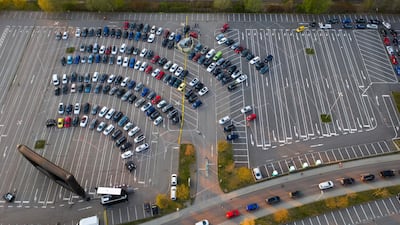
  • A health worker shows quick tests for COVID-19 with negative results at a drive-through in the parking lot of the Mane Garrincha Stadium in Brasilia, Brazil. The Brazilian government started a mass testing program to improve control of the new coronavirus disease and plan how social isolation will be lifted. AFP
    A health worker shows quick tests for COVID-19 with negative results at a drive-through in the parking lot of the Mane Garrincha Stadium in Brasilia, Brazil. The Brazilian government started a mass testing program to improve control of the new coronavirus disease and plan how social isolation will be lifted. AFP
  • A teacher cleans and disinfects chairs and tables at the the Phoenix Gymnasium secondary school in Dortmund, western Germany. Students preparing for the Abitur high school graduation with exams taking place in May are allowed to turn back to school from April 23, 2020. AFP
    A teacher cleans and disinfects chairs and tables at the the Phoenix Gymnasium secondary school in Dortmund, western Germany. Students preparing for the Abitur high school graduation with exams taking place in May are allowed to turn back to school from April 23, 2020. AFP
  • People stand on designated spots to maintain social distancing at a market in Manila. AFP
    People stand on designated spots to maintain social distancing at a market in Manila. AFP
  • Members of the Myanmar Red Cross carry a dead body of a driver from a boat in Sittwe, Rakhine State killed while delivering test kits for COVID-19 coronavirus. A Myanmar government health worker was injured and his driver killed when their United Nations-marked vehicle was ambushed as they were carrying COVID-19 test samples in conflict-ridden Rakhine state. AFP
    Members of the Myanmar Red Cross carry a dead body of a driver from a boat in Sittwe, Rakhine State killed while delivering test kits for COVID-19 coronavirus. A Myanmar government health worker was injured and his driver killed when their United Nations-marked vehicle was ambushed as they were carrying COVID-19 test samples in conflict-ridden Rakhine state. AFP
  • Customers wearing face masks as a precautionary measure against the COVID-19 coronavirus sit in a cafe, which has masking tape on every other table to enforce social distancing, in Hong Kong. AFP
    Customers wearing face masks as a precautionary measure against the COVID-19 coronavirus sit in a cafe, which has masking tape on every other table to enforce social distancing, in Hong Kong. AFP
  • A woman wearing a protective face mask rides a scooter across a nearly empty 3rd Avenue in midtown Manhattan during the outbreak of the coronavirus disease (COVID-19) in New York City, New York, U.S. REUTERS
    A woman wearing a protective face mask rides a scooter across a nearly empty 3rd Avenue in midtown Manhattan during the outbreak of the coronavirus disease (COVID-19) in New York City, New York, U.S. REUTERS
  • An employee wearing a face mask sits next to a GE Carescape R860 ventilator in an assembly and testing area at a GE Healthcare manufacturing facility during the global coronavirus disease (COVID-19) outbreak in Madison, Wisconsin, U.S. REUTERS
    An employee wearing a face mask sits next to a GE Carescape R860 ventilator in an assembly and testing area at a GE Healthcare manufacturing facility during the global coronavirus disease (COVID-19) outbreak in Madison, Wisconsin, U.S. REUTERS
  • Workers wearing protective equipment are seen on the grounds of the Central Jamia Mosque Ghamkol Sharif, a temporary morgue set up at a Mosque as the spread of the Coronavirus disease (Covid-19) continues, Birmingham, Britain. REUTERS
    Workers wearing protective equipment are seen on the grounds of the Central Jamia Mosque Ghamkol Sharif, a temporary morgue set up at a Mosque as the spread of the Coronavirus disease (Covid-19) continues, Birmingham, Britain. REUTERS

To avoid the next pandemic, you need to know the difference between a black swan and a grey rhino


  • English
  • Arabic

Despite a chorus of financiers, politicians and self-satisfied pundits claiming that the Covid-19 pandemic is an unforeseen and even unforeseeable black swan, this crisis is a different beast entirely.

It is an obvious grey rhino – that is, a high-impact scenario that was always highly likely to occur. The pandemic was sending clear signals that it was getting ready to charge, and too many people with the power to head it off ignored those warnings for too long.

Unlike the black swan that appears only in hindsight, grey rhino theory is forward-looking. It is about actively seeing what’s in front of us and challenging ourselves to act.

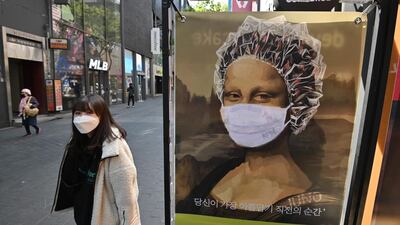
  • A woman wearing a face mask walks past an advertisement of a hair shop at a shopping district in Seoul. AFP
    A woman wearing a face mask walks past an advertisement of a hair shop at a shopping district in Seoul. AFP
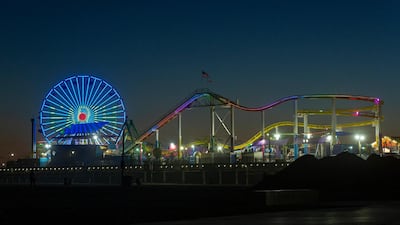
  • Pacific Park's solar-powered Ferris wheel lights show a green "Earth" logo at sunset on Santa Monica Pier for Earth Day, in Santa Monica, California. AP
    Pacific Park's solar-powered Ferris wheel lights show a green "Earth" logo at sunset on Santa Monica Pier for Earth Day, in Santa Monica, California. AP
  • A water police boat is seen as the Ruby Princess cruise ship docks at Port Kembla in Wollongong, Australia. Getty
    A water police boat is seen as the Ruby Princess cruise ship docks at Port Kembla in Wollongong, Australia. Getty
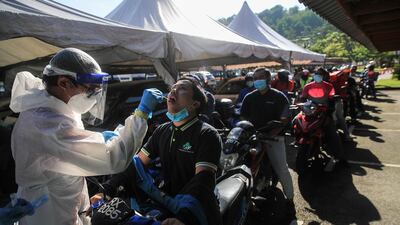
  • A health worker collects a sample from a man at a free coronavirus community screening service in Kuala Lumpur, Malaysia. EPA
    A health worker collects a sample from a man at a free coronavirus community screening service in Kuala Lumpur, Malaysia. EPA
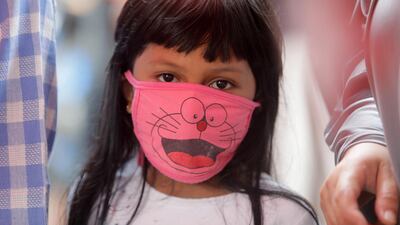
  • An Indonesian child wears a hand made protective mask at a temporary meat market, ahead of Ramadan in Banda Aceh, Indonesia. EPA
    An Indonesian child wears a hand made protective mask at a temporary meat market, ahead of Ramadan in Banda Aceh, Indonesia. EPA
  • A pedestrian is reflected in the window of a nail salon during a nationwide social distancing and stay-at-home order imposed due to coronavirus in Ho Chi Minh city, Vietnam. Bloomberg
    A pedestrian is reflected in the window of a nail salon during a nationwide social distancing and stay-at-home order imposed due to coronavirus in Ho Chi Minh city, Vietnam. Bloomberg
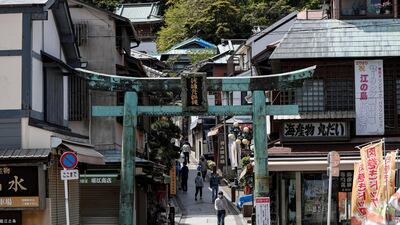
  • Visitors wearing protective face masks walk on a sightseeing spot on Enoshima Island after government asked citizens to be more diligent on social distancing under the state of emergency in Fujisawa, south of Tokyo, Japan. Reuters
    Visitors wearing protective face masks walk on a sightseeing spot on Enoshima Island after government asked citizens to be more diligent on social distancing under the state of emergency in Fujisawa, south of Tokyo, Japan. Reuters
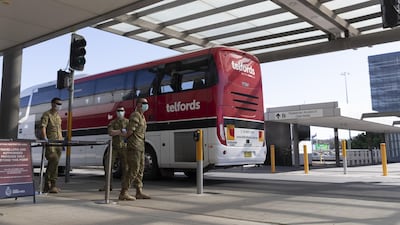
  • Army personnel watch as a charter bus that unloaded crew from the Ruby Princess Cruise ship departs Sydney Airport in Sydney, Australia. Getty
    Army personnel watch as a charter bus that unloaded crew from the Ruby Princess Cruise ship departs Sydney Airport in Sydney, Australia. Getty
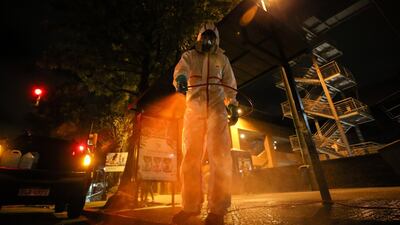
  • A municipality worker sprays disinfectant at a bus stop as a preventive measure against coronavirus in Montevideo, Uruguay. EPA
    A municipality worker sprays disinfectant at a bus stop as a preventive measure against coronavirus in Montevideo, Uruguay. EPA
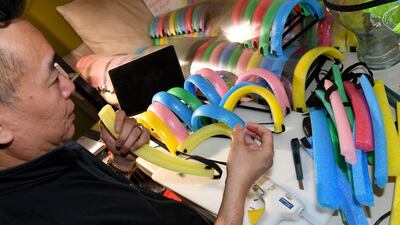
  • School of Nursing assistant professor Dr Rhigel Jay Tan, a licensed nurse practitioner in psychiatric mental health, makes custom-made face shields called "iCareFaceShields" at his home for health care workers amid the coronavirus pandemic in Las Vegas, Nevada. AFP
    School of Nursing assistant professor Dr Rhigel Jay Tan, a licensed nurse practitioner in psychiatric mental health, makes custom-made face shields called "iCareFaceShields" at his home for health care workers amid the coronavirus pandemic in Las Vegas, Nevada. AFP
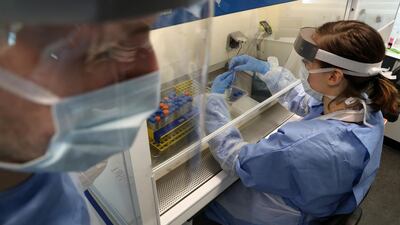
  • Technicians carry out a sample transfer during the opening of the new Covid-19 testing lab at Queen Elizabeth University Hospital in Glasgow, Scotland. Getty
    Technicians carry out a sample transfer during the opening of the new Covid-19 testing lab at Queen Elizabeth University Hospital in Glasgow, Scotland. Getty
  • Visitors gather for a drive-in cinema event in Chemnitz, Germany. AP
    Visitors gather for a drive-in cinema event in Chemnitz, Germany. AP
  • The Italian-operated cruise ship the Costa Atlantica is anchored at a port in Nagasaki, southern Japan. AP
    The Italian-operated cruise ship the Costa Atlantica is anchored at a port in Nagasaki, southern Japan. AP

The coronavirus crisis is a catalyst for an urgently needed reset of our global mentality, reminding us to hold both governments and ourselves as citizens responsible for stepping up to the clear and present dangers that threaten our survival.

As we move past the initial shock of the pandemic, many of us are thinking about how best to emerge from this global public health, economic and human catastrophe. We don’t want to get “back to normal” because what we accepted as normal is what got us into this mess. Rather, we should want to create a new and better reality.

How could so many leaders across society have turned such a blind eye to giant, red warning flags for so long? Once we understand that, how can we use our knowledge to switch from a passive, fatalistic mode to an active, problem-solving frame?

The alarm bells rung by experts about how poorly prepared the world has been for the pandemics have been well documented. The situation was predicted by the World Health Organisation and even gamed out in a scenario-planning exercise in the US under the Trump administration. In a widely shared TED Talk in 2015, Bill Gates made the point before carefully proceeding to outline what the world needed to do.

Those in policy circles will give you all kinds of knowing reasons why pandemic warnings went ignored: politics, “the problem is too big and expensive and complicated”, entrenched bureaucracies and so on and so forth. They’ll rub their chins to look thoughtful, but have no real answers. They are there to tell you how things are, not how to change them.

Pleading ignorance was particularly fashionable in the aftermath of the 2008 financial crisis, when leaders became too eager to call out, “Black swan! Nobody could have seen it coming!” even though many elements of that crisis were predictable, too.

Bill Gates, shown here in Berlin in 2015, warned the world that year of the dangers of a potential pandemic. AFP

Together, these attitudes have bred complacency and an accountability vacuum that have made it easy for everyone to dodge responsibility. But that is an explanation, not an excuse.

Instead of focusing mainly on why problems are not readily solvable, our priority needs to be on what it takes, from governments and civil society, to head off grey rhinos.

The solution begins with a reset of expectations. This requires building mutual trust between citizens and governments, beginning with two-way transparency involving governments sharing much more information and citizens consuming and using that information responsibly.

The uncomfortable truth is that governments often fail to make tough choices because citizens don't want them to. People don't want short-term pain even if it prevents something much worse down the road. They want to feel secure now. This toxic status quo encourages governments to drag their feet in the face of wicked problems, which in turn leads citizens to lower their expectations of what leaders expect them to do.

The coronavirus pandemic and its domino effect – the most wicked of wicked problems – has upended reality. It has exposed many other thorny and unaddressed challenges. Extreme inequality that puts the greatest burden on those who can least afford it. Deep financial fragilities, including dangerous levels of debt. Inadequate healthcare infrastructure.

When governments try to sweep problems under the rug for too long, they increase the chances of catastrophe when the dam finally breaks. That is why, as painful as it may be, it is better for governments to be open about challenges sooner rather than later.

We shouldn't want to get "back to normal" because what we accepted as normal is what got us into this mess.

The coronavirus also illustrates the power of regularly and publicly monitoring progress. Daily releases of epidemiological statistics provide a natural experiment in measuring how governments are doing in the fight to save lives. In every country, these figures are imprecise; because of test shortages, inconsistencies in counting and other technical challenges, they far understate the reality. But they give everyone a way to measure progress.

Contrary to the conclusions of some observers, differences in effectiveness are independent of whether a country’s political system is democratic or not. Rather, they depend upon how transparent and proactive governments are, and how much their populations both trust them to solve the problem and play their own roles in doing so.

Tracking focuses attention on issues while clarifying solutions and reassuring people that progress is possible. If a situation seems hopeless, citizens are less likely to do their part to help fix it or to approve of leaders expending resources to do so.

Hopelessness and a lack of information, moreover, leave the door open for citizens to make up their own, alternate realities. Social media has allowed everyone to become instant epidemiologists, market sages, economists and one-size-fits-all critics. Tribes assemble, picking and choosing the information that suits them.

Protesters in the US, for instance, have been endangering themselves and others by demanding that the government loosen stay-at-home orders. They see themselves as preserving their “liberty” to work and to be entertained.

Choosing one’s own reality is a way of asserting control over a situation when people feel they have none, and little in recent memory has made so many people feel so powerless as the coronavirus and the economic destruction it has wrought.

The key to confronting crises like coronavirus is for governments to communicate better with their citizens. EPA

Governments ought to recognise the benefits of being upfront about the nature of the problems they face, involving citizens in building solutions and then tracking their progress. Citizens, of course, must do their part, too. They ought to heed information and consume it responsibly, differentiating between what they need to hear and what they simply want to.

The rise of open-data projects and participatory budgeting have allowed governments to invite input from citizens more directly than ever before. Through these platforms, policymakers communicate the problem and the steps they are taking to fix it, then solicit feedback from citizen stakeholders. This can change citizens’ expectations of what can and should be done, making tough decisions easier.

Governments also are benefiting from comparing their own progress to that of their peers. Performance-tracking tools like Transparency International’s Corruption Perceptions Index, the World Economic Forum’s Global Competitiveness Index and the Programme for International Student Assessment (better known as PISA) all have helped to shape government policies for the better.

Similarly, the Sustainable Development Goals provide a powerful road map for tracking initiatives to address many of the grey rhino risks the world still faces: inequality, hunger, climate and 14 other worthy efforts.

There is one final benefit to these tools that ought to appeal to anyone in a position of power: they make it easier to give credit to leaders who work toward solutions to pressing policy problems, and hold accountable those who kick the crisis down the road.

Michele Wucker is a Chicago-based strategist and author of international bestseller The Gray Rhino: How to Recognize and Act on the Dangers We Ignore

10 tips for entry-level job seekers
  • Have an up-to-date, professional LinkedIn profile. If you don’t have a LinkedIn account, set one up today. Avoid poor-quality profile pictures with distracting backgrounds. Include a professional summary and begin to grow your network.
  • Keep track of the job trends in your sector through the news. Apply for job alerts at your dream organisations and the types of jobs you want – LinkedIn uses AI to share similar relevant jobs based on your selections.
  • Double check that you’ve highlighted relevant skills on your resume and LinkedIn profile.
  • For most entry-level jobs, your resume will first be filtered by an applicant tracking system for keywords. Look closely at the description of the job you are applying for and mirror the language as much as possible (while being honest and accurate about your skills and experience).
  • Keep your CV professional and in a simple format – make sure you tailor your cover letter and application to the company and role.
  • Go online and look for details on job specifications for your target position. Make a list of skills required and set yourself some learning goals to tick off all the necessary skills one by one.
  • Don’t be afraid to reach outside your immediate friends and family to other acquaintances and let them know you are looking for new opportunities.
  • Make sure you’ve set your LinkedIn profile to signal that you are “open to opportunities”. Also be sure to use LinkedIn to search for people who are still actively hiring by searching for those that have the headline “I’m hiring” or “We’re hiring” in their profile.
  • Prepare for online interviews using mock interview tools. Even before landing interviews, it can be useful to start practising.
  • Be professional and patient. Always be professional with whoever you are interacting with throughout your search process, this will be remembered. You need to be patient, dedicated and not give up on your search. Candidates need to make sure they are following up appropriately for roles they have applied.

Arda Atalay, head of Mena private sector at LinkedIn Talent Solutions, Rudy Bier, managing partner of Kinetic Business Solutions and Ben Kinerman Daltrey, co-founder of KinFitz

How to protect yourself when air quality drops

Install an air filter in your home.

Close your windows and turn on the AC.

Shower or bath after being outside.

Wear a face mask.

Stay indoors when conditions are particularly poor.

If driving, turn your engine off when stationary.

What should do investors do now?

What does the S&P 500's new all-time high mean for the average investor? 

Should I be euphoric?

No. It's fine to be pleased about hearty returns on your investments. But it's not a good idea to tie your emotions closely to the ups and downs of the stock market. You'll get tired fast. This market moment comes on the heels of last year's nosedive. And it's not the first or last time the stock market will make a dramatic move.

So what happened?

It's more about what happened last year. Many of the concerns that triggered that plunge towards the end of last have largely been quelled. The US and China are slowly moving toward a trade agreement. The Federal Reserve has indicated it likely will not raise rates at all in 2019 after seven recent increases. And those changes, along with some strong earnings reports and broader healthy economic indicators, have fueled some optimism in stock markets.

"The panic in the fourth quarter was based mostly on fears," says Brent Schutte, chief investment strategist for Northwestern Mutual Wealth Management Company. "The fundamentals have mostly held up, while the fears have gone away and the fears were based mostly on emotion."

Should I buy? Should I sell?

Maybe. It depends on what your long-term investment plan is. The best advice is usually the same no matter the day — determine your financial goals, make a plan to reach them and stick to it.

"I would encourage (investors) not to overreact to highs, just as I would encourage them not to overreact to the lows of December," Mr Schutte says.

All the same, there are some situations in which you should consider taking action. If you think you can't live through another low like last year, the time to get out is now. If the balance of assets in your portfolio is out of whack thanks to the rise of the stock market, make adjustments. And if you need your money in the next five to 10 years, it shouldn't be in stocks anyhow. But for most people, it's also a good time to just leave things be.

Resist the urge to abandon the diversification of your portfolio, Mr Schutte cautions. It may be tempting to shed other investments that aren't performing as well, such as some international stocks, but diversification is designed to help steady your performance over time.

Will the rally last?

No one knows for sure. But David Bailin, chief investment officer at Citi Private Bank, expects the US market could move up 5 per cent to 7 per cent more over the next nine to 12 months, provided the Fed doesn't raise rates and earnings growth exceeds current expectations. We are in a late cycle market, a period when US equities have historically done very well, but volatility also rises, he says.

"This phase can last six months to several years, but it's important clients remain invested and not try to prematurely position for a contraction of the market," Mr Bailin says. "Doing so would risk missing out on important portfolio returns."

PREMIER LEAGUE TABLE

1 Man City    26   20   3   3   63   17   63 

2 Liverpool   25   17   6   2   64   20    57 

3 Chelsea      25   14   8  3   49   18    50 

4 Man Utd    26   13   7  6   44   34    46 

----------------------------------------

5 West Ham   26   12   6   8   45   34    42 

----------------------------------------

6 Arsenal      23  13   3   7   36   26   42 

7 Wolves       24  12   4   8   23   18   40 

8 Tottenham  23  12   4   8   31   31   39  

Global state-owned investor ranking by size

1.

United States

2.

China

3.

UAE

4.

Japan

5

Norway

6.

Canada

7.

Singapore

8.

Australia

9.

Saudi Arabia

10.

South Korea

Our legal consultants

Name: Hassan Mohsen Elhais

Position: legal consultant with Al Rowaad Advocates and Legal Consultants.

Auron Mein Kahan Dum Tha

Starring: Ajay Devgn, Tabu, Shantanu Maheshwari, Jimmy Shergill, Saiee Manjrekar

Director: Neeraj Pandey

Rating: 2.5/5

The%20Boy%20and%20the%20Heron
%3Cp%3E%3Cstrong%3EDirector%3A%C2%A0%3C%2Fstrong%3EHayao%20Miyazaki%3C%2Fp%3E%0A%3Cp%3E%3Cstrong%3EStarring%3A%3C%2Fstrong%3E%C2%A0Soma%20Santoki%2C%20Masaki%20Suda%2C%20Ko%20Shibasaki%3C%2Fp%3E%0A%3Cp%3E%3Cstrong%3ERating%3A%20%3C%2Fstrong%3E5%2F5%3C%2Fp%3E%0A
Apple%20Mac%20through%20the%20years
%3Cp%3E1984%20-%20Apple%20unveiled%20the%20Macintosh%20on%20January%2024%3Cbr%3E1985%20-%20Steve%20Jobs%20departed%20from%20Apple%20and%20established%20NeXT%3Cbr%3E1986%20-%20Apple%20introduced%20the%20Macintosh%20Plus%2C%20featuring%20enhanced%20memory%3Cbr%3E1987%20-%20Apple%20launched%20the%20Macintosh%20II%2C%20equipped%20with%20colour%20capabilities%3Cbr%3E1989%20-%20The%20widely%20acclaimed%20Macintosh%20SE%2F30%20made%20its%20debut%3Cbr%3E1994%20-%20Apple%20presented%20the%20Power%20Macintosh%3Cbr%3E1996%20-%20The%20Macintosh%20System%20Software%20OS%20underwent%20a%20rebranding%20as%20Mac%20OS%3Cbr%3E2001%20-%20Apple%20introduced%20Mac%20OS%20X%2C%20marrying%20Unix%20stability%20with%20a%20user-friendly%20interface%3Cbr%3E2006%20-%20Apple%20adopted%20Intel%20processors%20in%20MacBook%20Pro%20laptops%3Cbr%3E2008%20-%20Apple%20introduced%20the%20MacBook%20Air%2C%20a%20lightweight%20laptop%3Cbr%3E2012%20-%20Apple%20launched%20the%20MacBook%20Pro%20with%20a%20retina%20display%3Cbr%3E2016%20-%20The%20Mac%20operating%20system%20underwent%20rebranding%20as%20macOS%3Cbr%3E2020%20-%20Apple%20introduced%20the%20M1%20chip%20for%20Macs%2C%20combining%20high%20performance%20and%20energy%20efficiency%3Cbr%3E2022%20-%20The%20M2%20chip%20was%20announced%3Cbr%3E2023%20-The%20M3%20line-up%20of%20chip%20was%20announced%20to%20improve%20performance%20and%20add%20new%20capabilities%20for%20Mac.%3C%2Fp%3E%0A
Specs

Engine: Dual-motor all-wheel-drive electric

Range: Up to 610km

Power: 905hp

Torque: 985Nm

Price: From Dh439,000

Available: Now

The specs
  • Engine: 3.9-litre twin-turbo V8
  • Power: 640hp
  • Torque: 760nm
  • On sale: 2026
  • Price: Not announced yet
Seven%20Winters%20in%20Tehran
%3Cp%3E%3Cstrong%3EDirector%20%3A%3C%2Fstrong%3E%20Steffi%20Niederzoll%3C%2Fp%3E%0A%3Cp%3E%3Cstrong%3EStarring%3A%3C%2Fstrong%3E%20Reyhaneh%20Jabbari%2C%20Shole%20Pakravan%2C%20Zar%20Amir%20Ebrahimi%3C%2Fp%3E%0A%3Cp%3E%3Cstrong%3ERating%3A%3C%2Fstrong%3E%204%2F5%3C%2Fp%3E%0A

A Prayer Before Dawn

Director: Jean-Stephane Sauvaire

Starring: Joe Cole, Somluck Kamsing, Panya Yimmumphai

Three stars

Mercer, the investment consulting arm of US services company Marsh & McLennan, expects its wealth division to at least double its assets under management (AUM) in the Middle East as wealth in the region continues to grow despite economic headwinds, a company official said.

Mercer Wealth, which globally has $160 billion in AUM, plans to boost its AUM in the region to $2-$3bn in the next 2-3 years from the present $1bn, said Yasir AbuShaban, a Dubai-based principal with Mercer Wealth.

Within the next two to three years, we are looking at reaching $2 to $3 billion as a conservative estimate and we do see an opportunity to do so,” said Mr AbuShaban.

Mercer does not directly make investments, but allocates clients’ money they have discretion to, to professional asset managers. They also provide advice to clients.

“We have buying power. We can negotiate on their (client’s) behalf with asset managers to provide them lower fees than they otherwise would have to get on their own,” he added.

Mercer Wealth’s clients include sovereign wealth funds, family offices, and insurance companies among others.

From its office in Dubai, Mercer also looks after Africa, India and Turkey, where they also see opportunity for growth.

Wealth creation in Middle East and Africa (MEA) grew 8.5 per cent to $8.1 trillion last year from $7.5tn in 2015, higher than last year’s global average of 6 per cent and the second-highest growth in a region after Asia-Pacific which grew 9.9 per cent, according to consultancy Boston Consulting Group (BCG). In the region, where wealth grew just 1.9 per cent in 2015 compared with 2014, a pickup in oil prices has helped in wealth generation.

BCG is forecasting MEA wealth will rise to $12tn by 2021, growing at an annual average of 8 per cent.

Drivers of wealth generation in the region will be split evenly between new wealth creation and growth of performance of existing assets, according to BCG.

Another general trend in the region is clients’ looking for a comprehensive approach to investing, according to Mr AbuShaban.

“Institutional investors or some of the families are seeing a slowdown in the available capital they have to invest and in that sense they are looking at optimizing the way they manage their portfolios and making sure they are not investing haphazardly and different parts of their investment are working together,” said Mr AbuShaban.

Some clients also have a higher appetite for risk, given the low interest-rate environment that does not provide enough yield for some institutional investors. These clients are keen to invest in illiquid assets, such as private equity and infrastructure.

“What we have seen is a desire for higher returns in what has been a low-return environment specifically in various fixed income or bonds,” he said.

“In this environment, we have seen a de facto increase in the risk that clients are taking in things like illiquid investments, private equity investments, infrastructure and private debt, those kind of investments were higher illiquidity results in incrementally higher returns.”

The Abu Dhabi Investment Authority, one of the largest sovereign wealth funds, said in its 2016 report that has gradually increased its exposure in direct private equity and private credit transactions, mainly in Asian markets and especially in China and India. The authority’s private equity department focused on structured equities owing to “their defensive characteristics.”

World Cricket League Division 2

In Windhoek, Namibia - Top two teams qualify for the World Cup Qualifier in Zimbabwe, which starts on March 4.

UAE fixtures

Thursday, February 8 v Kenya; Friday, February v Canada; Sunday, February 11 v Nepal; Monday, February 12 v Oman; Wednesday, February 14 v Namibia; Thursday, February 15 final

World record transfers

1. Kylian Mbappe - to Real Madrid in 2017/18 - €180 million (Dh770.4m - if a deal goes through)
2. Paul Pogba - to Manchester United in 2016/17 - €105m
3. Gareth Bale - to Real Madrid in 2013/14 - €101m
4. Cristiano Ronaldo - to Real Madrid in 2009/10 - €94m
5. Gonzalo Higuain - to Juventus in 2016/17 - €90m
6. Neymar - to Barcelona in 2013/14 - €88.2m
7. Romelu Lukaku - to Manchester United in 2017/18 - €84.7m
8. Luis Suarez - to Barcelona in 2014/15 - €81.72m
9. Angel di Maria - to Manchester United in 2014/15 - €75m
10. James Rodriguez - to Real Madrid in 2014/15 - €75m

The story in numbers

18

This is how many recognised sects Lebanon is home to, along with about four million citizens

450,000

More than this many Palestinian refugees are registered with UNRWA in Lebanon, with about 45 per cent of them living in the country’s 12 refugee camps

1.5 million

There are just under 1 million Syrian refugees registered with the UN, although the government puts the figure upwards of 1.5m

73

The percentage of stateless people in Lebanon, who are not of Palestinian origin, born to a Lebanese mother, according to a 2012-2013 study by human rights organisation Frontiers Ruwad Association

18,000

The number of marriages recorded between Lebanese women and foreigners between the years 1995 and 2008, according to a 2009 study backed by the UN Development Programme

77,400

The number of people believed to be affected by the current nationality law, according to the 2009 UN study

4,926

This is how many Lebanese-Palestinian households there were in Lebanon in 2016, according to a census by the Lebanese-Palestinian dialogue committee

The Transfiguration

Director: Michael O’Shea

Starring: Eric Ruffin, Chloe Levine

Three stars

Star%20Wars%3A%20Episode%20I%20%E2%80%93%20The%20Phantom%20Menace
%3Cp%3E%3Cstrong%3EDeveloper%3A%3C%2Fstrong%3E%20Big%20Ape%20Productions%3Cbr%3E%3Cstrong%3EPublisher%3A%3C%2Fstrong%3E%20LucasArts%3Cbr%3E%3Cstrong%3EConsoles%3A%3C%2Fstrong%3E%20PC%2C%20PlayStation%3Cbr%3E%3Cstrong%3ERating%3A%3C%2Fstrong%3E%202%2F5%3C%2Fp%3E%0A
RESULTS

5pm: Handicap (PA) Dh80,000 (Turf) 2,200m
Winner: Jawal Al Reef, Fernando Jara (jockey), Ahmed Al Mehairbi (trainer)

5.30pm: Handicap (PA) Dh80,000 (T) 1,600m
Winner: AF Seven Skies, Bernardo Pinheiro, Qais Aboud

6pm: Maiden (PA) Dh80,000 (T) 1,200m
Winner: Almahroosa, Fabrice Veron, Eric Lemartinel

6.30pm: Maiden (PA) Dh80,000 (T) 1,200m
Winner: AF Sumoud, Tadhg O’Shea, Ernst Oertel

7pm: Wathba Stallions Cup Handicap (PA) Dh70,000 (T) 1,200m
Winner: AF Majalis, Tadhg O’Shea, Ernst Oertel

7.30pm: Handicap (TB) Dh90,000 (T) 1,400m
Winner: Adventurous, Sandro Paiva, Ali Rashid Al Raihe

The%20Afghan%20connection
%3Cp%3EThe%20influx%20of%20talented%20young%20Afghan%20players%20to%20UAE%20cricket%20could%20have%20a%20big%20impact%20on%20the%20fortunes%20of%20both%20countries.%20Here%20are%20three%20Emirates-based%20players%20to%20watch%20out%20for.%0D%3Cbr%3E%20%0D%3Cbr%3E%3Cstrong%3EHassan%20Khan%20Eisakhil%3C%2Fstrong%3E%0D%3Cbr%3EMohammed%20Nabi%20is%20still%20proving%20his%20worth%20at%20the%20top%20level%20but%20there%20is%20another%20reason%20he%20is%20raging%20against%20the%20idea%20of%20retirement.%20If%20the%20allrounder%20hangs%20on%20a%20little%20bit%20longer%2C%20he%20might%20be%20able%20to%20play%20in%20the%20same%20team%20as%20his%20son%2C%20Hassan%20Khan.%20The%20family%20live%20in%20Ajman%20and%20train%20in%20Sharjah.%0D%3Cbr%3E%20%0D%3Cbr%3E%3Cstrong%3EMasood%20Gurbaz%3C%2Fstrong%3E%0D%3Cbr%3EThe%20opening%20batter%2C%20who%20trains%20at%20Sharjah%20Cricket%20Academy%2C%20is%20another%20player%20who%20is%20a%20part%20of%20a%20famous%20family.%20His%20brother%2C%20Rahmanullah%2C%20was%20an%20IPL%20winner%20with%20Kolkata%20Knight%20Riders%2C%20and%20opens%20the%20batting%20with%20distinction%20for%20Afghanistan.%0D%3Cbr%3E%20%0D%3Cbr%3E%3Cstrong%3EOmid%20Rahman%3C%2Fstrong%3E%0D%3Cbr%3EThe%20fast%20bowler%20became%20a%20pioneer%20earlier%20this%20year%20when%20he%20became%20the%20first%20Afghan%20to%20represent%20the%20UAE.%20He%20showed%20great%20promise%20in%20doing%20so%2C%20too%2C%20playing%20a%20key%20role%20in%20the%20senior%20team%E2%80%99s%20qualification%20for%20the%20Asia%20Cup%20in%20Muscat%20recently.%0D%3Cbr%3E%3C%2Fp%3E%0A