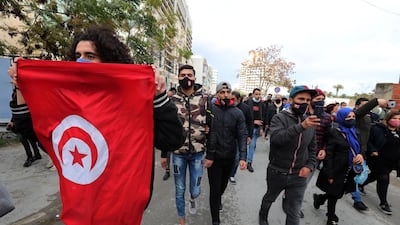

Mass demonstrations have returned to Tunisia, a decade after it became the progenitor of a wave of uprisings across a number of Arab countries. Today's protesters decry a stagnant economy, corruption and youth unemployment. They are chanting the same slogans and marching on the same locations where a decade ago society gathered in hope of progress.
Tunisians are lamenting a lack of change.
The current protests have been building for the past several weeks, though the proximate spark is the government's decision to impose another lockdown to prevent the spread of Covid-19. The virus has all but shut down many countries and forced politicians to strike a fine balance between protecting public health and preserving prosperity – the balance of lives and livelihoods. Tunisia's government was already walking a particularly precarious economic tightrope. Tourism, a major source of the nation's income was already in decline before the pandemic. Now the sector is almost nonexistent.

A stagnant economy disproportionately affects younger generations. Data released in 2017 by the National Institute of Statistics in Tunis shows that university graduates are badly affected, with 32 per cent unemployed, a rate even higher than for those without a degree. An estimated 100,000 Tunisian students drop out of school every year. Twelve thousand of them migrate illegally to Europe. They are not fleeing war, but rather the desperation of a life on hold.
In North Africa, one in three young people are out of work. Widespread cronyism benefits a small but privileged minority there and across much of the Middle East. For those who remain, demographics are not in their favour, with more young people applying to fewer jobs. Palestine has the highest youth unemployment rate in the region, at 43 per cent. The average across the whole of the region was over 26 per cent in 2018, double the global average.
Solutions lie in improving education and a more diverse range of initiatives through which young people can build CVs, such as internships and apprenticeships. Some programmes have worked, particularly ones on a smaller scale that teach work-based and technical skills and those that promote entrepreneurship and self-employment. Reducing state over-regulation and creating more favourable conditions for the private sector could build on this. Many governments in the region have put youth issues at the centre of their visions for the future, including the UAE, Saudi Arabia, Oman and Jordan.
Tunisia has strong base from which it can build a better nation for its youth. The country has a high number of graduates, a history of enterprise and a tourism industry that benefits from its long coastline. Strong labour unions have the power to lobby the government for better employment policies.
Nations with young populations sit on a pool of potential. Events in the country remind us that promise can be all too easily lost. Progress boosts the prosperity of all generations. But without solutions, a cycle of protest and resentment could continue.

