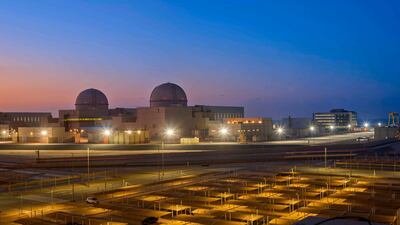
For decades, a large part of the GCC's success has been linked to its vast contribution to global energy markets. On Tuesday, the Emirates opened a new chapter in this story, showing just how much the region has changed since its oil reserves were discovered in the first half of the 20th century.
The UAE's Barakah facility, the Arab world's only nuclear energy plant, is now producing a steady stream of electricity at its 1400-megawatt Unit 1. This is the first of four sections, with the second set to open later this year. Building at the remaining two is 94 and 89 per cent complete respectively. When the $25 billion project, which was launched in 2008, is fully operational, it will begin a lifespan of at least 60 years, producing a quarter of the country's energy.
The plant's opening is the latest in a series of scientific achievements for the Arab world. AFP photo
Barakah has two principles at its core: safety and transparency
Barakah is another in a series of scientific firsts for the Arab world, happening weeks after the UAE's Hope Probe entered the Mars atmosphere in February and Tunisia launched its first domestically made satellite, Challenge-1, in March. This has all happened amid the Covid-19 pandemic, a sign that the region is growing a resilient culture of the pursuit of science.
It is also a success of international co-operation, something that has proven its value time and time again, particularly during the past year. Throughout the project, South Korea has been on hand to lend its expertise through a partnership with the Korea Electric Power Corporation.
The Barakah plant proves that nuclear power has a place in the 21st century, particularly as a means of producing electricity that does not contribute to global warming. When it reaches full capacity, its clean energy will reduce the nation's output of carbon dioxide by 21 million tonnes, a reduction that is equivalent to removing 3.2 million cars from the country's roads.
The project adds a new scientific dimension to the UAE's economic diversification strategy. A nuclear sector is a mark of an advanced nation. Across the world, the most developed states have been harnessing its strategic benefits not just for eco-friendly power, but for a sovereign source of energy that can be used to power submarines, ships and shore up a nation's electricity expenditure at times of market instability. Domestic nuclear capability empowers all citizens. Women represent 40 per cent of the workforce at the UAE's Federal Authority for Nuclear Regulation and young scientists will have a new home to pursue their dreams.
Barakah has two other principles at its core: safety and transparency. Whether protection at the site itself, or protocols to deal with radioactive waste, the facility uses the latest technology to ensure that atomic energy’s benefit is not clouded by risk. It is deemed one of the safest nuclear programmes in the world.
We will save the planet by embracing, not shying away from innovative approaches to the climate crisis. With the Arab world’s first nuclear plant now online, the region is one step closer to a carbon-free future.

What vitamins do we know are beneficial for living in the UAE
Vitamin D: Highly relevant in the UAE due to limited sun exposure; supports bone health, immunity and mood. Vitamin B12: Important for nerve health and energy production, especially for vegetarians, vegans and individuals with absorption issues. Iron: Useful only when deficiency or anaemia is confirmed; helps reduce fatigue and support immunity. Omega-3 (EPA/DHA): Supports heart health and reduces inflammation, especially for those who consume little fish.
Gearbox Six speed automatic with manual and sports mode
Power 165hp @ 6,000rpm
Torque 240Nm @ 1,400rpm 0-100kph: 9.2 seconds
Top speed 420 kph (governed)
Fuel economy, combined 35.2L / 100km (est)
Coming soon
Torno Subito by Massimo Bottura
When the W Dubai – The Palm hotel opens at the end of this year, one of the highlights will be Massimo Bottura’s new restaurant, Torno Subito, which promises “to take guests on a journey back to 1960s Italy”. It is the three Michelinstarred chef’s first venture in Dubai and should be every bit as ambitious as you would expect from the man whose restaurant in Italy, Osteria Francescana, was crowned number one in this year’s list of the World’s 50 Best Restaurants.
Akira Back Dubai
Another exciting opening at the W Dubai – The Palm hotel is South Korean chef Akira Back’s new restaurant, which will continue to showcase some of the finest Asian food in the world. Back, whose Seoul restaurant, Dosa, won a Michelin star last year, describes his menu as, “an innovative Japanese cuisine prepared with a Korean accent”.
Dinner by Heston Blumenthal
The highly experimental chef, whose dishes are as much about spectacle as taste, opens his first restaurant in Dubai next year. Housed at The Royal Atlantis Resort & Residences, Dinner by Heston Blumenthal will feature contemporary twists on recipes that date back to the 1300s, including goats’ milk cheesecake. Always remember with a Blumenthal dish: nothing is quite as it seems.
West Indies: Holder (c), Ambris, Bishoo, Brathwaite, Chase, Dowrich (wk), Gabriel, Hamilton, Hetmyer, Hope, Lewis, Paul, Powell, Roach, Warrican, Joseph
Race results:
1. Thani Al Qemzi (UAE) Team Abu Dhabi: 46.44 min
2. Peter Morin (FRA) CTIC F1 Shenzhen China Team: 0.91sec
3. Sami Selio (FIN) Mad-Croc Baba Racing Team: 31.43sec
How has net migration to UK changed?
The figure was broadly flat immediately before the Covid-19 pandemic, standing at 216,000 in the year to June 2018 and 224,000 in the year to June 2019.
It then dropped to an estimated 111,000 in the year to June 2020 when restrictions introduced during the pandemic limited travel and movement.
The total rose to 254,000 in the year to June 2021, followed by steep jumps to 634,000 in the year to June 2022 and 906,000 in the year to June 2023.
The latest available figure of 728,000 for the 12 months to June 2024 suggests levels are starting to decrease.
