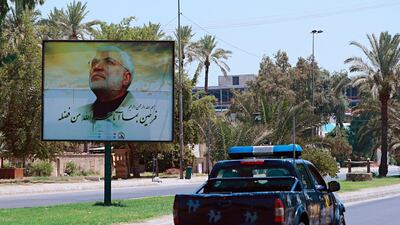

In recent weeks, attacks on Iraqi sovereignty have intensified. Turkey has conducted airstrikes on Iraq's Kurdish region, allegedly against Kurdistan Workers' Party targets, but they have also claimed civilian lives. Turkish incursions are only the latest addition to a long list of encroachments by Iraq's neighbours, chief among them Iran. Tehran has a plethora of loyalist militias operating in the country, some under the umbrella of the Popular Mobilisation Forces.
At the weekend, Iraqi Prime Minister Mustafa Al Kadhimi sent a strong message to these groups, signalling that they will no longer be allowed to ignore the rule of law.
On Thursday, Iraq's Counter Terrorism Services raided the base of the powerful Kataib Hezbollah, a PMF militia that is also Iran's powerful ally in Iraq. Fourteen of its members were arrested and rocket launchers were seized, while an investigation is now under way. These arrests are another step in the right direction for Iraq to win its sovereignty back and reassert the authority of the state.
The PMF has fought against ISIS in the past, but its victories have been tainted by sectarian killings and the pro-Iranian stance of most of its militias.
The groups within the PMF have officially been integrated into the Iraqi Army, but in name only. They have their own commanders, to whom they are loyal. This failed integration has fostered the rise of a state within the Iraqi state, threatening peace and stability in the country. In addition to terrorising civilians, some PMF factions have allegedly killed hundreds of peaceful protesters since October last year. Mr Al Kadhimi has opened an investigation into those killings. These dangerous groups have also attacked US assets in Iraq, turning their own country into a battleground where differences between the US and Iran are settled. Last December, Kataib Hezbollah attacked an Iraqi base housing US troops, killing a US contractor and wounding both Iraqi and American soldiers. In the past two weeks alone, pro-Iranian militias have launched six rocket attacks against the US embassy, along with attacks close to Baghdad International Airport.
Today, however, these militias are weakened by increased US sanctions on Iran, which have slashed Tehran’s ability to fund its proxies. In January, the US killing of Qassem Suleimani, the leader of Iran's Islamic Revolutionary Guard Corps' Al Quds Force in charge of co-ordinating these proxies, and Abu Mahdi Al Muhandis, the leader of both the PMF and Kataib Hezbollah at the time, also dealt a blow to Iran-aligned militias in the country.
Afterwards divisions began to emerge between these groups, which were increasingly embroiled in an internecine struggle for power.
Since Thursday's arrests, Kataib Hezbollah has sent out convoys to roam the streets of Baghdad and their members have openly threatened Mr Al Kadhimi. No one should be above the rule of law, and the Iraqi state has a duty to protect this principle.
Mr Al Kadhimi had made sovereignty a priority on his agenda. This also includes tackling those who undermine Iraq from within its borders. Militias have competed with the authority of the state for much too long, and their presence has expanded Iran's grip on the nation. It is high time that they are held accountable for their actions.

