In the past few months, countries have raced to find vaccines and treatments for Covid-19.
From the US to the UK, potential vaccines are being tested out. Recently, scientists in the UAE have also made extraordinary advances in treatment and testing. Abu Dhabi Stem Cell Centre unveiled a new type of aerosol stem-cell therapy that has been tested on 73 patients with mild to severe symptoms, all of whom recovered. This new treatment helps lung cells regenerate faster and is meant to be administered alongside other existing protocols.
Among the recovered patients who underwent stem-cell therapy is Abdullahi Rodhile. A father of 10 with underlying conditions, he had to be put in an induced coma for nearly three weeks. "I was brought back to life." he told The National. "I was dead and now I am alive."
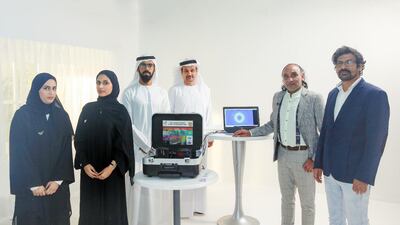
And on Tuesday, QuantLase Imaging Lab, the medical research arm of Abu Dhabi-based International Holdings Company, announced the development of a rapid laser coronavirus test with the potential to carry out mass screenings and deliver results in seconds. The new technology could, in the coming months, replace swab tests, which can take hours to process.
These new treatments, vaccines and testing methods have yet to be accessible on a large scale, and require further work. But they are a clear step towards the innovation necessary to diminish the pandemic’s threat to daily life. For several years now, scientific research worldwide has suffered from a lack of resources and funding. In Europe, home to many renowned institutions of medical science, governments have repeatedly struck blows to research programmes through immigration restrictions, budget cuts to universities and a lack of public investment in the sciences. In the US, the Trump administration has been criticised for its 2018 dissolution of Washington’s pandemic response team, a taskforce put in place by the Obama administration after the discovery of Ebola.
This pandemic has proved the importance of promoting strong research institutions and scientific advancement. It has also given more space for medical and scientific experts in the media landscape. Their contribution is vital to combating conspiracy theories, providing trusted information and raising awareness. Nurses, doctors and innovators have now become the role models and heroes of the new generation.
"I was brought back to life. I was dead and now I am alive."
But while renewed interest in scientific advancements is pivotal to global public health and to our economies, the focus on coronavirus has, unfortunately but inevitably, come at the cost of furthering research in other essential fields. The Bill and Melinda Gates Foundation has announced it will give its “total attention” to the coronavirus pandemic. Similarly, the European Union has decided to allot an additional €675 million from the Horizon 2020 programme, the biggest research and innovation fund in Europe, to research into the coronavirus, with pandemic investment from the fund totaling €1 billion.
Global policymakers, the scientific community and civil society are all part of a delicate balancing act between allocating the resources necessary to find a path out of the coronavirus pandemic, and not allowing other priorities to fall to the wayside. Resources are limited, but when used carefully and effectively, we can spur innovation on all fronts.

Common OCD symptoms and how they manifest
Checking: the obsession or thoughts focus on some harm coming from things not being as they should, which usually centre around the theme of safety. For example, the obsession is “the building will burn down”, therefore the compulsion is checking that the oven is switched off.
Contamination: the obsession is focused on the presence of germs, dirt or harmful bacteria and how this will impact the person and/or their loved ones. For example, the obsession is “the floor is dirty; me and my family will get sick and die”, the compulsion is repetitive cleaning.
Orderliness: the obsession is a fear of sitting with uncomfortable feelings, or to prevent harm coming to oneself or others. Objectively there appears to be no logical link between the obsession and compulsion. For example,” I won’t feel right if the jars aren’t lined up” or “harm will come to my family if I don’t line up all the jars”, so the compulsion is therefore lining up the jars.
Intrusive thoughts: the intrusive thought is usually highly distressing and repetitive. Common examples may include thoughts of perpetrating violence towards others, harming others, or questions over one’s character or deeds, usually in conflict with the person’s true values. An example would be: “I think I might hurt my family”, which in turn leads to the compulsion of avoiding social gatherings.
Hoarding: the intrusive thought is the overvaluing of objects or possessions, while the compulsion is stashing or hoarding these items and refusing to let them go. For example, “this newspaper may come in useful one day”, therefore, the compulsion is hoarding newspapers instead of discarding them the next day.
Source: Dr Robert Chandler, clinical psychologist at Lighthouse Arabia
The bairaq is a competition for the best herd of 50 camels, named for the banner its winner takes home
Namoos - a word of congratulations reserved for falconry competitions, camel races and camel pageants. It best translates as 'the pride of victory' - and for competitors, it is priceless
While the taste of beans and freshness of roast is paramount to the specialty coffee scene, so is sustainability and workers’ rights.
The bulk of genuine specialty coffee companies aim to improve on these elements in every stage of production via direct relationships with farmers. For instance, Mokha 1450 on Al Wasl Road strives to work predominantly with women-owned and -operated coffee organisations, including female farmers in the Sabree mountains of Yemen.
Because, as the boutique’s owner, Garfield Kerr, points out: “women represent over 90 per cent of the coffee value chain, but are woefully underrepresented in less than 10 per cent of ownership and management throughout the global coffee industry.”
One of the UAE’s largest suppliers of green (meaning not-yet-roasted) beans, Raw Coffee, is a founding member of the Partnership of Gender Equity, which aims to empower female coffee farmers and harvesters.
Also, globally, many companies have found the perfect way to recycle old coffee grounds: they create the perfect fertile soil in which to grow mushrooms.
The biog
Occupation: Key marker and auto electrician
Hometown: Ghazala, Syria
Date of arrival in Abu Dhabi: May 15, 1978
Family: 11 siblings, a wife, three sons and one daughter
Favourite place in UAE: Abu Dhabi
Favourite hobby: I like to do a mix of things, like listening to poetry for example.
Favourite Syrian artist: Sabah Fakhri, a tenor from Aleppo
