

This month, a five-second Instagram video produced by a 19-year-old woman in Pakistan went viral. In the video, Dananeer Mobin points the camera to her friends as they listen to music and dance while their car is pulled over on the side of a mountain road, with Ms Mobin saying to the viewer in Urdu: “This is our car, this is us, and this is our party.”
Her pronunciation of the word “party” as “pawry” is deliberate – an imitation of elite Pakistanis educated abroad who speak with foreign accents. Urdu and Hindi are mutually intelligible, so Ms Mobin’s video resonated with many not just in her home country, but in neighbouring India, too, where it has racked up millions of views, spawning copycat videos from Indian police departments and Bollywood celebrities alike.
“India and Pakistan are two nations with one soul,” goes an old but oft-repeated cliche. And yet, as much as their history is shared, their present is bitterly divided.
After two years of escalating tensions between the two countries, Ms Mobin inadvertently reminded Indians and Pakistanis how easy it can be for them to share a laugh.
The most recent escalation in tensions on the subcontinent began in February 2019, when India blamed Pakistan-sponsored militants for the deaths of 44 soldiers in Indian-administered Kashmir, a disputed area. Six months later, New Delhi revoked Kashmir's autonomous status, provoking anger in Islamabad and a threat to merge Gilgit-Baltistan – a neighbouring disputed area – with the rest of Pakistan. Various clashes since then have resulted in dozens of casualties, including civilian ones, being reported by both sides.
On Friday, however, the two countries' militaries began a mutually agreed total ceasefire. In reality, it is the restoration of a previous one signed in 2003, though after so many years it appears a fresh start. The ceasefire would bring much-needed relief to ordinary Kashmiris who have spent nearly a generation caught in the crossfire. It potentially also represents an important first step towards a normalisation of ties.
But India and Pakistan, it must be mentioned, have been here before. Short periods of peace have often been disrupted by long durations of cross-border fire and violence in the border areas. Indeed, over the past two years, almost 11,000 ceasefire violations have been reported. Trust is at an all-time low.
To bring long-term peace to the Kashmir valley and build a sustainable relationship, the two governments must focus on taking small steps rather than giant strides.
-
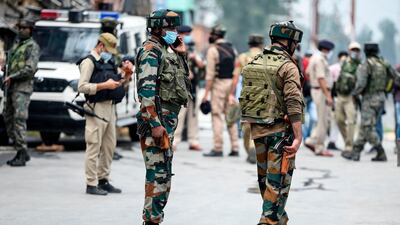
Security personnel stand guard near the site where suspected militants fired at police near Nowgam bypass in Srinagar. At least two policemen were killed and another wounded after militants allegedly opened fire on police party in Nowgam area, local media reported on August 14. AFP -

Security personnel and police on patrol in Srinagar. AFP -
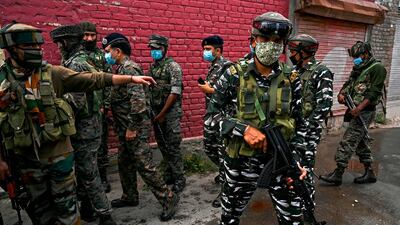
Inspector-General Vijay Kumar said militants sprayed bullets at the police from a narrow lane. AFP -
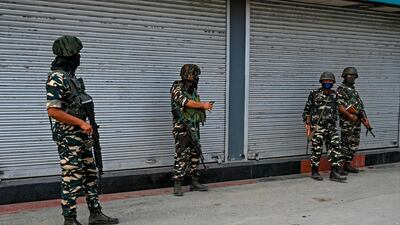
Reinforcements of counterinsurgency police and soldiers were searching the area for the attackers. AFP -
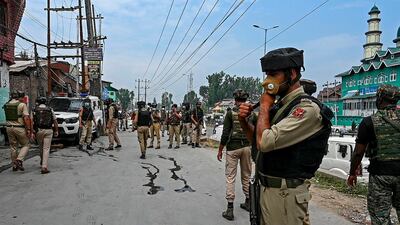
Security personnel gather near the site where suspected militants fired at police near Nowgam bypass in Srinagar. AFP -
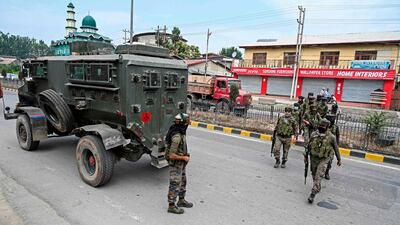
None of the rebel groups that have been fighting against Indian rule since 1989 immediately claimed responsibility for the attack. AFP -
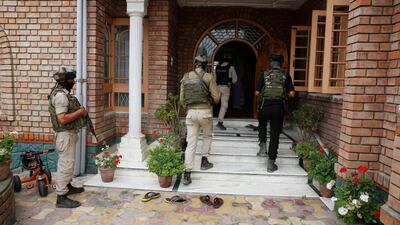
Indian policemen enter homes in Kashmir searching for Anti-India rebels accused of firing on a police convoy in Srinagar, EP -
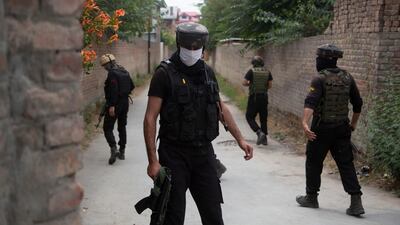
Members of special Operations Group (SOG) of Jammu and Kashmir police examine at the site of the attack. AP Photo


New Delhi insists on putting the issue of what it sees as Pakistan-sponsored terrorism on the table. Islamabad, meanwhile, wants to discuss the future of Kashmir. Talks have stalled with neither government ready to accept the other side’s demand. Rather than digging their heels, however, they could be talking about issues that are more easily resolved. This is important, especially with both countries experiencing economic headwinds and trouble in other border areas: along the Line of Actual Control between India and China and the Durand Line separating Pakistan and Afghanistan.
Beyond it being a feel-good measure, the restoration of trade and cultural exchanges will boost both countries' pandemic-stricken economies. India, a vaccine-manufacturing hub, could extend its "vaccine diplomacy" – afforded thus far to some neighbours and allies – to Pakistan as well. Much else can be done but will require political will and bold leadership.
A dash of humour, provided by Ms Mobin, brought a sense of fraternity and cheer to millions of Indians and Pakistanis, even if it was for a fleeting moment. The task ahead for their officials is to somehow turn such fleeting moments into something more lasting and permanent.

