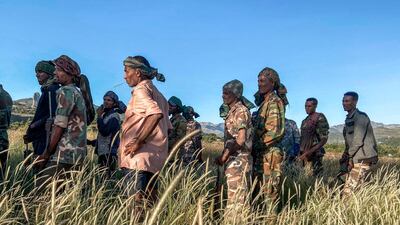
On November 5, the Ethiopian military declared war with separatists in the Tigray region of Ethiopia. The world now faces the prospect of another country descending into conflict.
The implications of full-blown war in Ethiopia would be of huge significance. It would have the potential to displace 9 million people, according to reports. This would be a figure even greater than the number of people displaced in Syria’s ongoing civil war.
The chief victims, of course, would be Ethiopians, who last suffered the tragedy of war 20 years ago. But risks also extend to the wider Horn of Africa, a region with huge potential that could be rocked by instability.
The "great man theory" of history, coined by the Scottish philosopher Thomas Carlyle, argues that individuals have the ability to alter the course of major events. This, many hope, is true for Ethiopia's Prime Minister, Abiy Ahmed. Even with his impressive political career – he has won the Nobel Peace Prize and the UAE Order of Zayed, and is credited with impressive economic and environmental achievements in his country – his task ahead will require the leadership and compassion of a great statesman.
Tribal and ethnic divisions have long existed in Ethiopia. For many years, politics in the country was dominated by former prime minister Meles Zenawi. Mr Meles was from the semi-autonomous Tigray region, homeland of the Tigrayan ethnic group, who comprise six per cent of Ethiopia’s population of 110 million.
After Mr Abiy – who is a member of the Oromo, one of the largest ethnic groups in the country – rose to power, Tigrayan leaders claimed he was launching a campaign to reduce their influence in the country.
Tensions in Tigray boiled over when, ostensibly due to the pandemic, Mr Abiy postponed national elections. This prompted the TPLF, the ruling party in Tigray, to hold its own elections, which the national government deemed illegal.
Since then, fighting has broken out, putting at risk the end of the country's fragile peace. Illustrating the seriousness of the situation, The National reported last Saturday that Mr Abiy had told civilians in Tigray to stay indoors to avoid "collateral damage" from government airstrikes.
The UN and many in the international community have called for de-escalation. But with news yesterday of Ethiopian forces seizing a Tigrayan airport and reports of refugees fleeing to neighbouring Sudan, many worry the situation is worsening.
There are also concerns that ethnic factions in the Ethiopian military could splinter, endangering internal security. A potential conflict threatens to reverse recent economic achievements and reforms. Last year, investment in Ethiopia reached 38 per cent of GDP.
Ethiopia bears the unique distinction in Africa of having retained its independence throughout the colonial era. It also possesses an ancient heritage tied to each of the three great Abrahamic faiths. Despite its challenges, there has been a historic coherence and continuity to Ethiopian identity that provides a model for strength in diversity.
The prospect of war must not jeopardise the wellbeing of one of Africa’s great nations and turn a success story into a tragedy. Mr Abiy, with the support of the international community, must guide his country through this difficult episode. The future of Ethiopia and its people rests on it.

COMPANY PROFILE
Name: Kumulus Water
Started: 2021
Founders: Iheb Triki and Mohamed Ali Abid
Based: Tunisia
Sector: Water technology
Number of staff: 22
Investment raised: $4 million
The more serious side of specialty coffee
While the taste of beans and freshness of roast is paramount to the specialty coffee scene, so is sustainability and workers’ rights.
The bulk of genuine specialty coffee companies aim to improve on these elements in every stage of production via direct relationships with farmers. For instance, Mokha 1450 on Al Wasl Road strives to work predominantly with women-owned and -operated coffee organisations, including female farmers in the Sabree mountains of Yemen.
Because, as the boutique’s owner, Garfield Kerr, points out: “women represent over 90 per cent of the coffee value chain, but are woefully underrepresented in less than 10 per cent of ownership and management throughout the global coffee industry.”
One of the UAE’s largest suppliers of green (meaning not-yet-roasted) beans, Raw Coffee, is a founding member of the Partnership of Gender Equity, which aims to empower female coffee farmers and harvesters.
Also, globally, many companies have found the perfect way to recycle old coffee grounds: they create the perfect fertile soil in which to grow mushrooms.
How it works
Booklava works on a subscription model. On signing up you receive a free book as part of a 30-day-trial period, after which you pay US$9.99 (Dh36.70) per month to gain access to a library of books and discounts of up to 30 per cent on selected titles. You can cancel your subscription at any time. For more details go to www.booklava.com
The Lost Letters of William Woolf
Helen Cullen, Graydon House
Dr Afridi's warning signs of digital addiction
Spending an excessive amount of time on the phone.
Neglecting personal, social, or academic responsibilities.
Losing interest in other activities or hobbies that were once enjoyed.
Having withdrawal symptoms like feeling anxious, restless, or upset when the technology is not available.
Experiencing sleep disturbances or changes in sleep patterns.
What are the guidelines?
Under 18 months: Avoid screen time altogether, except for video chatting with family.
Aged 18-24 months: If screens are introduced, it should be high-quality content watched with a caregiver to help the child understand what they are seeing.
Aged 2-5 years: Limit to one-hour per day of high-quality programming, with co-viewing whenever possible.
Aged 6-12 years: Set consistent limits on screen time to ensure it does not interfere with sleep, physical activity, or social interactions.
Teenagers: Encourage a balanced approach – screens should not replace sleep, exercise, or face-to-face socialisation.
Source: American Paediatric Association
Evacuations to France hit by controversy
- Over 500 Gazans have been evacuated to France since November 2023
- Evacuations were paused after a student already in France posted anti-Semitic content and was subsequently expelled to Qatar
- The Foreign Ministry launched a review to determine how authorities failed to detect the posts before her entry
- Artists and researchers fall under a programme called Pause that began in 2017
- It has benefited more than 700 people from 44 countries, including Syria, Turkey, Iran, and Sudan
- Since the start of the Gaza war, it has also included 45 Gazan beneficiaries
- Unlike students, they are allowed to bring their families to France
More from Neighbourhood Watch:
BRIEF SCORES
England 228-7, 50 overs
N Sciver 51; J Goswami 3-23
India 219, 48.4 overs
P Raut 86, H Kaur 51; A Shrubsole 6-46
England won by nine runs
Tightening the screw on rogue recruiters
The UAE overhauled the procedure to recruit housemaids and domestic workers with a law in 2017 to protect low-income labour from being exploited.
Only recruitment companies authorised by the government are permitted as part of Tadbeer, a network of labour ministry-regulated centres.
A contract must be drawn up for domestic workers, the wages and job offer clearly stating the nature of work.
The contract stating the wages, work entailed and accommodation must be sent to the employee in their home country before they depart for the UAE.
The contract will be signed by the employer and employee when the domestic worker arrives in the UAE.
Only recruitment agencies registered with the ministry can undertake recruitment and employment applications for domestic workers.
Penalties for illegal recruitment in the UAE include fines of up to Dh100,000 and imprisonment
But agents not authorised by the government sidestep the law by illegally getting women into the country on visit visas.
The five pillars of Islam
