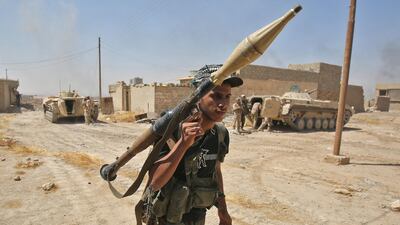
A fighter from the Hashed Al-Shaabi (Popular Mobilization units) carries his RPG inside al-Nour neighbourhood, in eastern Tal Afar, the main remaining stronghold of the Islamic State group, after the government announced the beginning of an operation to retake it from the jihadists, on August 23, 2017. - Iraqi forces recaptured several districts and advanced towards the centre of Tal Afar, one of the Islamic State group's last strongholds in the country, as aid workers braced for an exodus of civilians fleeing the fighting. (Photo by AHMAD AL-RUBAYE / AFP)
A fighter from the Hashed Al-Shaabi (Popular Mobilization units) carries his RPG inside al-Nour neighbourhood, in eastern Tal Afar, the main remaining stronghold of the Islamic State group, after the
A rocket attack on Erbil was not a small militia acting out on its own. It was part of Tehran's wider strategy to weaken Western presence in the country.
On Monday, the scale of the challenge posed by Iran to US President Joe Biden's Middle East policy was laid bare when a rocket struck an American base in the capital of Iraq's semi-autonomous Kurdistan region, killing a civilian contractor and injuring six, including a US service member.
The attack was carried out by an Iran supported militia group, Saraya Awliya Al Dam, raising the complicated question of how the new American administration should deal with Tehran’s asymmetric warfare capabilities. It must do so urgently for the sake of the Middle East, especially Iraq, which is caught in the middle. Mr Biden will have to form a long-term strategy that counters a growing sense among Iraqis that America is an unreliable ally, not fully committed to stabilising their country.
Saraya Awliya Al Dam is a small and largely unknown group. Its obscurity should not come as a surprise; Iran's proxy war in Iraq is so difficult to combat precisely because the militias it supports vary greatly in size, prominence and function. Larger and better-known organisations take the spotlight and occupy the highest pulpits, putting their divisive, anti-western stamp on Iraqi society and politics. But violence of the kind seen on Monday is increasingly carried out by smaller groups.
Monday's rocket attack struck a sight in Erbil, a city that houses many Western diplomats and aid workers. AFP
A steady stream of attacks antagonises the US to an extent just short of the threshold for provoking a war
This is not necessarily a sign of diverging strategies among Iran-backed militias. Their aims can vary but Qassem Suleimani, the deceased commander of Iran's Quds Force who was previously responsible for the Islamic Revolutionary Guard Corps' proxy wars, encouraged this kind of complexity. Splinter groups carried out Tehran's dirty work, while larger organisations promoted themselves as domestic political movements, capitalising on their role in defeating ISIS in Iraq.
This comprehensive strategy, which holds large parts of Iraqi politics hostage, stunts the country's development and threatens alliances with western powers.
A steady stream of attacks antagonises the US to an extent just short of the threshold for provoking a war – something Iran cannot afford – while undermining Iraqi faith in US security assistance.
Mr Biden must face up to this challenge. Without his support, Iran's grip on Iraq will increase. The fact that the attack took place in Erbil, often considered a safe base for diplomatic and aid operations in the country, indicates that Tehran is upping the ante and taking advantage of an America resting on its laurels.
Mr Biden has a chance to demonstrate that his administration will not tolerate Iran's destabiling use of proxies. He can do this in a non-violent manner by addressing Iran's use of asymmetric warfare as Tehran lobbies him to remove crippling US sanctions.
It is a complex task, but it is that way precisely because it is so important to accomplish.

Want to sound on message about the biggest show on television without actually watching it? Best not to get locked into the labyrinthine tales of revenge and royalty: as Isaac Hempstead Wright put it, all you really need to know from now on is that there’s going to be a huge fight between humans and the armies of undead White Walkers.
The season ended with a dragon captured by the Night King blowing apart the huge wall of ice that separates the human world from its less appealing counterpart. Not that some of the humans in Westeros have been particularly appealing, either.
Anyway, the White Walkers are now free to cause any kind of havoc they wish, and as Liam Cunningham told us: “Westeros may be zombie land after the Night King has finished.” If the various human factions don’t put aside their differences in season 8, we could be looking at The Walking Dead: The Medieval Years.
Treaty of Friendship between the United Kingdom of Great Britain and Northern Ireland and the United Arab Emirates
The United kingdom of Great Britain and Northern Ireland and the United Arab Emirates; Considering that the United Arab Emirates has assumed full responsibility as a sovereign and independent State; Determined that the long-standing and traditional relations of close friendship and cooperation between their peoples shall continue; Desiring to give expression to this intention in the form of a Treaty Friendship; Have agreed as follows:
ARTICLE 1 The relations between the United Kingdom of Great Britain and Northern Ireland and the United Arab Emirates shall be governed by a spirit of close friendship. In recognition of this, the Contracting Parties, conscious of their common interest in the peace and stability of the region, shall: (a) consult together on matters of mutual concern in time of need; (b) settle all their disputes by peaceful means in conformity with the provisions of the Charter of the United Nations.
ARTICLE 2 The Contracting Parties shall encourage education, scientific and cultural cooperation between the two States in accordance with arrangements to be agreed. Such arrangements shall cover among other things: (a) the promotion of mutual understanding of their respective cultures, civilisations and languages, the promotion of contacts among professional bodies, universities and cultural institutions; (c) the encouragement of technical, scientific and cultural exchanges.
ARTICLE 3 The Contracting Parties shall maintain the close relationship already existing between them in the field of trade and commerce. Representatives of the Contracting Parties shall meet from time to time to consider means by which such relations can be further developed and strengthened, including the possibility of concluding treaties or agreements on matters of mutual concern.
ARTICLE 4 This Treaty shall enter into force on today’s date and shall remain in force for a period of ten years. Unless twelve months before the expiry of the said period of ten years either Contracting Party shall have given notice to the other of its intention to terminate the Treaty, this Treaty shall remain in force thereafter until the expiry of twelve months from the date on which notice of such intention is given.
IN WITNESS WHEREOF the undersigned have signed this Treaty.
DONE in duplicate at Dubai the second day of December 1971AD, corresponding to the fifteenth day of Shawwal 1391H, in the English and Arabic languages, both texts being equally authoritative.
Signed
Geoffrey Arthur Sheikh Zayed
The biog
Family: wife, four children, 11 grandchildren, 16 great-grandchildren
Reads: Newspapers, historical, religious books and biographies
Education: High school in Thatta, a city now in Pakistan
Regrets: Not completing college in Karachi when universities were shut down following protests by freedom fighters for the British to quit India
Happiness: Work on creative ideas, you will also need ideals to make people happy
Founders: Mike Dawson, Varuna Singh, and Benita Rowe
Based: Dubai
Sector: Education technology
Size: Five employees
Investment: $100,000 from the ExpoLive Innovation Grant programme in 2018 and an initial $30,000 pre-seed investment from the Turn8 Accelerator in 2014. Most of the projects are government funded.
Partners/incubators: Turn8 Accelerator; In5 Innovation Centre; Expo Live Innovation Impact Grant Programme; Dubai Future Accelerators; FHI 360; VSO and Consult and Coach for a Cause (C3)
