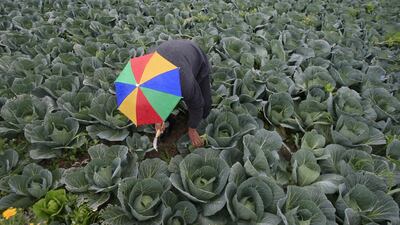
Shoppers at Madina Al Riyadiye, a fruit and vegetable market in Beirut, were treated to a small bonanza this week, when they saw lemons, bananas and other fruits on offer at discounts of up to 50 per cent. In a country where food prices and poverty rates have risen dramatically since the start of an economic crisis more than a year ago, the fire sale was a rare respite. For Lebanon's farmers, it is a complete disaster.
The rush to offload fruit wasn't spurred by competitive market sellers or an unexpectedly successful crop yield, but rather by drug dealers and unscrupulous customs officials. Last week, after discovering millions of amphetamine pills in a shipment of pomegranates delivered from Lebanon, authorities in Saudi Arabia decided to halt Lebanese agricultural produce imports indefinitely, until security fears are allayed. The decision was supported by the majority of Saudi Arabia's Gulf neighbours, who receive the bulk of Lebanese agricultural imports via Saudi ports. Consequently, Lebanese fruit and vegetable farmers, who have seen their own costs rise as a result of the economic crisis, have found themselves cut off from the Gulf, which accounts for 55 per cent of their export trade.
Agriculture as a whole accounts for a mere five per cent of Lebanon’s economy, and the majority of exports are produced by large-scale commercial operators rather than independent farmers with fewer resources, who tend to produce for domestic consumers. But the latter will lose out from the dumping of products intended for export into local market stalls. And the longer the situation continues, the more it will threaten the jobs of ancillary workers, such as lorry drivers.
Saudi customs officers discovered millions of amphetamine pills in a shipment of pomegranates arriving from Lebanon. Saudi Press Agency via AP
The impact will be felt outside of Lebanon, too. Saudi Arabia’s ban covers not only fruit and vegetables originating in Lebanon, but also those transiting there. Lebanese agriculture industry representatives have concluded that the pomegranate shipment disguising the amphetamines originated in Syria, highlighting the importance of Beirut as a trade hub for Syrian farmers. Even within Lebanon’s agriculture sector, Syrian refugees, some of whom remit money to their families back in Syria, comprise the majority of labourers.
Lebanon's economic crisis notwithstanding, it has already been a difficult year for farmers across the Middle East. Climate change, Covid-19, ongoing locust plagues and other market forces have already forced price increases in the food sector, putting food security at the top of the regional agenda. Most Arab countries rely on food imports from outside the region, and, as experts from the UN's Food and Agriculture Organisation have said, taking advantage of the "enormous untapped potential" for intra-regional trade would benefit everyone. A recent report from the World Bank noted that breaking down barriers in agricultural trade between Arab countries would be integral in the region's post-Covid-19 economic recovery.
What has transpired in Lebanon, however, has brought into sharp relief what should be obvious: that food security relies on actual security. Enhanced trading ties and all of the economic benefits that come with them can only go so far in the absence of basic trust in one's export partners. The Middle East's relatively low level of regional trade integration is as much the result of security problems and a trust gap as it is trade policy. Until those fundamentals are taken care of, one shipment of illicit drugs will have the power to jeopardise an entire country's agricultural sector.

BMW M5 specs
Engine: 4.4-litre twin-turbo V-8 petrol enging with additional electric motor
1 Mohammed Hafeez, 2 Imam-ul-Haq, 3 Azhar Ali, 4 Asad Shafiq, 5 Haris Sohail, 6 Babar Azam, 7 Sarfraz Ahmed, 8 Bilal Asif, 9 Yasir Shah, 10, Mohammed Abbas, 11 Wahab Riaz or Mir Hamza
Australia
1 Usman Khawaja, 2 Aaron Finch, 3 Shaun Marsh, 4 Mitchell Marsh, 5 Travis Head, 6 Marnus Labuschagne, 7 Tim Paine, 8 Mitchell Starc, 9 Peter Siddle, 10 Nathan Lyon, 11 Jon Holland
The specs
Engine: 4.0-litre V8 twin-turbocharged and three electric motors
Power: Combined output 920hp
Torque: 730Nm at 4,000-7,000rpm
Transmission: 8-speed dual-clutch automatic
Fuel consumption: 11.2L/100km
On sale: Now, deliveries expected later in 2025
Price: expected to start at Dh1,432,000
THE BIG MATCH
Arsenal v Manchester City,
Sunday, Emirates Stadium, 6.30pm
MATCH INFO
Uefa Champions League semi-final, first leg
Bayern Munich v Real Madrid When: April 25, 10.45pm kick-off (UAE) Where: Allianz Arena, Munich Live: BeIN Sports HD Second leg: May 1, Santiago Bernabeu, Madrid
AI traffic lights to ease congestion at seven points to Sheikh Zayed bin Sultan Street
The seven points are:
Shakhbout bin Sultan Street
Dhafeer Street
Hadbat Al Ghubainah Street (outbound)
Salama bint Butti Street
Al Dhafra Street
Rabdan Street
Umm Yifina Street exit (inbound)
Milestones on the road to union
1970
October 26: Bahrain withdraws from a proposal to create a federation of nine with the seven Trucial States and Qatar.
December: Ahmed Al Suwaidi visits New York to discuss potential UN membership.
1971
March 1: Alex Douglas Hume, Conservative foreign secretary confirms that Britain will leave the Gulf and “strongly supports” the creation of a Union of Arab Emirates.
July 12: Historic meeting at which Sheikh Zayed and Sheikh Rashid make a binding agreement to create what will become the UAE.
July 18: It is announced that the UAE will be formed from six emirates, with a proposed constitution signed. RAK is not yet part of the agreement.
August 6: The fifth anniversary of Sheikh Zayed becoming Ruler of Abu Dhabi, with official celebrations deferred until later in the year.
August 15: Bahrain becomes independent.
September 3: Qatar becomes independent.
November 23-25: Meeting with Sheikh Zayed and Sheikh Rashid and senior British officials to fix December 2 as date of creation of the UAE.
November 29: At 5.30pm Iranian forces seize the Greater and Lesser Tunbs by force.
November 30: Despite a power sharing agreement, Tehran takes full control of Abu Musa.
November 31: UK officials visit all six participating Emirates to formally end the Trucial States treaties
December 2: 11am, Dubai. New Supreme Council formally elects Sheikh Zayed as President. Treaty of Friendship signed with the UK. 11.30am. Flag raising ceremony at Union House and Al Manhal Palace in Abu Dhabi witnessed by Sheikh Khalifa, then Crown Prince of Abu Dhabi.
December 6: Arab League formally admits the UAE. The first British Ambassador presents his credentials to Sheikh Zayed.
Dubai launched the pilot phase of its real estate tokenisation project last month.
The initiative focuses on converting real estate assets into digital tokens recorded on blockchain technology and helps in streamlining the process of buying, selling and investing, the Dubai Land Department said.
Dubai’s real estate tokenisation market is projected to reach Dh60 billion ($16.33 billion) by 2033, representing 7 per cent of the emirate’s total property transactions, according to the DLD.
A ancient classical dance from the southern Indian state of Tamil Nadu. Intricate footwork and expressions are used to denote spiritual stories and ideas.
Fujairah is a crucial hub for fuel storage and is just outside the Strait of Hormuz, a vital shipping route linking Middle East oil producers to markets in Asia, Europe, North America and beyond.
The strait is 33 km wide at its narrowest point, but the shipping lane is just three km wide in either direction. Almost a fifth of oil consumed across the world passes through the strait.
Iran has repeatedly threatened to close the strait, a move that would risk inviting geopolitical and economic turmoil.
Last month, Iran issued a new warning that it would block the strait, if it was prevented from using the waterway following a US decision to end exemptions from sanctions for major Iranian oil importers.
Created in 1961, the World Food Programme is pledged to fight hunger worldwide as well as providing emergency food assistance in a crisis.
One of the organisation’s goals is the Zero Hunger Pledge, adopted by the international community in 2015 as one of the 17 Sustainable Goals for Sustainable Development, to end world hunger by 2030.
The WFP, a branch of the United Nations, is funded by voluntary donations from governments, businesses and private donations.
Almost two thirds of its operations currently take place in conflict zones, where it is calculated that people are more than three times likely to suffer from malnutrition than in peaceful countries.
It is currently estimated that one in nine people globally do not have enough to eat.
On any one day, the WFP estimates that it has 5,000 lorries, 20 ships and 70 aircraft on the move.
Outside emergencies, the WFP provides school meals to up to 25 million children in 63 countries, while working with communities to improve nutrition. Where possible, it buys supplies from developing countries to cut down transport cost and boost local economies.
List of alleged parties
May 12, 2020: PM and his wife Carrie attend 'work meeting' with at least 17 staff
May 20, 2020: They attend 'bring your own booze party'
Nov 27, 2020: PM gives speech at leaving party for his staff
Dec 10, 2020: Staff party held by then-education secretary Gavin Williamson
Dec 13, 2020: PM and his wife throw a party
Dec 14, 2020: London mayoral candidate Shaun Bailey holds staff event at Conservative Party headquarters
Dec 15, 2020: PM takes part in a staff quiz
Dec 18, 2020: Downing Street Christmas party
THE BIO
Born: Mukalla, Yemen, 1979
Education: UAE University, Al Ain
Family: Married with two daughters: Asayel, 7, and Sara, 6
Favourite piece of music: Horse Dance by Naseer Shamma
Favourite book: Science and geology
Favourite place to travel to: Washington DC
Best advice you’ve ever been given: If you have a dream, you have to believe it, then you will see it.
