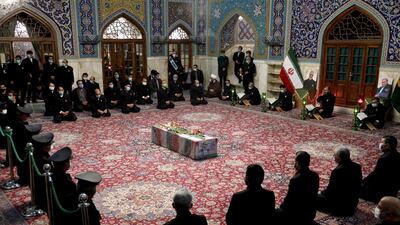

The assassination last week of a top Iranian scientist, Mohsen Fakhrizadeh, is undoubtedly a blow to the malign mission in which he was accused of playing a central role: Tehran’s suspected nuclear weapons programme. But the fallout, if mismanaged, could be damaging to the region as a whole.
Iran has faced similar setbacks before. Four Iranian nuclear scientists were assassinated between 2010 and 2012. And last January, the head of the Quds Force of the Islamic Revolutionary Guard Corps, Qassem Suleimani, was killed in a US strike. While it remains unclear who is behind the killing, attacks like these fuel anxiety in Iran's government.
Despite threats of a severe response each time, however, Tehran’s immediate retribution tends to be more muted. The fact that there was no direct military response after the killing of Suleimani, whose death was far more significant and symbolic than Fakhrizadeh, is telling about the unlikelihood of such a response this time around.
There are important distinctions between the two men's profiles. Suleimani was a soldier who had ordered many assassinations. Fakhrizadeh’s killing was more surprising as he was not seen as an immeditate military target. Although Iran’s progress towards a nuclear weapon must not be allowed to continue apace, critics will question whether long-term safety and justice are served if extra-judicial killings become a staple of strategies to contain those ambitions.
Moreover, Fakhrizadeh’s assassination creates new risks. Iran has many violent proxy groups in the region. They endanger the lives of those living in countries in which Iranian influence is strong. Rising tensions could result in tragic missteps, like Iran's inadvertent downing of a Ukrainian airliner, killing all 176 passengers, in the tense atmosphere after Suleimani's assassination.

There are political risks, too. Fakhrizadeh’s killing and the emotive internal response to it could empower those in Tehran advocating aggressive reactions. Perhaps this is what the assassins were relying on. Iran’s hard-line faction already has some momentum, as the country struggles under sanctions, Covid-19 and a plunging economy. Paranoia within the government could make Iran move its activities further underground, complicating future negotiations for a new nuclear deal to curb its weapons programme.
History shows us that an Iran under pressure can be particularly volatile. For Tehran’s hardliners, looking like an ineffective victim is unconscionable. In contrast, the real danger to Iran, its people and the wider Middle East, would be the reckless actions advocated by the fringe. Iran should view its current vulnerability as proof that it cannot justify its pariah status any longer.
In less than two months, Joe Biden will take his seat in the Oval Office and his administration will endeavour to find a more certain path by which Iran can come in from the cold. This can only happen, however, if Iran’s leaders can demonstrate restraint and level-headedness, and walk away from their destabilising activities within their borders and around the region.

