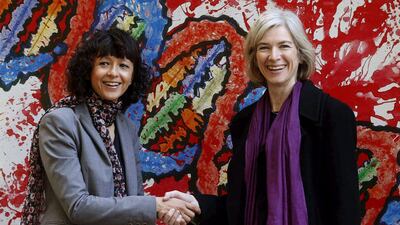

The French scientist Emmanuelle Charpentier and her American colleague Jennifer Doudna won the 2020 Nobel Prize in Chemistry. Together they developed a genetic tool called the "Crispr-Cas 9" that enables medical researchers to edit parts of the genome by removing, adding or altering sections of the DNA sequence.
It is only the fourth time the Nobel science prize has been awarded to a woman, let alone a double act. Since 1901 when the first prize was awarded for Physics, Chemistry and the Physiology of Medicine, women researchers have been consistently sidelined.
In France today, Marie Curie is a respected figure a full century after her pioneering research in radioactivity. The Curie Institute in Paris is regarded as one of the world's greatest cancer research centres.

However, Curie – born Maria Salomea Sklodowska in Poland – had to fight for laboratory funding at the start of her career. She was often humiliated on the basis of her gender, finding herself constantly mansplained. Nonetheless, she soldiered on.
Following the death of Pierre, her husband and fellow researcher, Curie became a target of sexism and derision by her colleagues. She also had to endure the hardship of raising two small daughters alone. She still went on to win two Nobel Prizes – in 1903 and 1911.
The prizes were hard-won, too. Despite carrying out the bulk of the research work – she even coined the term “radioactivity” – Pierre was initially named the sole recipient of 1903 prize. It was upon the husband's insistence that the Nobel Committee recognised the work of his wife. Curie died at the age of 66 from a blood disease that was most likely caused by her exposure to radiation.
Many decades later, it is a fact that women are still struggling to make a name for themselves in scientific research. Ms Doudna's reaction after hearing the news that she and Ms Charpentier had won the 2020 prize was telling. “Who could imagine something like this,” she said.

This is how most women I know, myself included, react after receiving a promotion or an award. Women are often brought up to assume they are never going to come first.
Perhaps, just as Curie inspired the 2020 winners – Charpentier studied at the Curie Institute – let's hope they will draw young women into various scientific fields of study. This is important because Unesco estimates that less than 30 per cent of scientific researchers worldwide are women.
According to a startling study by the American Association of University Women (AAUW), women in the US make up just 28 per cent of the science, engineering, technology and maths (Stem) academic disciplines. The gender gap is the most evident in the fastest-growing and highest-paying areas, such as computer science and engineering – the so-called “jobs of the future”. And yet, women are still not accessing them in the numbers they should be.
In 2019, Yale University, where I teach, celebrated 50 years of going co-ed. In 1969, the university admitted 575 women. I think of how frightening it must have been, but also exhilarating, for them to crack open a mostly white and male enclave. But even in 1969, women were not encouraged to study the hard sciences.
Years ago, I toured a few labs inside the Massachusetts Institute of Technology and was amazed at how few women were involved. A cousin of mine, who happened to work in one of these labs, did not think much of the fact she was among a small group of women there. Her focus was on getting on with her work. Indeed, for the few women taking this path, there is little time or energy to waste on why sexism continues to prevail.
According to a recent AAUW report titled Why so Few?, boys and girls in American high schools take maths and science courses at the same rate, but their results are widely different. Their research states: "Thirty years ago, there were 13 boys for every girl who scored above 700 on the SAT maths exam at age 13; today that ratio has shrunk to about 3:1."
-
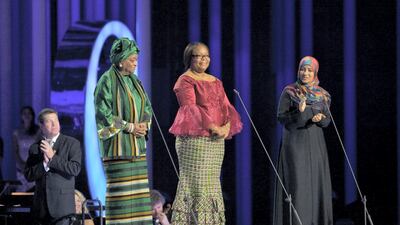
2011 - Ellen Johnson Sirleaf, Leymah Gbowee and Tawakul Karman, “for their non-violent struggle for the safety of women and for women’s rights to full participation in peace-building work”. Getty Images -
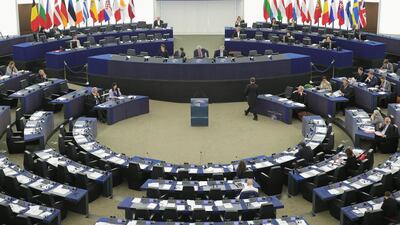
2012 - The European Union (EU), “for over six decades contributed to the advancement of peace and reconciliation, democracy and human rights in Europe”. Getty Images -
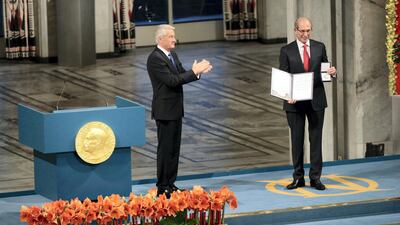
2013 - The Organisation for the Prohibiton of Chemical Weapons (OPCW), “for its extensive efforts to eliminate chemical weapons”. AFP -
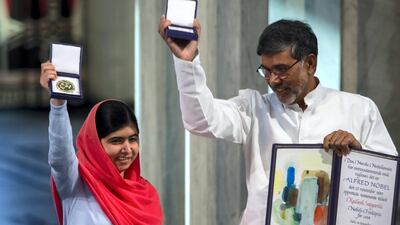
2014 - Malala Yousafzai and Kailash Satyarthi, “for their struggle against the suppression of children and young people and for the right of all children to education”. Getty Images -

2015 - National Dialogue Quartet, “for its decisive contribution to the building of a pluralistic democracy in Tunisia”. Getty Images -
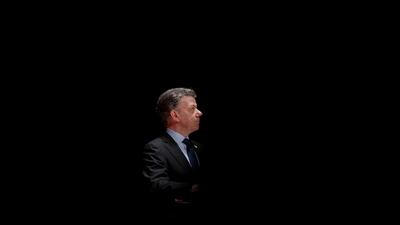
2016 - Former President of Colombia Juan Manuel Santos, “for his resolute efforts to bring the country’s more than 50-year-long civil war to an end”. Getty Images -
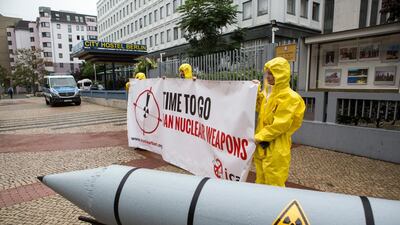
2017 - International Campaign to Abolish Nuclear Weapons (ICAN), “for its work to draw attention to the catastrophic humanitarian consequences of any use of nuclear weapons and for its ground-breaking efforts to achieve a treaty-based prohibition of such weapons”. Getty Images -
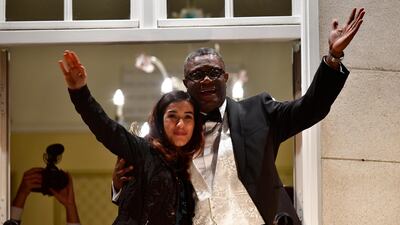
2018 - Denis Mukwege and Nadia Murad, “for their efforts to end the use of sexual violence as a weapon of war and armed conflict”. AFP -
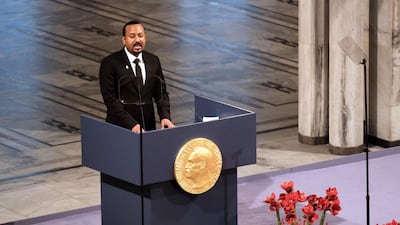
2019 - Ethiopia's Prime Minister Abiy Ahmed Ali, “for his efforts to achieve peace and international cooperation, and in particular for his decisive initiative to resolve the border conflict with neighbouring Eritrea”. Getty Images -
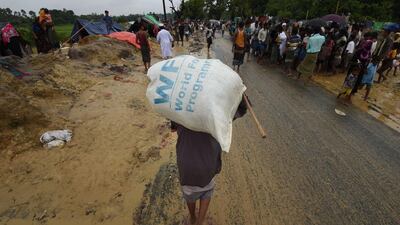
2020 - World Food Progamme, “for its efforts to combat hunger, for its contribution to bettering conditions for peace in conflict-affected areas and for acting as a driving force in efforts to prevent the use of hunger as a weapon of war and conflict”. AFP


Yet, despite their high scores, fewer women pursue Stem as their university majors. The study shows that girls’ achievements and interest in maths are shaped by their environment. Young ladies being reared in New York's elite schools, for instance, receive plenty of encouragement. I don’t worry about their futures. But I do fret about the millions of young women around the world who live in patriarchal societies and have little access to teachers who would encourage them to push the envelope.
So what can be done?
According to the same AAUW report, one of the largest gender gaps in cognitive abilities is found in the area of spatial skills. They can be as simple as reading a map, finding one's way into an unfamiliar building or merging into traffic when driving a car. But girls can improve these skills with the help of training courses. And if they can be encouraged to enhance their success levels in Stem, the learning curve in spatial skills can be short.

Colleges are the real training grounds for scientists and must attract more female scholars. They can do this by recruiting more female instructors and by implementing mentoring programmes and internships.
But more importantly, we need to stop thinking of maths and science in terms of being male or masculine jobs. The striking difference in the figures of men and women in the field are not indicative of men being naturally gifted in these fields – any more than women are better at nursing and teaching. We must discard gender boundaries that have divided professions for generations.
It is not an easy task, but it is one that we must address.
Janine di Giovanni is a Senior Fellow at Yale University’s Jackson Institute for Global Affairs

