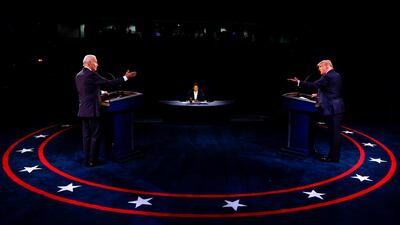
There is barely a week left before November 3, when polls close in the most momentous American election in decades, if not a century or more. Fifty-six million ballots have already been cast by early and postal voting. If results are close, counting could go on for days and litigation for weeks. But a decisive outcome could be clear as early as election night.
Democratic candidate Joe Biden's edge over incumbent Republican President Donald Trump has been amazingly consistent. Since early summer, he has held a strong, typically double-digit, lead in national polls, and smaller but significant ones in most swing states, with almost no deviation.
Democrats are haunted by Mr Trump's unexpected victory over Hillary Clinton four years ago. Many Republicans appear convinced that he will somehow pull off another stunning upset.
But with the economy struggling and the coronavirus pandemic again surging, the underlying circumstances are radically different. Mrs Clinton was deeply unpopular, but there is no sign Mr Trump has provoked widespread dislike or mistrust of Mr Biden or demonstrated that he is senile or secretly radical.
Early voting data heavily favours the Democrats. Yet Mr Trump could still win, particularly if he inspires a large group of those among his core constituency of non-college-educated white Americans who typically don't vote to go to the polls on election day. A marked surge of new Republican voter registrations in key states provides the main hope that he will prevail after all.
The all-important Senate, meanwhile, seems a real toss-up and is now the main focus of serious Republican efforts.
Four years ago, many Trump-backers cast the election in starkly existential terms. Now he is being even more lurid and aggressive, warning that a Biden victory would destroy the country, wreck its economy, prompt waves of non-white immigration, and hand power to radical socialists.
This time, however, Democrats and numerous prominent disaffected Republican commentators and operatives (though few serving elected officials) agree that the stakes are historically and nationally existential. Mrs Clinton, by contrast, never took Mr Trump seriously until he won, and no one knew how he would behave in office.
Mr Trump's campaign proclaims that American culture, capitalism and, in effect, white ethnic power are at stake. Mr Biden's allies insist that democratic institutions and the rule of law might not survive four more years of Mr Trump. The “soul of the country", both sides say, is on the ballot.
The outcome will therefore force a far more dramatic reckoning within the losing party than any normal defeat would.
To counter Mr Trump's narrow but deeply passionate base, the Democratic Party and its own base voters strategically chose to unite, tack strongly to the centre and, through the staunchly moderate Mr Biden, build the broadest national coalition they could, including by courting receptive conservatives.
Democrats have bet everything on their centre-left mainstream leadership, essentially the old guard from the Bill Clinton and Barack Obama eras. They are basically offering Americans a return to pre-Trump “normality” through a familiar, moderate standard-bearer backed by a historically unprecedented bevy of his Republican former opponents who agree that democratic processes and institutions are in mortal peril from the current president.
If Mr Biden wins, this gamble will be strongly vindicated and reinforced. As the clash between Mrs Clinton and Senator Bernie Sanders of Vermont four years ago demonstrated, there is a bitter Democratic split between a typically younger and passionate left-wing camp, and the centrist, often literally old, guard still in charge.
From left: Democratic Representatives Rashida Tlaib, Ilhan Omar, Alexandria Ocasio-Cortez and Ayanna Pressley comprise the left wing of the Democratic Party. EPA
That division will persist and perhaps grow. But a Biden victory will mean the new generation of leftists, now led by Congresswoman Alexandria Ocasio-Cortez of New York, must be patient. They can still pursue control of the party, but will have to proceed cautiously, given the success of the centrist gambit, and, especially at first, the glow of victory.
But if Mr Trump wins, their ascendancy will be rapid. Amid bitter recriminations, the left would surely seize control of the party, shifting it radically in their direction.
Among Republicans, as Mr Trump's presidency demonstrates, populist hardliners have already decisively defeated and marginalised the centre-right old guard, such as 2012 GOP presidential candidate Senator Mitt Romney of Utah.
If Mr Trump is re-elected, this radicalism will be strongly reinforced, and his personal control become so entrenched that one of his own children may inherit his party leadership.
Senator Tom Cotton is aligned with the radical wing of the Republican Party. AP Photo
If Mr Trump is narrowly defeated while loudly charging fraud, and especially if Republicans retain the Senate, the stage will be set for him to attempt a comeback in 2024, health permitting. Failing that, one of his core “America First” supporters – perhaps Senators Tom Cotton of Arkansas or Josh Hawley of Missouri, or the notorious white nationalist TV commentator Tucker Carlson – could take the helm of a doggedly extreme Republican Party.
Even if he is trounced and Democrats take the Senate, a rapid resurgence of the beleaguered Republican centre-right seems unlikely. The base is now so extreme that what is needed is another programmatic Republican de-radicalisation campaign, even more extensive than efforts in the 1960s to marginalise the fanatical John Birch Society.
Instead, former South Carolina governor Nikki Haley is poised to try to amalgamate populist Trumpians and traditional Reaganite conservatives. She has strong Reaganite credentials but served as Mr Trump's UN ambassador without alienating him or his base.
Former UN ambassador Nikki Haley, right, could succeed Donald Trump at the helm of the Republican Party. AP Photo
Having painstakingly planted a foot in each camp, she has positioned herself to offer Republicans a viable future under a conservative, Christian woman of colour in an increasingly diverse country – a plausible opponent to another Indian-American, Mr Biden’s running mate and possible successor, Senator Kamala Harris.
If Trumpism implodes in the coming days, a new Haley-led conservative fusionism could be the sequel. But there is no sign of any Republican leaders preparing to banish or subdue the increasingly empowered menagerie of fanatics, white nationalists, QAnon and other bizarre cultists in their ranks.
If Mr Biden loses, the US could be trapped between two extremist parties, with moderates sidelined in both. But if he wins, centrists and all Americans still committed to traditional institutions of democracy and the rule of law will retain a strong, even commanding, voice into the foreseeable future.
Hussein Ibish is a senior resident scholar at the Arab Gulf States Institute and a US affairs columnist for The National

1. Black holes are objects whose gravity is so strong not even light can escape their pull
2. They can be created when massive stars collapse under their own weight
3. Large black holes can also be formed when smaller ones collide and merge
4. The biggest black holes lurk at the centre of many galaxies, including our own
5. Astronomers believe that when the universe was very young, black holes affected how galaxies formed
Mercer, the investment consulting arm of US services company Marsh & McLennan, expects its wealth division to at least double its assets under management (AUM) in the Middle East as wealth in the region continues to grow despite economic headwinds, a company official said.
Mercer Wealth, which globally has $160 billion in AUM, plans to boost its AUM in the region to $2-$3bn in the next 2-3 years from the present $1bn, said Yasir AbuShaban, a Dubai-based principal with Mercer Wealth.
“Within the next two to three years, we are looking at reaching $2 to $3 billion as a conservative estimate and we do see an opportunity to do so,” said Mr AbuShaban.
Mercer does not directly make investments, but allocates clients’ money they have discretion to, to professional asset managers. They also provide advice to clients.
“We have buying power. We can negotiate on their (client’s) behalf with asset managers to provide them lower fees than they otherwise would have to get on their own,” he added.
Mercer Wealth’s clients include sovereign wealth funds, family offices, and insurance companies among others.
From its office in Dubai, Mercer also looks after Africa, India and Turkey, where they also see opportunity for growth.
Wealth creation in Middle East and Africa (MEA) grew 8.5 per cent to $8.1 trillion last year from $7.5tn in 2015, higher than last year’s global average of 6 per cent and the second-highest growth in a region after Asia-Pacific which grew 9.9 per cent, according to consultancy Boston Consulting Group (BCG). In the region, where wealth grew just 1.9 per cent in 2015 compared with 2014, a pickup in oil prices has helped in wealth generation.
BCG is forecasting MEA wealth will rise to $12tn by 2021, growing at an annual average of 8 per cent.
Drivers of wealth generation in the region will be split evenly between new wealth creation and growth of performance of existing assets, according to BCG.
Another general trend in the region is clients’ looking for a comprehensive approach to investing, according to Mr AbuShaban.
“Institutional investors or some of the families are seeing a slowdown in the available capital they have to invest and in that sense they are looking at optimizing the way they manage their portfolios and making sure they are not investing haphazardly and different parts of their investment are working together,” said Mr AbuShaban.
Some clients also have a higher appetite for risk, given the low interest-rate environment that does not provide enough yield for some institutional investors. These clients are keen to invest in illiquid assets, such as private equity and infrastructure.
“What we have seen is a desire for higher returns in what has been a low-return environment specifically in various fixed income or bonds,” he said.
“In this environment, we have seen a de facto increase in the risk that clients are taking in things like illiquid investments, private equity investments, infrastructure and private debt, those kind of investments were higher illiquidity results in incrementally higher returns.”
The Abu Dhabi Investment Authority, one of the largest sovereign wealth funds, said in its 2016 report that has gradually increased its exposure in direct private equity and private credit transactions, mainly in Asian markets and especially in China and India. The authority’s private equity department focused on structured equities owing to “their defensive characteristics.”
The specs
Engine: 2-litre 4-cylinder and 3.6-litre 6-cylinder
Founded in 1985 by Sheikh Mohammed bin Rashid, Vice President and Ruler of Dubai, the Central Veterinary Research Laboratory (CVRL) is a government diagnostic centre that provides testing and research facilities to the UAE and neighbouring countries.
One of its main goals is to provide permanent treatment solutions for veterinary related diseases.
The taxidermy centre was established 12 years ago and is headed by Dr Ulrich Wernery.
F1 The Movie
Starring: Brad Pitt, Damson Idris, Kerry Condon, Javier Bardem
The Nobel Prize was created by wealthy Swedish chemist and entrepreneur Alfred Nobel.
In his will he dictated that the bulk of his estate should be used to fund "prizes to those who, during the preceding year, have conferred the greatest benefit to humankind".
Nobel is best known as the inventor of dynamite, but also wrote poetry and drama and could speak Russian, French, English and German by the age of 17. The five original prize categories reflect the interests closest to his heart.
Nobel died in 1896 but it took until 1901, following a legal battle over his will, before the first prizes were awarded.
Despite the extreme distance, flying to Fairbanks is relatively simple, requiring just one transfer in Seattle, which can be reached directly from Dubai with Emirates for Dh6,800 return.
Touring
Gondwana Ecotours’ seven-day Polar Bear Adventure starts in Fairbanks in central Alaska before visiting Kaktovik and Utqiarvik on the North Slope. Polar bear viewing is highly likely in Kaktovik, with up to five two-hour boat tours included. Prices start from Dh11,500 per person, with all local flights, meals and accommodation included; gondwanaecotours.com
The White Lotus: Season three
Creator: Mike White
Starring: Walton Goggins, Jason Isaacs, Natasha Rothwell
Rating: 4.5/5
The specs
Engine: 3.0-litre six-cylinder turbo
Power: 398hp from 5,250rpm
Torque: 580Nm at 1,900-4,800rpm
Transmission: Eight-speed auto
Fuel economy, combined: 6.5L/100km
On sale: December
Price: From Dh330,000 (estimate)
Who's who in Yemen conflict
Houthis: Iran-backed rebels who occupy Sanaa and run unrecognised government
Yemeni government: Exiled government in Aden led by eight-member Presidential Leadership Council
Southern Transitional Council: Faction in Yemeni government that seeks autonomy for the south
Habrish 'rebels': Tribal-backed forces feuding with STC over control of oil in government territory
Racecard:
2.30pm: Hamdan bin Rashid Al Maktoun Emirates Breeders Society Challenge; Conditions (PA); Dh40,000; 1,600m
3pm: Handicap; Dh80,000; 1,800m
3.30pm: Jebel Ali Mile Prep Rated Conditions; Dh110,000; 1,600m
4pm: Handicap; Dh95,000; 1,950m
4.30pm: Maiden; Dh65,000; 1,400m
5pm: Handicap; Dh85,000; 1,200m
UAE currency: the story behind the money in your pockets
