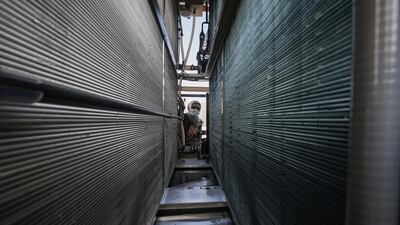
Renewable energy-based solutions to everyday problems are increasingly deployed throughout the Middle East. In Gaza, Palestine, an engineer checks the filters in a solar-powered water generator. AFP
Despite being generally accepted as one of the most difficult years on record for many industries, 2020 demonstrated the inherent resilience of renewable energy solutions.
This point is captured by the fact that, in the face of industrial torpor across the board, global renewable energy installations are thought to have hit a record level in 2020, according to the latest statistics from the International Renewable Energy Agency (Irena). This fact stands in sharp contrast to the declines in production and consumption caused by the pandemic in the other energy sectors.
In the UAE, our firm commitment to combating climate change has only become stronger. In the words of Sheikh Mohammed bin Rashid Al Maktoum, the UAE's Vice-President and Ruler of Dubai, “Climate change is the most prominent battle for mankind in the coming decades to preserve the planet Earth for new generations.” In a tweet at the end of last year, Sheikh Mohammed repeated the UAE’s national pledge to reduce carbon emissions by 23.5 per cent before 2030.
Renewable energy is on its way to becoming mainstream throughout Asia, as the continent boosts manufacturing of solar panels. EPA
Central to this commitment is the development of renewable energy solutions here in the UAE and across the planet. Indeed, the development of renewable energy infrastructure across the globe in 2020 meant that almost 90 per cent of new electricity generation was from a renewable source. As we take our first steps into 2021, the consequences of the year of renewable acceleration is clear: green electricity is on track to become the largest power source by 2025, by which time renewables are forecast to supply more than one third of the world’s energy.
Furthermore, the performance of stock prices in the renewables sector was robust since the outbreak of the pandemic throughout 2020. Despite the declines and falling revenues witnessed around the world in March, the stock prices of major wind and solar companies rebounded quickly and strongly, to reach all-time highs by the third quarter of 2020.
This is not only a clear indication of a growing demand and healthy business over the medium to long term. It also highlights the fact that major manufacturers have firm plans to continue increasing their solar panel manufacturing capacity in the medium term, thanks to continued investor appetite for this future energy technology.
In many ways, the renewable energy sector’s defiance in the face of the difficulties posed by the pandemic, and its robust growth, should come as no surprise. Throughout the year, the UAE Mission to Irena and Irena itself have worked tirelessly and diligently to ensure that the momentum we had gathered since the agency's establishment has not eased.
In 2020, we launched the Irena Renewables Talks and the "On Renewables" podcast, both of which have reached out to and engaged the international renewable energy and climate action communities to enable the sector to make the most of the opportunities available to it in 2021.
It was revealing to me, when co-hosting the Irena Renewables Talks with Director General Francesco La Camera, that the permanent representatives attending the webinars all spoke in detail about how each member state has been able to pivot and adapt to these new times because of the inherent agility and resilience of renewable solutions.
The Director General summed up the point nicely. During the second Renewables Talk event in December, he spoke of Irena’s members coming together, five years on from the ratification of the historic Paris Agreement by 196 states, because of an inherent willingness and necessity to pursue "a climate resilient world”.
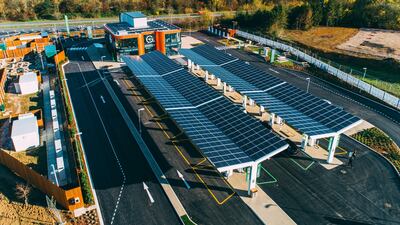
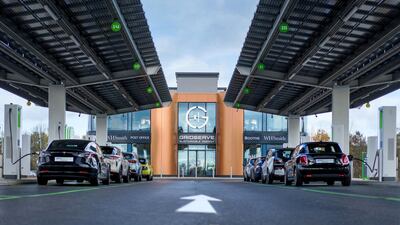
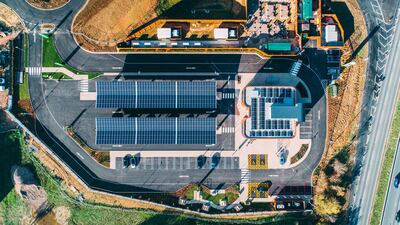
Grideserve has opened the UK’s first electric forecourt near Braintree in Essex. Courtesy Gridserve
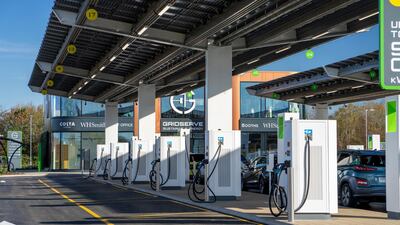
36 electric cars are able to recharge their batteries simultaneously. Courtesy Gridserve
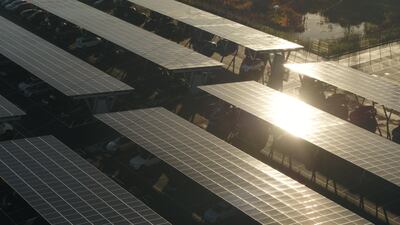
Electricity is generated from solar power canopies situated above the station. Courtesy Gridserve
Grideserve plans to unveil more than 100 over the next five years. Courtesy Gridserve
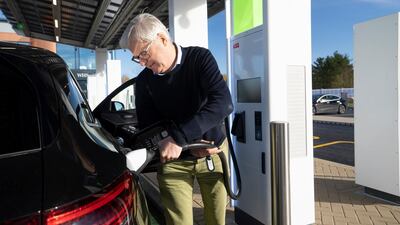
A customer charges his car at the new service station. Courtesy Gridserve
Bentley's headquarters in Crewe became the UK’s first carbon neutral automotive factory. Courtesy Bentley
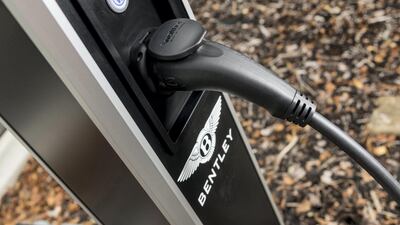
A Bentley charging point. Courtesy Bentley
Chief executive Adrian Hallmark said that by 2030, all Bentley cars will be entirely electric. Courtesy Bentley
Global renewable energy installations are thought to have hit a record level in 2020
Throughout the talks, permanent representatives highlighted, both at home and abroad, the growing acceptance of the need to tackle the climate crisis by cutting carbon emissions. That acceptance, they said, has contributed to making renewable energy a more attractive option to investors – a point evidenced by the fact that the value of shares in solar companies has more than doubled since December 2019.
That this two-fold momentum – externally from a material markets perspective, but also internally from an emerging, collective mindset – is gaining pace now, five years since the Paris Agreement was struck, is no coincidence.
My guest on the second episode of On Renewables, Christiana Figures, the former executive secretary of the UN Framework Convention on Climate Change, whose leadership helped the Paris Agreement come to fruition, said about the agreement: "Overcoming that defeatist attitude was something I set about changing almost straight away…Everyone has a voice, which is equally valid; everybody has a need and a vision, and let's bring those all together into a multicoloured tapestry. It's not that my vision is better than yours or yours is better than mine...We can co-exist and collaborate on a collective vision."
Ms Figueres’s point on collectivism – of convening a multitude of perspectives to find solutions to overcome our biggest challenges – is perhaps nowhere better exemplified than in the UAE today. We continue to convene, collaborate and inspire the international community into acting for impact when it comes to making renewable energy solutions the de facto producer of energy in the future and turning the tide on climate change.
The Emirates will once again be at the forefront of convening this collective, international will at the 11th session of the Irena Assembly, to take place virtually from January 18-21. The theme of the discussions will be energy transition in light of Covid-19. They will reflect the needs and priorities highlighted by the agency's members towards achieving a green recovery to inform its future work, with “convergence and collaboration” a core aspect of this year’s virtual sessions.
And so, there are reasons we can move into 2021 not just with hope, but knowledge that we have not wavered, and we will not ever waver, in our commitment to providing a brighter future for all, even when the going gets toughest.
Dr Nawal Al-Hosany is a permanent representative of the UAE to the International Renewable Energy Agency

Weather warnings show that Storm Eunice is soon to make landfall. The videographer and I are scrambling to return to the other side of the Channel before it does. As we race to the port of Calais, I see miles of wire fencing topped with barbed wire all around it, a silent ‘Keep Out’ sign for those who, unlike us, aren’t lucky enough to have the right to move freely and safely across borders.
We set sail on a giant ferry whose length dwarfs the dinghies migrants use by nearly a 100 times. Despite the windy rain lashing at the portholes, we arrive safely in Dover; grateful but acutely aware of the miserable conditions the people we’ve left behind are in and of the privilege of choice.
WOMAN AND CHILD
Director: Saeed Roustaee
Starring: Parinaz Izadyar, Payman Maadi
Rating: 4/5
Benefits of first-time home buyers' scheme
Priority access to new homes from participating developers
Discounts on sales price of off-plan units
Flexible payment plans from developers
Mortgages with better interest rates, faster approval times and reduced fees
DLD registration fee can be paid through banks or credit cards at zero interest rates
Zakat definitions
Zakat: an Arabic word meaning ‘to cleanse’ or ‘purification’.
Nisab: the minimum amount that a Muslim must have before being obliged to pay zakat. Traditionally, the nisab threshold was 87.48 grams of gold, or 612.36 grams of silver. The monetary value of the nisab therefore varies by current prices and currencies.
Zakat Al Mal: the ‘cleansing’ of wealth, as one of the five pillars of Islam; a spiritual duty for all Muslims meeting the ‘nisab’ wealth criteria in a lunar year, to pay 2.5 per cent of their wealth in alms to the deserving and needy.
Zakat Al Fitr: a donation to charity given during Ramadan, before Eid Al Fitr, in the form of food. Every adult Muslim who possesses food in excess of the needs of themselves and their family must pay two qadahs (an old measure just over 2 kilograms) of flour, wheat, barley or rice from each person in a household, as a minimum.
Technology expert in robotics and automation: Dh20,000 to Dh40,000
Energy engineer: Dh25,000 to Dh30,000
Production engineer: Dh30,000 to Dh40,000
Data-driven supply chain management professional: Dh30,000 to Dh50,000
HR leader: Dh40,000 to Dh60,000
Engineering leader: Dh30,000 to Dh55,000
Project manager: Dh55,000 to Dh65,000
Senior reservoir engineer: Dh40,000 to Dh55,000
Senior drilling engineer: Dh38,000 to Dh46,000
Senior process engineer: Dh28,000 to Dh38,000
Senior maintenance engineer: Dh22,000 to Dh34,000
Field engineer: Dh6,500 to Dh7,500
Field supervisor: Dh9,000 to Dh12,000
Field operator: Dh5,000 to Dh7,000
Who is Mohammed Al Halbousi?
The new speaker of Iraq’s parliament Mohammed Al Halbousi is the youngest person ever to serve in the role.
The 37-year-old was born in Al Garmah in Anbar and studied civil engineering in Baghdad before going into business. His development company Al Hadeed undertook reconstruction contracts rebuilding parts of Fallujah’s infrastructure.
He entered parliament in 2014 and served as a member of the human rights and finance committees until 2017. In August last year he was appointed governor of Anbar, a role in which he has struggled to secure funding to provide services in the war-damaged province and to secure the withdrawal of Shia militias. He relinquished the post when he was sworn in as a member of parliament on September 3.
He is a member of the Al Hal Sunni-based political party and the Sunni-led Coalition of Iraqi Forces, which is Iraq’s largest Sunni alliance with 37 seats from the May 12 election.
He maintains good relations with former Prime Minister Nouri Al Maliki’s State of Law Coaliton, Hadi Al Amiri’s Badr Organisation and Iranian officials.
The specs: 2017 Maserati Quattroporte
Price, base / as tested Dh389,000 / Dh559,000
Engine 3.0L twin-turbo V8
Transmission Eight-speed automatic
Power 530hp @ 6,800rpm
Torque 650Nm @ 2,000 rpm
Fuel economy, combined 10.7L / 100km
Ten tax points to be aware of in 2026
1. Domestic VAT refund amendments: request your refund within five years
If a business does not apply for the refund on time, they lose their credit.
2. E-invoicing in the UAE
Businesses should continue preparing for the implementation of e-invoicing in the UAE, with 2026 a preparation and transition period ahead of phased mandatory adoption.
3. More tax audits
Tax authorities are increasingly using data already available across multiple filings to identify audit risks.
4. More beneficial VAT and excise tax penalty regime
Tax disputes are expected to become more frequent and more structured, with clearer administrative objection and appeal processes. The UAE has adopted a new penalty regime for VAT and excise disputes, which now mirrors the penalty regime for corporate tax.
5. Greater emphasis on statutory audit
There is a greater need for the accuracy of financial statements. The International Financial Reporting Standards standards need to be strictly adhered to and, as a result, the quality of the audits will need to increase.
6. Further transfer pricing enforcement
Transfer pricing enforcement, which refers to the practice of establishing prices for internal transactions between related entities, is expected to broaden in scope. The UAE will shortly open the possibility to negotiate advance pricing agreements, or essentially rulings for transfer pricing purposes.
7. Limited time periods for audits
Recent amendments also introduce a default five-year limitation period for tax audits and assessments, subject to specific statutory exceptions. While the standard audit and assessment period is five years, this may be extended to up to 15 years in cases involving fraud or tax evasion.
8. Pillar 2 implementation
Many multinational groups will begin to feel the practical effect of the Domestic Minimum Top-Up Tax (DMTT), the UAE's implementation of the OECD’s global minimum tax under Pillar 2. While the rules apply for financial years starting on or after January 1, 2025, it is 2026 that marks the transition to an operational phase.
9. Reduced compliance obligations for imported goods and services
Businesses that apply the reverse-charge mechanism for VAT purposes in the UAE may benefit from reduced compliance obligations.
10. Substance and CbC reporting focus
Tax authorities are expected to continue strengthening the enforcement of economic substance and Country-by-Country (CbC) reporting frameworks. In the UAE, these regimes are increasingly being used as risk-assessment tools, providing tax authorities with a comprehensive view of multinational groups’ global footprints and enabling them to assess whether profits are aligned with real economic activity.
Contributed by Thomas Vanhee and Hend Rashwan, Aurifer
Founded over 50 years ago, the National Archives collects valuable historical material relating to the UAE, and is the oldest and richest archive relating to the Arabian Gulf.
Much of the material can be viewed on line at the Arabian Gulf Digital Archive - https://www.agda.ae/en
Tissue re-implanted at a time of the patient’s choosing
Full hormone production regained within 4-6 months
Primera Liga fixtures (all times UAE: 4 GMT)
Friday
Real Sociedad v Villarreal (10.15pm)
Real Betis v Celta Vigo (midnight) Saturday
Alaves v Barcelona (8.15pm)
Levante v Deportivo La Coruna (10.15pm)
Girona v Malaga (10.15pm)
Las Palmas v Atletico Madrid (12.15am) Sunday
Espanyol v Leganes (8.15pm)
Eibar v Athletic Bilbao (8.15pm)
Getafe v Sevilla (10.15pm)
Real Madrid v Valencia (10.15pm)
Fire and Fury
By Michael Wolff,
Henry Holt
What can victims do?
Always use only regulated platforms
Stop all transactions and communication on suspicion
Save all evidence (screenshots, chat logs, transaction IDs)
Report to local authorities
Warn others to prevent further harm
Courtesy: Crystal Intelligence
Conflict, drought, famine
Estimates of the number of deaths caused by the famine range from 400,000 to 1 million, according to a document prepared for the UK House of Lords in 2024. It has been claimed that the policies of the Ethiopian government, which took control after deposing Emperor Haile Selassie in a military-led revolution in 1974, contributed to the scale of the famine. Dr Miriam Bradley, senior lecturer in humanitarian studies at the University of Manchester, has argued that, by the early 1980s, “several government policies combined to cause, rather than prevent, a famine which lasted from 1983 to 1985. Mengistu’s government imposed Stalinist-model agricultural policies involving forced collectivisation and villagisation [relocation of communities into planned villages]. The West became aware of the catastrophe through a series of BBC News reports by journalist Michael Buerk in October 1984 describing a “biblical famine” and containing graphic images of thousands of people, including children, facing starvation.
Band Aid
Bob Geldof, singer with the Irish rock group The Boomtown Rats, formed Band Aid in response to the horrific images shown in the news broadcasts. With Midge Ure of the band Ultravox, he wrote the hit charity single Do They Know it’s Christmas in December 1984, featuring a string of high-profile musicians. Following the single’s success, the idea to stage a rock concert evolved. Live Aid was a series of simultaneous concerts that took place at Wembley Stadium in London, John F Kennedy Stadium in Philadelphia, the US, and at various other venues across the world. The combined event was broadcast to an estimated worldwide audience of 1.5 billion.