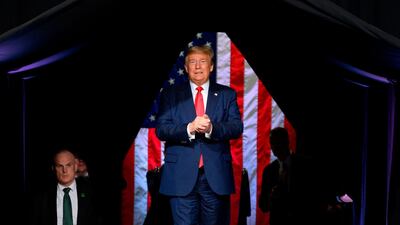
US President Donald Trump at an election rally in Arizona in February. Change is under way around the world even as nations keep an eye on the US election in November. AFP

Whether Trump wins the US election or Biden, change is afoot around the world


  • English
  • Arabic

America's inadequate response to the coronavirus pandemic may have shocked the rest of the world and perhaps even dimmed the allure of its model, at least in the minds of some. The killing of an African-American man, George Floyd, in police custody exposed the bitter political divisions that already exist in the country. Furthermore, the pandemic left economic devastation in its wake.

There might be a feeling of schadenfreude among some critics of the US, while many others will be pondering on the implications of the country’s current problems for the international community.

The world is, therefore, keeping an eye on the presidential election in November. Some observers believe that Donald Trump will be re-elected, even though polling numbers show Mr Trump lagging behind his opponent, Joe Biden. The President could enjoy a resurgence in September and October based on two factors: probable recovery of the US economy and Democratic rival Mr Biden's weaknesses as a candidate.

Anticipating a shift in the wind, many Democrats are hoping that by naming a female African-American running mate, Mr Biden would secure the minority vote. They will also be intent on underscoring the dysfunctional state of the country under Mr Trump.

In this June 11, 2020, photo, Democratic presidential candidate Joe Biden speaks during a roundtable in Philadelphia. Mr Biden’s search for a running mate is under way. AP Photo

This race is one that is being closely watched around the world, especially by the country's supposed adversaries.

I am given to understand that Russia would prefer to have Mr Trump back in the White House because Moscow enjoys fair to middling relations with the current administration. There might also be concerns that Mr Biden would be tougher on Russia, just as Hillary Clinton, fellow Democrat and 2016 presidential candidate, was expected to be had she won.

China is holding its cards close to its chest. It is not clear which candidate Beijing prefers, even though Mr Trump's rhetoric regarding the superpower has been confrontational.

For its part, Iran is hoping for Mr Trump's defeat, given his decision to impose, and even expand, sanctions on Tehran. Recent punitive measures targeting more than 50 oil tankers, especially those operating between Venezuela and Iran, have led to discussions among the regime's generals about launching another "tanker war", like the one we witnessed last year.

All this could translate to even greater unrest in many parts of the world until the election is over, especially because resolutions to many an international conflict will be put on hold until the end of the year. The bigger problem is that in the intervening period, we could see great instability not just on the geopolitical and economic fronts but also in the personal lives of many.

In such circumstances, it has come to my notice that individuals around the world are turning to arts, culture and education to restore balance to their lives. But how do politics, economics and culture overlap in the human experience even as individuals seek to find reassurance in a world struggling to deal with disease, unemployment and unrest?

The sixth e-policy circle of the Beirut Institute Summit in Abu Dhabi tried to tackle this question in a session titled Stability redefined: Who authors the future?

Prof Mikhail Piotrovsky, director of the Saint Petersburg Hermitage Museum, said the world is in a state of division – a trend that would continue beyond the pandemic as nations retreat in order to tend to their wounds, while people distance themselves from one another. Prof Piotrovsky argued that culture might already offer a "cure" to the effects of such isolation.

Before the Covid-19 outbreak, for example, the Hermitage Museum used to receive five million visitors every year. In the space of just two months since the outbreak, the number swelled up to 34 million – all of them virtual. Another example is that of Zayed University in Abu Dhabi, which has remotely delivered lessons to 7,000 students even as efforts are under way to develop its courses to suit a post-coronavirus world.

These trends are encouraging because it shows that people and institutions are thinking creatively and, in the process, trying to reinvent themselves.

Of course, it is also true that there is a yearning to return to normality. To be sure, some things will never change. As pointed out by Noura Al Kaabi, UAE’s Minister of Culture and Knowledge Development, humans will never lose the urge to use their five senses and to keep in touch with their surroundings. But the question that arises is whether we will go back to our flawed ways of living as well. Lebanese filmmaker Nadine Labaki said we should not miss the opportunity to reform existing systems many of which have been built on the foundations of corruption, greed, over-consumption and disregard for nature. This is, perhaps, where our politics will play an important role.

Artists perform in front of screens showing audience via the Zoom application during the first six-hour online music festival at a studio in Bangkok earlier this month. Reuters

French Education Minister Najat Vallaud-Belkacem expressed hope that our awareness of the fragility of those systems would lead us to capitalise on the solidarity that we have witnessed during these difficult times, and turn this experience into something positive over the long term.

It is fascinating, therefore, to imagine what the world might look like in the distant future. But one thing is for sure: changes are already under way in how we live our lives – whatever may be the result of the US election, although that outcome could perhaps have a bearing on the pace and direction of these changes.

Raghida Dergham is the founder and executive chairwoman of the Beirut Institute

Director: Laxman Utekar

Cast: Vicky Kaushal, Akshaye Khanna, Diana Penty, Vineet Kumar Singh, Rashmika Mandanna

Rating: 1/5

UK%20record%20temperature
%3Cp%3E38.7C%20(101.7F)%20set%20in%20Cambridge%20in%202019%3C%2Fp%3E%0A
How much sugar is in chocolate Easter eggs?
  • The 169g Crunchie egg has 15.9g of sugar per 25g serving, working out at around 107g of sugar per egg
  • The 190g Maltesers Teasers egg contains 58g of sugar per 100g for the egg and 19.6g of sugar in each of the two Teasers bars that come with it
  • The 188g Smarties egg has 113g of sugar per egg and 22.8g in the tube of Smarties it contains
  • The Milky Bar white chocolate Egg Hunt Pack contains eight eggs at 7.7g of sugar per egg
  • The Cadbury Creme Egg contains 26g of sugar per 40g egg
Dhadak

Director: Shashank Khaitan

Starring: Janhvi Kapoor, Ishaan Khattar, Ashutosh Rana

Stars: 3

Mercer, the investment consulting arm of US services company Marsh & McLennan, expects its wealth division to at least double its assets under management (AUM) in the Middle East as wealth in the region continues to grow despite economic headwinds, a company official said.

Mercer Wealth, which globally has $160 billion in AUM, plans to boost its AUM in the region to $2-$3bn in the next 2-3 years from the present $1bn, said Yasir AbuShaban, a Dubai-based principal with Mercer Wealth.

Within the next two to three years, we are looking at reaching $2 to $3 billion as a conservative estimate and we do see an opportunity to do so,” said Mr AbuShaban.

Mercer does not directly make investments, but allocates clients’ money they have discretion to, to professional asset managers. They also provide advice to clients.

“We have buying power. We can negotiate on their (client’s) behalf with asset managers to provide them lower fees than they otherwise would have to get on their own,” he added.

Mercer Wealth’s clients include sovereign wealth funds, family offices, and insurance companies among others.

From its office in Dubai, Mercer also looks after Africa, India and Turkey, where they also see opportunity for growth.

Wealth creation in Middle East and Africa (MEA) grew 8.5 per cent to $8.1 trillion last year from $7.5tn in 2015, higher than last year’s global average of 6 per cent and the second-highest growth in a region after Asia-Pacific which grew 9.9 per cent, according to consultancy Boston Consulting Group (BCG). In the region, where wealth grew just 1.9 per cent in 2015 compared with 2014, a pickup in oil prices has helped in wealth generation.

BCG is forecasting MEA wealth will rise to $12tn by 2021, growing at an annual average of 8 per cent.

Drivers of wealth generation in the region will be split evenly between new wealth creation and growth of performance of existing assets, according to BCG.

Another general trend in the region is clients’ looking for a comprehensive approach to investing, according to Mr AbuShaban.

“Institutional investors or some of the families are seeing a slowdown in the available capital they have to invest and in that sense they are looking at optimizing the way they manage their portfolios and making sure they are not investing haphazardly and different parts of their investment are working together,” said Mr AbuShaban.

Some clients also have a higher appetite for risk, given the low interest-rate environment that does not provide enough yield for some institutional investors. These clients are keen to invest in illiquid assets, such as private equity and infrastructure.

“What we have seen is a desire for higher returns in what has been a low-return environment specifically in various fixed income or bonds,” he said.

“In this environment, we have seen a de facto increase in the risk that clients are taking in things like illiquid investments, private equity investments, infrastructure and private debt, those kind of investments were higher illiquidity results in incrementally higher returns.”

The Abu Dhabi Investment Authority, one of the largest sovereign wealth funds, said in its 2016 report that has gradually increased its exposure in direct private equity and private credit transactions, mainly in Asian markets and especially in China and India. The authority’s private equity department focused on structured equities owing to “their defensive characteristics.”

How to protect yourself when air quality drops

Install an air filter in your home.

Close your windows and turn on the AC.

Shower or bath after being outside.

Wear a face mask.

Stay indoors when conditions are particularly poor.

If driving, turn your engine off when stationary.

Dubai World Cup nominations

UAE: Thunder Snow/Saeed bin Suroor (trainer), North America/Satish Seemar, Drafted/Doug Watson, New Trails/Ahmad bin Harmash, Capezzano, Gronkowski, Axelrod, all trained by Salem bin Ghadayer

USA: Seeking The Soul/Dallas Stewart, Imperial Hunt/Luis Carvajal Jr, Audible/Todd Pletcher, Roy H/Peter Miller, Yoshida/William Mott, Promises Fulfilled/Dale Romans, Gunnevera/Antonio Sano, XY Jet/Jorge Navarro, Pavel/Doug O’Neill, Switzerland/Steve Asmussen.

Japan: Matera Sky/Hideyuki Mori, KT Brace/Haruki Sugiyama. Bahrain: Nine Below Zero/Fawzi Nass. Ireland: Tato Key/David Marnane. Hong Kong: Fight Hero/Me Tsui. South Korea: Dolkong/Simon Foster.

Company Profile

Name: Thndr
Started: 2019
Co-founders: Ahmad Hammouda and Seif Amr
Sector: FinTech
Headquarters: Egypt
UAE base: Hub71, Abu Dhabi
Current number of staff: More than 150
Funds raised: $22 million
