

Turkish President Recep Tayyip Erdogan is betting on a determination on the part of the US to preserve his country’s membership in Nato and to persuade it to resist Russia’s attempts to disorient the security alliance through its sale of the S-400 anti-aircraft missile system to Ankara. Mr Erdogan is making audacious moves with regard to Libya, Greece, Syria and Iraq, ignoring the European powers, challenging Arab nations on their home turf and ruling Turkey unchallenged.
In Iran, Supreme Leader Ayatollah Ali Khamenei and the Islamic Revolutionary Guard Corps are betting on support from Russia and China as strategic partners against the US, as they seek to expand their influence in the Middle East. Tehran is also relying on its proxies and allies embedded in the Arab countries to do so.
Leaders of some Arab countries, therefore, are looking for ways to secure their positions in the regional balance of power. Others, meanwhile, are using their own peoples as pawns for the regional and global powers to exploit. All this puts the Middle East and the adjoining Mediterranean Basin in a delicate and potentially dangerous situation.
-
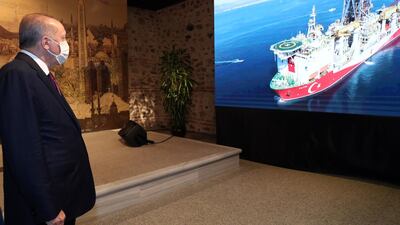
President Recep Tayyip Erdogan takes part in a video conference with Turkish drilling vessel 'Fatih' before announcing the biggest natural gas discovery in history, in Istanbul, Turkey. EPA -
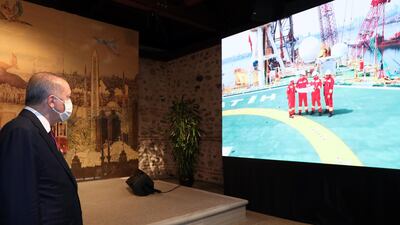
President Recep Tayyip Erdogan takes part in a video conference with Turkish drilling vessel 'Fatih' before announcing the biggest natural gas discovery in history, in Istanbul, Turkey. EPA -
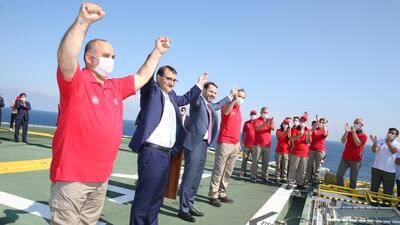
Turkish Finance Minister Berat Albayrak and Energy Minister Fatih Donmez pose with members of Turkish Petroleum (TPAO) on the deck of drilling vessel Fatih in the western Black Sea, off Turkey. REUTERS -
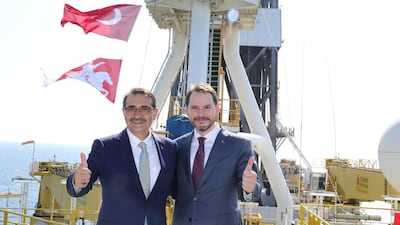
Turkish Finance Minister Berat Albayrak and Energy Minister Fatih Donmez pose on the deck of drilling vessel 'Fatih' in the western Black Sea, off Turkey. Reuters -
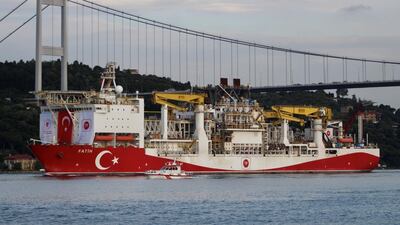
The Turkish drilling ship, 'Fatih', had been carrying out exploration operations in the Tuna-1 sector in the western Black Sea for the past month. Reuters -
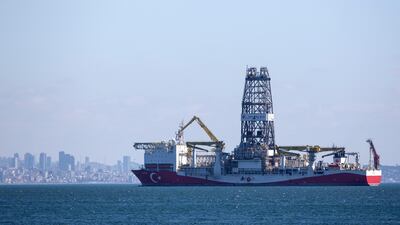
President Recep Tayyip Erdogan said the natural gas reserve, at 320 billion cubic metres, is the biggest in Turkish history. EPA -
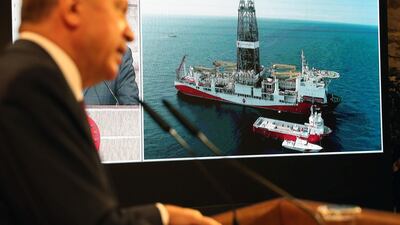
Turkey's President Tayyip Erdogan addresses the nation. Reuters -
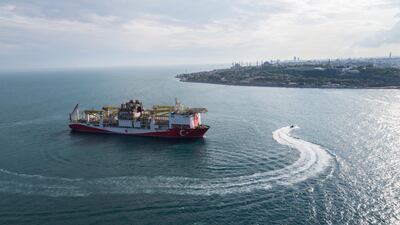
Turkey aims to bring the find to use in 2023 and to become a net energy exporter, Mr Erdogan said. EPA -
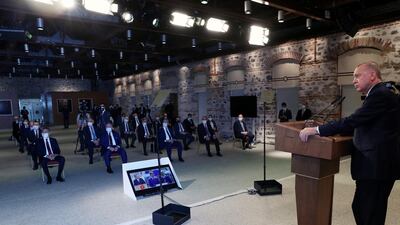
The announcement comes as tensions between Turkey and Greece, and EU nations, are running high over oil and gas exploration in disputed waters in the eastern Mediterranean. Reuters -
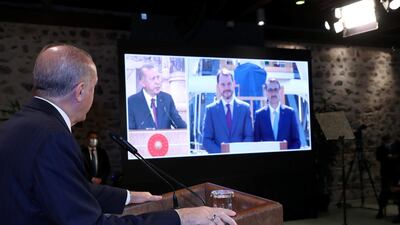
Mr Erdogan listens to Finance Minister Berat Albayrak and Energy Minister Fatih Donmez on a live video feed about the find. Reuters -
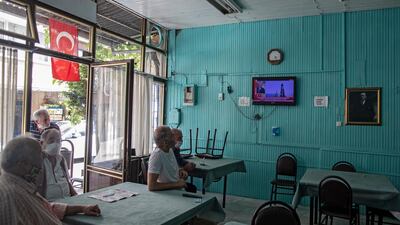
People watch the TV at a coffee house while Turkish President Recep Tayyip Erdogan announces the biggest natural gas discovery in history in Istanbul, Turkey. EPA -
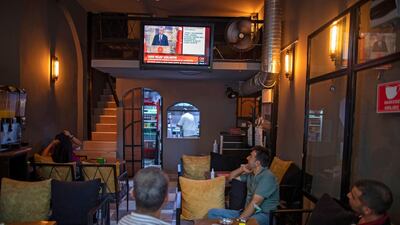
People watch the at a cafe TV while Turkish President Recep Tayyip Erdogan announces the biggest natural gas discovery in history in Istanbul, Turkey. EPA


Turkey's bittersweet relations with Russia is a subject of scrutiny in the West.
I am given to understand that talks are under way between Washington and Ankara to resolve the controversy surrounding the sale of the S-400 system. The US could offer to acquire the system from Turkey, in return for which Ankara would be readmitted into Washington's F-35 programme. Moscow has supposedly already received around $800 million in payments for the S-400 from Ankara. But despite the financial gain, Russia's loss could be a strategic one, should the US-Turkey deal come through.
It is important to remember that Nato was formed as a multinational defence alliance against the erstwhile Soviet Union. While the alliance may not wield the clout it once did, Moscow will have been eager to breach it by drawing Ankara closer. But quite the opposite seems to be happening.
Indeed, for a variety of reasons, Turkey-Russia relations have experienced headwinds in recent times, starting with the ongoing conflicts in Syria and Libya, where they support opposing groups battling each other for primacy in the respective countries. Turkey's gas imports from Russia have been at their lowest since March, despite Moscow's heavy investment in building the Blue Stream gas pipelines.
In this context, therefore, attempts to preserve Turkey's place in Nato – despite its misgivings with France over its actions in Libya and the Eastern Mediterranean – could amount to a temporary setback for Russia while giving the US a win over its old adversary.
The Kremlin knows this, of course. And it is – as are all of Ankara’s neighbours – watching the Mediterranean stand-off over resources between Turkey and its Nato ally Greece. A military confrontation cannot be ruled out, which would almost certainly end any hopes Ankara might still have of joining the European Union. It is, therefore, for good reason that Nato is trying to de-escalate tensions.
Whatever the direct consequences of Turkey's behaviour, Russia has during this time moved Iran closer to it.
During his recent visit to Moscow, Iran's Defence Minister Amir Hatami declared that the end of the arms embargo on his country – thanks in part to Russia's influence in the UN Security Council – would herald a new chapter in defence co-operation between the two countries. General Hatami said: "We have the Russian-made S-200 and S-300 systems. We must hold talks on the S-400 to reach an agreement."
This then begs the question as to why Moscow would strike a deal with Tehran, which is adversarial towards its own allies in the Gulf. There are a few reasons.
-
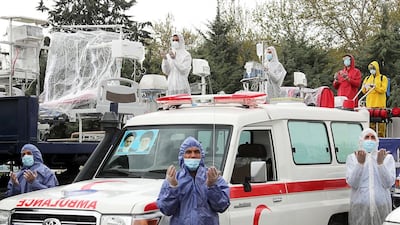
Iranian army soldiers wearing protective face masks parade with disinfection equipment to mark National Army Day in Tehran on April 17, 2020. Iranian military via EPA, HO -
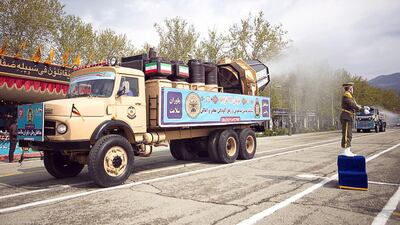
Iran did not hold a main ceremony on its annual National Army Day due to the coronavirus crises in the country. Iranian military via EPA, HO -
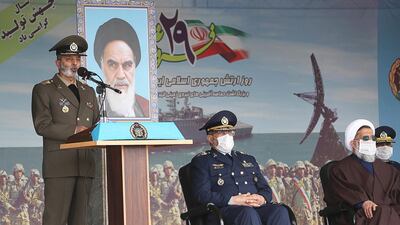
Iran is one of the most impacted countries by the pandemic with over 5,000 reported deaths. Iranian military via EPA, HO -

Iran’s parliament has suggested that the true toll of the virus may in fact be double the official numbers. Iranian military via EPA, HO -
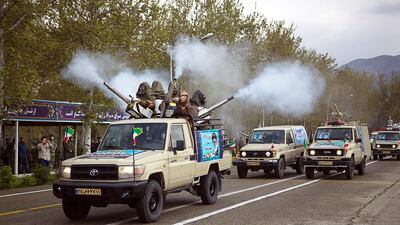
The military has been deployed in the mass national sterilisation programme and to aid the domestic civilian administrations handle the crisis. Iranian military via EPA, HO -
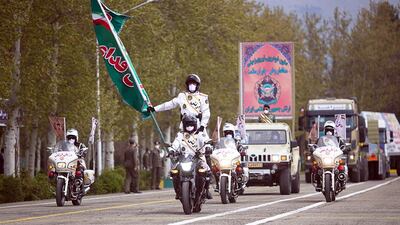
Soldiers wearing protective face masks as they parade amid the ongoing coronavirus pandemic. Iranian military via EPA, HO -
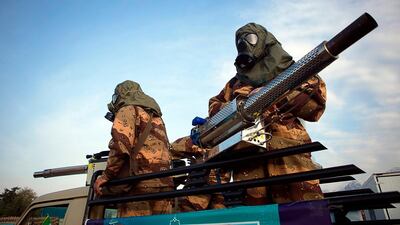
Iran is one of the most effected countries by the pandemic with over 5,000 reported deaths. Iranian military via EPA, HO -
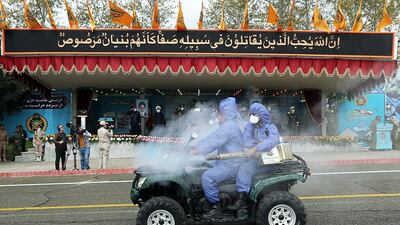
Soldiers wearing protective face masks as they parade amid the ongoing coronavirus pandemic. Iranian military via EPA, HO


First, Russia is keen to flex its muscles against the US, which over the past few months had attempted to extend the arms embargo against Iran. Second, access for Russia's military-industrial complex to the Iranian market would compensate for the ongoing cooling of Moscow-Ankara relations. According to experts I have spoken to, the Iranian market might be worth between $2-4 billion annually, which could offset losses from potential US sanctions. Nonetheless, Moscow will exercise caution for fear of inviting economic sanctions from Washington.
It is, meanwhile, seeking to balance its interests between Iran and the Gulf states – although it has managed to compartmentalise them. For example, it is allied with Iran over the future of Syria and Lebanon. But it has in Egypt, which is an ally of the Gulf states, an important strategic partner in Libyan conflict.
What Washington seems to be working towards is the ending of this compartmentalisation by trying to persuade its Arab allies to join its efforts in preventing Russia and China from supplying weapons to Iran.
It was a message that US Secretary of State Mike Pompeo carried with him to the region last week. That the timing of his visit coincided with the Republican National Convention, where Mr Trump was formally anointed his party's candidate in November's US presidential election, shows the importance that the administration gives to the Iranian question. The visit also lays to rest the assumption that America is absent from the Middle East due to the Trump administration's preoccupation with the election.
While the terrifying developments in Iraq, Syria and Lebanon may suggest that Iran and its proxies have secured winning alliances with Russia and China, the US is not asleep at the wheel – as some might assume. Given its economic heft, even Moscow and Beijing will tread carefully, especially if Washington decides to impose sanctions on them all the while convincing its friends that any deal with Tehran will prove detrimental to Middle East security.
Raghida Dergham is the founder and executive chairwoman of the Beirut Institute

