
As countries around the world work to overcome the Covid-19 pandemic and restart their economies, they all face the challenge of reopening borders while protecting their populations’ health.
Each border crossing point must ensure travellers do not import a new deadly wave of the virus. In East Africa, we saw the logistical challenge of this with kilometres of lorry drivers backed up along our borders as they waited for hours to get test results.
The East African Community – an intergovernmental organisation comprising six eastern African nations – responded promptly by equipping and certifying more laboratories to test travellers and share results electronically with border control and law enforcement.
-

Health care providers - nurses, doctors, midwives and health care workers- attend the 4th Zumba dance session organised by the Nursing Council of Kenya at Kenyatta stadium where screening booths and an isolation field hospital are installed, in Machakos, Kenya, on June 19. Yasuyoshi Chiba / AFP -
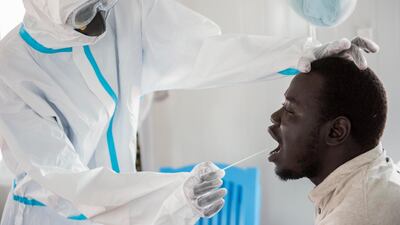
An infectious disease specialist, left, takes a sample from Dr Reagan Taban Augustino, now a coronavirus patient himself under quarantine, at the Dr John Garang Infectious Diseases Unit in Juba, South Sudan, June 21. The UN says the country's outbreak is growing rapidly, with nearly 1,900 cases, including more than 50 health workers infected, and at the only laboratory in the country that tests for the virus a team of 16 works up to 16-hour days slogging through a backlog of more than 5,000 tests. Charles Atiki Lomodon/ AP -
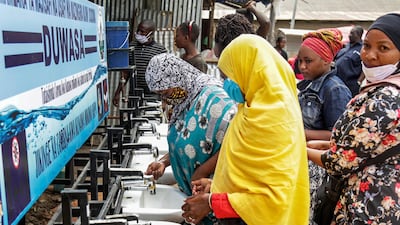
A hand-washing station installed for members of the public entering a market in Dodoma, Tanzania, May 18. AP -

Grace Twisimire, 25, sits in her once-thriving shop selling clothes and plastic shoes in the capital Kampala, Uganda, June 20. The Covid-19 pandemic means that millions of women in Africa and other developing regions could lose years of success in contributing to household incomes, asserting their independence and expanding financial inclusion. Ronald Kabuubi / AP -

A worker gestures as he peers out of a public service van with a signage on the usage of face masks at the main central bus station, in downtown Nairobi, Kenya June 22. Thomas Mukoya / Reuters -

Health care providers - nurses, doctors, midwives and health care workers- attend the 4th Zumba dance session organised by the Nursing Council of Kenya at Kenyatta stadium where screening booths and an isolation field hospital are installed, in Machakos, Kenya, on June 19. Yasuyoshi Chiba / AFP


The Regional Electronic Cargo and Driver Tracking System worked off an app and used GPS for real time monitoring of driver compliance to health measures. Supported by TradeMark East Africa, this was the fastest co-ordinated change of border protocols accomplished in the history of East Africa.
Our next challenge is to safely reopen our land, sea and air border crossings. It is widely expected that all countries will initially require travellers to have a recent negative Covid-19 test in order to ensure that they do not spread the infection during the journey and at their destination.
To achieve this, we need people to show Covid-19 test results from a certified lab in a way that cannot be falsified or counterfeited. Even as they share this highly personal health information, we want to preserve their personal privacy.
To address the challenge, the East African Community is working with The Commons Project, a Swiss-based non-profit public trust that builds digital services for public good. Using an app called CommonPass, travellers will share their recent test in a way that ensures authenticity of results and the privacy of the traveller. CommonPass is being implemented through a collaborative design sprint that starts on July 9 with national, regional and global stakeholders that include the design firm IDEO and The World Economic Forum, with the support of the Rockefeller Foundation.
Travellers begin their journey using CommonPass by taking an accredited lab test that can be shared electronically to their mobile phone. That certificate is a digital analogue to the widely used “yellow card”, an international certificate of vaccination. This digital health passport will start with lab results, but eventually include vaccination records when a Covid-19 vaccine becomes available. By using CommonPass, test results and authenticity can be assessed by authorised healthcare, airlines or immigration authorities.
A crucial part of the system is the fact that – apart from the specific test result selected by the user – no personal health information ever leaves the traveller’s phone without their consent.
The CommonPass initiative builds on work already done by the East African Community, including the CommonHealth Map, which tracks Covid-19 cases across the region, and the COVIDcheck risk assessment tool, which is available in Swahili, Kinyarwanda, English, French and many other languages.
Moving forward, our major priority is to ensure that Covid-19 does not disrupt implementation of the African Continental Free Trade Area, which will improve so many lives by removing trade obstacles between 28 African countries. This is a major achievement, which must be protected and progressed further.
We may not have a vaccine yet, but the East African Community has shown how digital services for public good can combat the pandemic and preserve privacy. Opening borders is our next challenge, and an opportunity to apply this model.
Daniel Murenzi is the head of information technology at the East African Community

